We are talking about the neutral zone, which is exposed to ultraviolet (UV) radiation from massive
When viewed with the naked eye, the nebulaoften mistaken for one of the stars of the constellation. Viewed through a telescope, the photogenic nebula looks like a glowing, gaseous nursery of stars and lies 1,350 light-years from Earth.
Since the Orion Nebula is the nearestus a region of massive star formation and similar to the environment in which the solar system was born, studying its regions of photodissociation heated by starlight is an ideal place to understand how stars and planets are born.
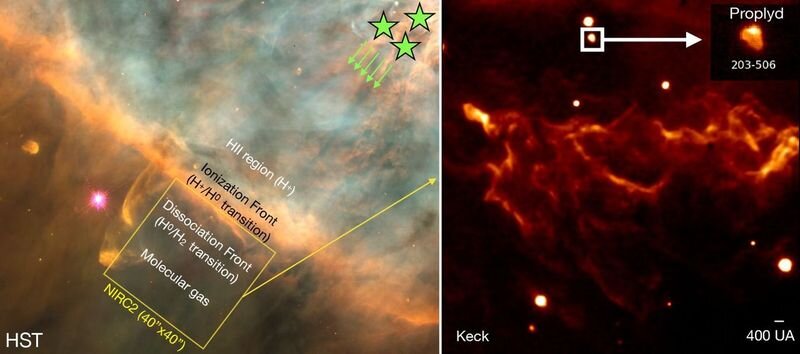 Left: Hubble mosaic showing Orion's streak. Credit: NASA/STScI/Rice Univ./C.O'Dell et al. The field of view of the NIRC2 wide-angle camera is shown as a yellow square.
Right: An infrared heat map of Orion taken with the Keck Observatory's NIRC2 instrument. Substructures such as proplyds are visible. Image Credit & Copyright: Habart et al./V. M. Keck Observatory
“Observing regions of photodissociation is liketo travel back in time,” said Emily Khabar, associate professor at the Institute of Spatial Astrophysics at the University of Paris-Saclay and lead author of the paper on the new study. “These regions are important because they allow us to understand how young stars affect the gas and dust cloud in which they are born. Especially in places where stars like the Sun are forming.”
To explore the photodissociation region of Orion,The PDRs4All team of astronomers used the Keck Observatory's Second Generation Near Infrared Camera (NIRC2) in conjunction with the Keck II Telescope's adaptive optics system.
Read more:
The ancient Vikings suffered from a dangerous disease. It is caused by a parasite from Africa
Plant on Mars produces oxygen at the rate of an average tree
Physicists have cooled atoms to record temperatures. They are a billion times colder than outer space.
Cover photo: The Great Nebula in Orion in narrow bands. Astrofalls, CC BY 4.0, via Wikimedia Commons