Astronomers have learned more about the inner workings of the Crab Nebula than ever before. results
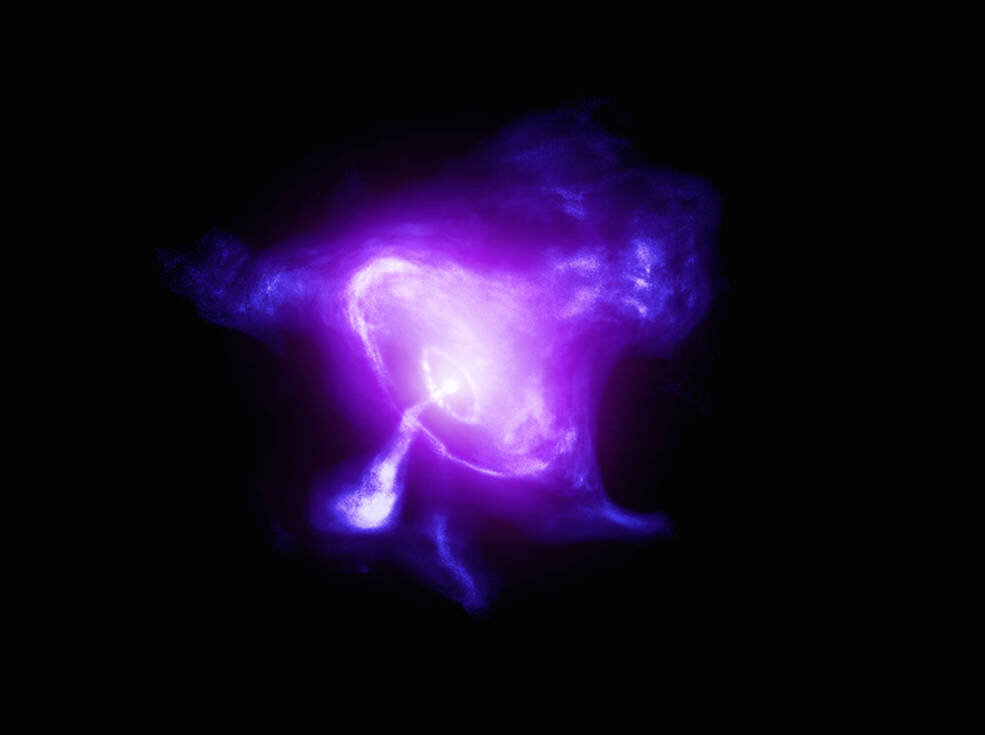 Credit & Copyright: X-ray (IXPE: NASA), (Chandra: NASA/CXC/SAO)
Image processing: NASA/CXC/SAO/K. Arkan and L. Frattare
IXPE data showed that the magnetic fieldThe Crab Nebula resembles that found in those nebulae that are sometimes found inside the shell of a supernova remnant. They are powered by winds generated by the central pulsar. It is located 6,500 light years from Earth. But what surprised the authors of the new study was the region of turbulence in the Crab Nebula's magnetic field. They turned out to be more spotty and asymmetrical than expected.
“This is a clear sign that even more complexModels developed in the past using advanced numerical methods do not fully capture the complexity of this object,” explains Niccolò Bucciantini, lead author of the study and an astronomer at the Arcetri Observatory in Florence, Italy.
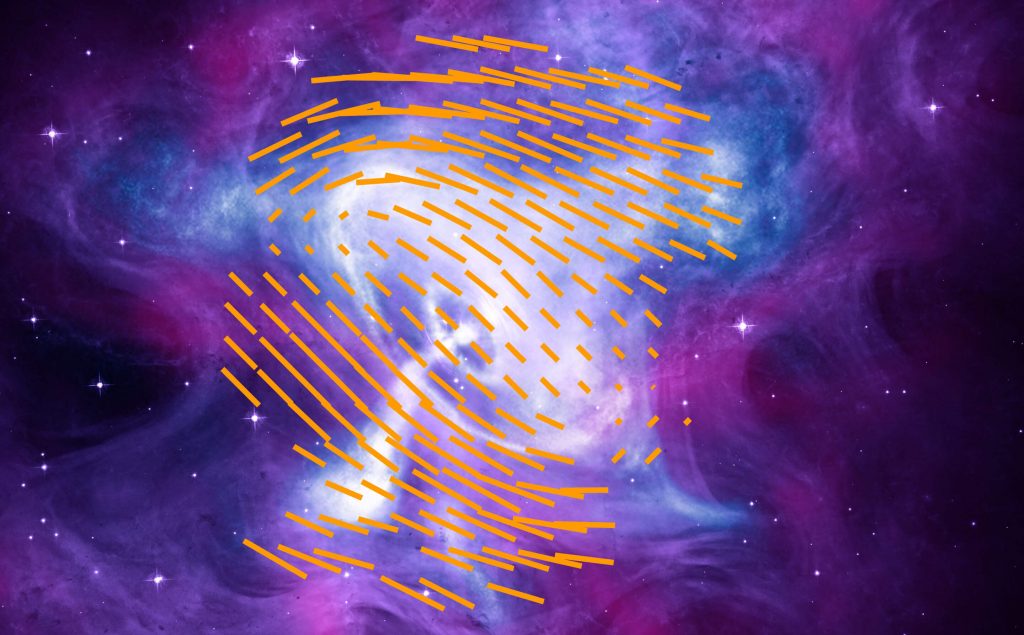 The Crab Nebula contains a donut-shaped magnetic field that was observed by IXPE.
Orange lines highlight its shape.They are superimposed on a composite image made using data from the Chandra X-ray Observatory (blue and white), the Hubble Space Telescope (purple) and the Spitzer Space Telescope (pink). Credit: Magnetic field lines: NASA/Bucciantini et al; X-ray light: NASA/CXC/SAO; optical light: NASA/STScI; infrared light: NASA-JPL-Caltech
A favorite object of study among astronomers,The Crab Nebula was created by a supernova explosion documented in 1054. The explosion left behind a dense object—the Crab Pulsar. Its length is about the size of Manhattan Island, and its mass is as large as that of two suns. The chaotic mixture of gases, shock waves, magnetic fields and high-energy light and particles emanating from the spinning pulsar create a bizarre environment that is not yet fully understood.
Read more:
Special diet triggers self-destruction of brain cancer cells in mice
Scientists have deciphered the mysterious manuscript of Ptolemy. It was hidden under other text
New image of Hubble puzzled scientists
On the cover: collage “High-tech”
Sources: NASA, ESA, J. Hester and A.Loll (Arizona State University), Public domain, via Wikimedia Commons (photo 1); X-ray (IXPE: NASA), (Chandra: NASA/CXC/SAO), image processing NASA/CXC/SAO/K. Arkan and L. Frattare (photo 2)