Eta Carinae, or Eta Carinae, is a double star system (η Car, η Carinae) that is surrounded by an expanding nebula
Two stars in the Eta Carinae system are moving aroundcommon center of mass along elongated elliptical orbits (eccentricity 0.9) with a period of 5.54 Earth years. The main component of the system is a hypergiant, a bright blue variable (BLV), which initially had a mass of 150–250 solar masses, of which about 30 solar masses have already been lost. It is one of the largest and most unstable stars known, with a mass close to the theoretical upper limit. It is expected to go supernova in the astronomically near future (several tens of millennia). Eta Carinae itself is extremely massive, its mass more than 100 times the mass of the Sun.
The light from the components of the Eta Carinae system is strongabsorbed by the small bipolar nebula Homunculus with dimensions of 12 × 18 arc seconds, which consists of the matter of the central star, ejected during the "Great Flare". This Carina A loses mass so quickly that its photosphere is not gravitationally bound to the star and is "blown away" by radiation into the surrounding space.
A recently published study wasfocused on one hypothesis that the binary star system used to be triple, which eventually became unstable and caused the stars to merge. As more detailed observations of Eta Carinae are made, this scenario becomes more popular, but still lacks detailed theoretical studies.
Astronomers from Monash UniversityUniversity) performed the first comprehensive and detailed theoretical calculations for this scenario. They first ran three-body dynamic simulations to see how the triple system becomes unstable. Scientists started with a stable system in which one star rotates in a wide orbit around two other stars in close orbit. As the most massive star approaches the end of its life, it expands and begins to transfer matter to its companion. This makes the system unstable and leads to the merger of two stars. The process takes place over several thousand years. Scientists have discovered that before the final merger, stars can suddenly change places and meet each other at close distances, touching each other's surfaces.
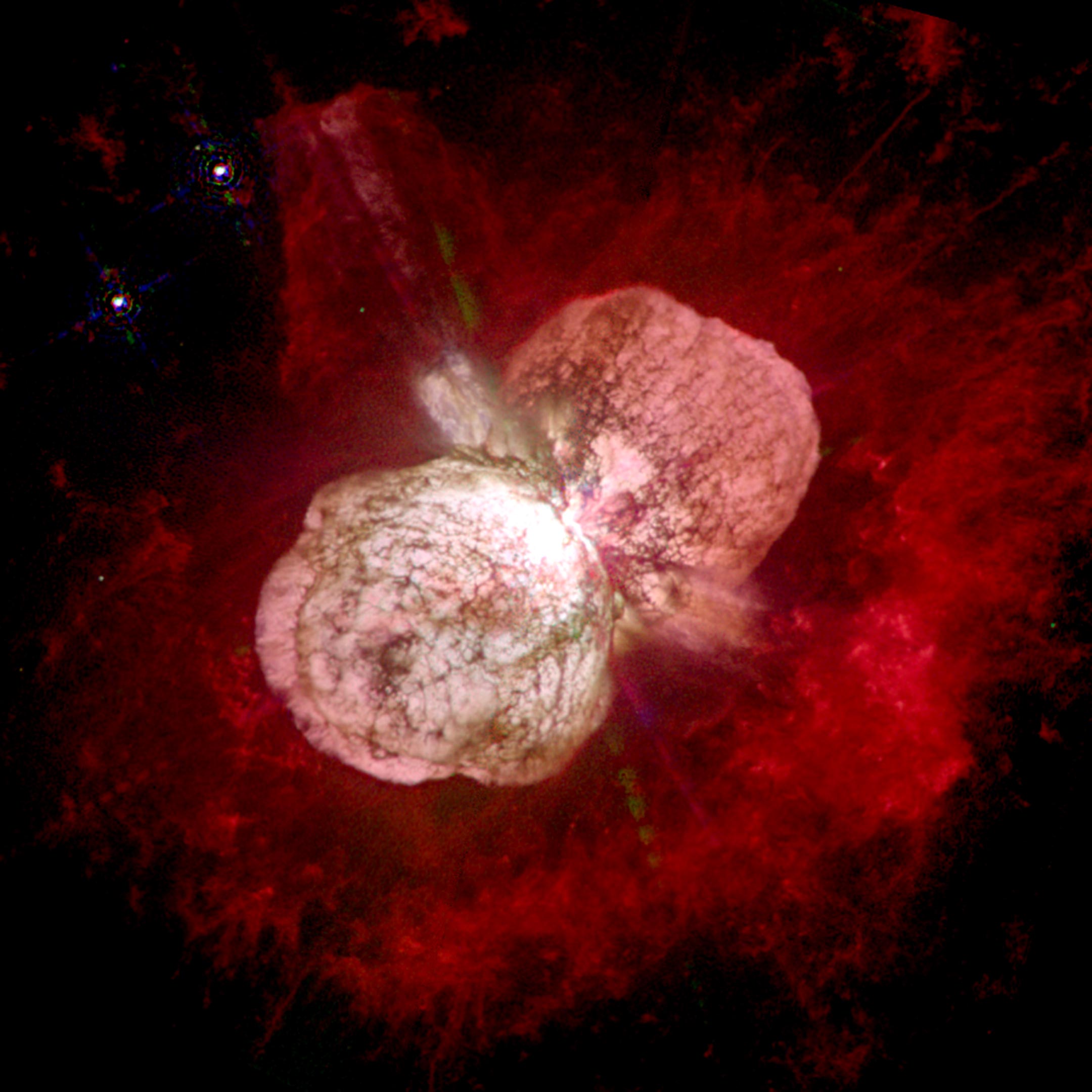 Optical image of Eta Carinae. Credit: NASA / STScI / ESA.
In addition, the researchers conducted additionalN-body simulations to see how the star reacts to these close encounters. By combining orbital dynamics and near-impact simulations, they found that multiple collisions can reproduce the disordered structure outside the Homunculus Nebula.
Hydrodynamic modeling, in turn,showed how the flow from the merger of stars takes the shape of the hourglass we see today. Scientists have proposed a new scenario that uses similar ideas about how the triple-ring nebula of supernova SN1987A formed. When stars merge, a huge amount of energy is released within the star, causing a Great Eruption. But unlike supernovae, most of the energy and mass remains in the star. This energy slowly seeps out over the next century in the form of strong bipolar winds. The wind sweeps away the internal parts of the explosion and forms a hollow shell. Our simulations show that with this scenario we can accurately reproduce the shape and size of the Homunculus Nebula.
A combination of scientists' simulations successfully reproducedThe main features of the surrounding Eta Carinae nebula provided strong support for the triple star system scenario. This not only provided insight into the origins of Eta Carinae, but also into many other astronomical objects that could be created by mergers in triple systems. For example, some massive black holes discovered by LIGO (GW190521) are thought to have been created in this way. Using information from the Eta Carinae study, we can learn much more about the formation of exotic objects in the Universe.
Read more
Hear NASA's Perseverance rover move across Mars
Physicists have created an analogue of a black hole and confirmed Hawking's theory. Where it leads?
Humans can withstand very low temperatures even without heat sources
SN 1987A is a supernova that exploded onon the outskirts of the Tarantula Nebula in the Large Magellanic Cloud, a dwarf satellite of the Milky Way, approximately 51.4 kiloparsecs from Earth. The flash light reached Earth on February 23, 1987: 22: 197.