Traces of ancient valleys and river channels suggest that liquid water once flowed across the surface of Mars.
They discovered the vapor by analyzing the light,passing through the Martian atmosphere, using the NOMAD (Nadir and Occultation for Mars Discovery) instrument. This is a scientific instrument of the TGO orbital module of the international ExoMars 2016 mission. Scientific organizations from Spain, Italy, the USA, Canada and the UK took part in the development and manufacture of the instrument . The device travels aboard the ExoMars Trace Gas Orbiter, a joint mission between the European Space Agency and Roscosmos.
Measuring water isotopes is an important elementunderstanding how Mars lost water over time and therefore how the planet's habitability has changed throughout its history. The ExoMars Trace Gas Orbiter studies water vapor and its components as it rises through the atmosphere into space. By looking specifically at the ratio of hydrogen to its heavier counterpart deuterium, it is possible to trace the evolution of water loss over time.
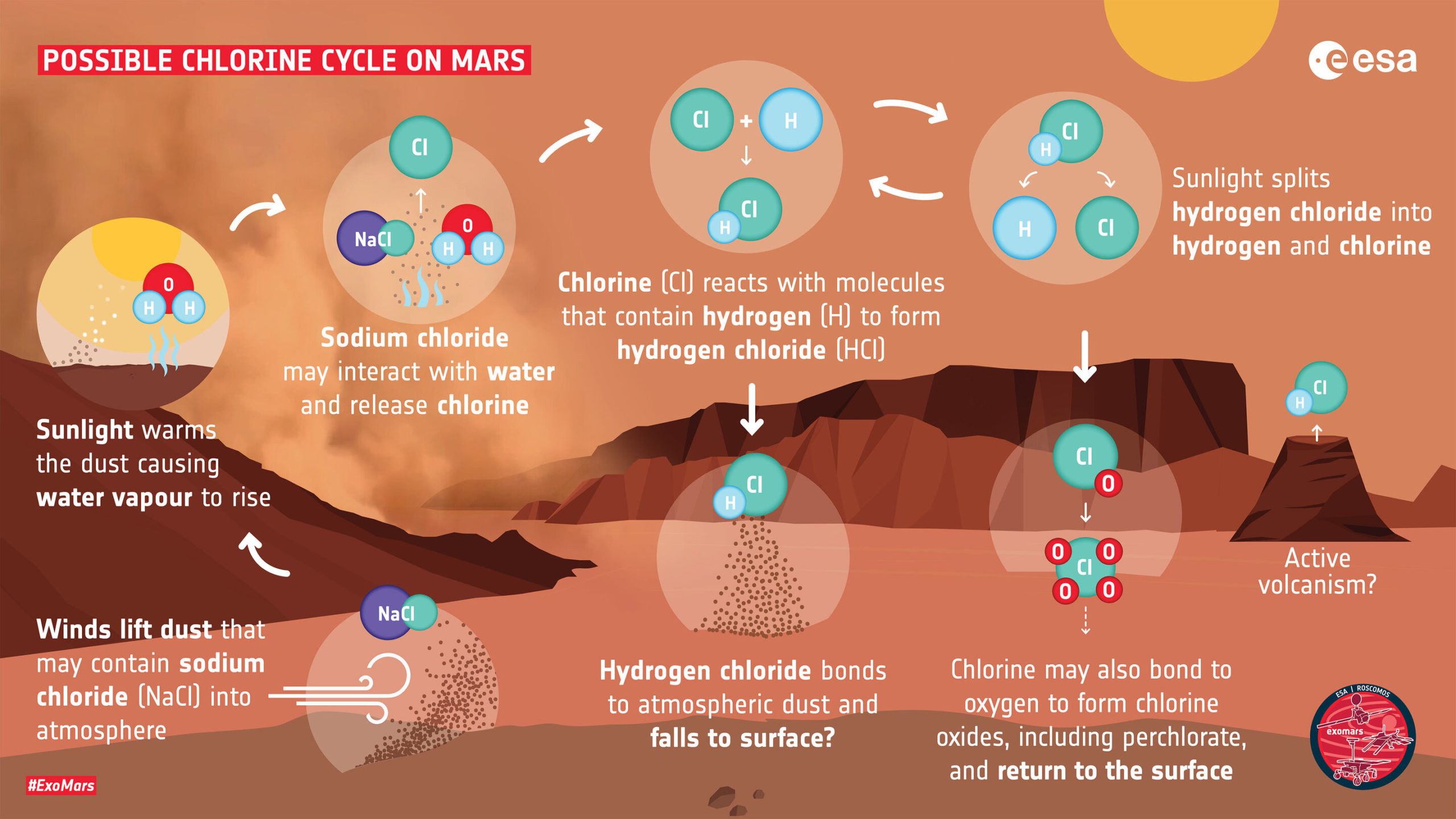 The graphics are simplified so that in a very broad senseshow one of the possible ways of the formation of hydrogen chloride; There are likely additional chemical pathways that could also take place, possibly with other trace gases that ExoMars has not yet discovered. Credit: (C) ESA
This week has been a busy week for research.Mars. China's Tianwen-1 probe entered orbit on Wednesday after launching from southern China in July last year in the latest step in Beijing's ambitious space program. The day before, the United Arab Emirates' Nadezhda probe also successfully entered Mars orbit.
Read more
Traces of rocket fuel were found on Saturn's moon Rhea. Where does it come from?
The largest iceberg in the world collapsed, fragments rushed north. Is it dangerous?
Abortion and science: what will happen to the children who will give birth