Using the Gemini North telescope, researchers found unusual materials near one of the quasars (supermassive
Researchers believe that the very first starsformed in the universe when it was only 100 million years old. Scientists call these stars Genetic Population III. It is assumed that they were very massive, died quickly and could not survive to this day. Due to the absence of carbon in such stars, only the proton-proton nuclear cycle could occur, which requires ultrahigh temperatures.
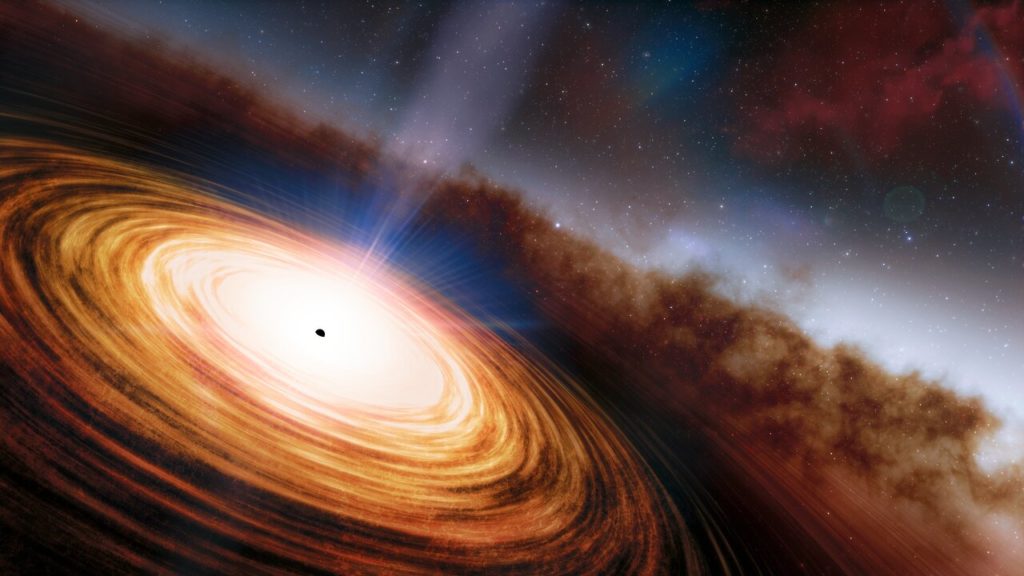 Artistic illustration of a quasar surrounded by the remnants of ancient stars. Image: NOIRLab/NSF/AURA/J. da Silva/Spaceengine
Researchers believe that as a result of a supernova explosion, which ended the life cycle of such stars, they were torn apart, seeding the space around them with heavy elements.
In a new study, researchers reporteddetection of an anomalous abundance of heavy elements in the gas cloud surrounding the J1342+0928 quasar. Using an innovative method to determine the chemical elements found in the clouds, the researchers noticed a very unusual composition - the material contained 10 times more iron than magnesium, compared to the ratio of these elements found on our Sun.
The researchers believe that the most likelythe explanation for this striking feature is that the material was left behind by a first-generation star that exploded as a pair-instability supernova. These amazingly powerful versions of supernova explosions have never been observed, but simulations show that this is how giant stars with masses 150 to 250 times that of the sun end.
Read more:
It turned out what happens to the human brain after one hour in the forest
It became known which tea destroys protein in the brain
Strange sea creatures in the depths of the ocean turned out to be similar to humans
On the cover: an artistic illustration of the explosion of a supermassive star. Image: NOIRLab/NSF/AURA/J. da Silva/Spaceengine