An international group of astrophysicists led by the Max Planck Institute for Astronomy in
The researchers used survey dataGALACTICNUCLEUS. To create it, scientists took almost 150 images of the central region of the Milky Way using the HAWK-I infrared camera on the Very Large Telescope of the European Southern Observatory. The resulting images cover a total area of 64 thousand square light years around the center of the galaxy.
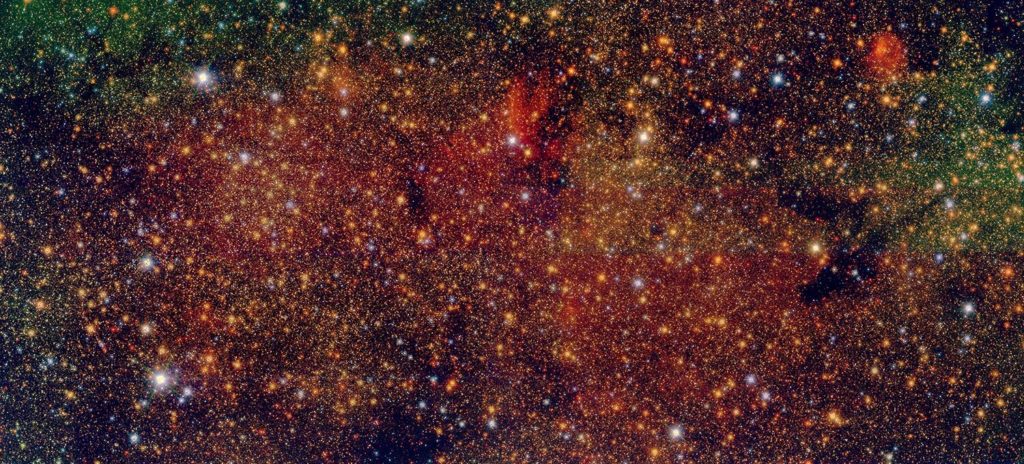 An image of the galactic center taken with the Very Large Telescope. Source: F. Nogueras-Lara et al./MPIA
The stars at the center of the galaxy are extremely difficultdetermine, astrophysicists explain. Firstly, our observations are in the plane of the Milky Way, and therefore light from the center of the galaxy passes through a large amount of dust, and secondly, the stars in this region are located so densely that it is difficult to separate one from the other. The first problem was solved thanks to the use of the infrared range (light with this length passes through dust), and the second - with the help of ultra-precise instruments.
GALACTICNUCLEUS - the most detailed imagecenter of the Milky Way. But even this survey only allows us to identify the largest and brightest massive stars, which are much larger than the Sun. However, even in this survey, scientists were able to detect more than 3 million individual stars and measure their physical parameters.
 Researched area. Source: F. Nogueras-Lara et al. /MPIA
Luminosity analysis showed that in the region of the centerThe galaxy has two cohorts of stars: an old population that formed between 23 and 7 billion years ago, and a huge number of young stars that formed no more than 10 million years ago. As the researchers note, the total mass of the identified young stars exceeds the mass of the Sun by 400 thousand times. This is almost 10 times larger than the largest known clusters of young stars that have been observed in other galaxies.
The researchers also found that youngstars are dispersed in space, and are not part of a mass cluster. The researchers believe that they were originally born in regions loosely bound by gravitational forces, and then further separated as they orbited the black hole at the center of the Milky Way.
Read more:
Earth-sized sunspot grows 10 times in 2 days: it is directed at us
This is the "twin" of the Earth in the past: a unique planet-ocean was found not far from us
Einstein was right again: after half a century, physicists proved the stability of black holes