A group of astrophysicists led by scientists from the University of California studied observational data on
4U 0142+61 is a neutron star located ona distance of 13 thousand light years from Earth in the constellation Cassiopeia. It is referred to as magnetars - these are very dense remnants of the cores of massive stars that exploded as supernovas at the end of their lives. Unlike other neutron stars, they have a huge magnetic field and emit bright X-rays.
In their work, astrophysicists used datathe first observation of polarized X-ray light from a magnetar collected by NASA's Imaging X-ray Polarimetry Explorer (IXPE) satellite, which was launched in December 2021.
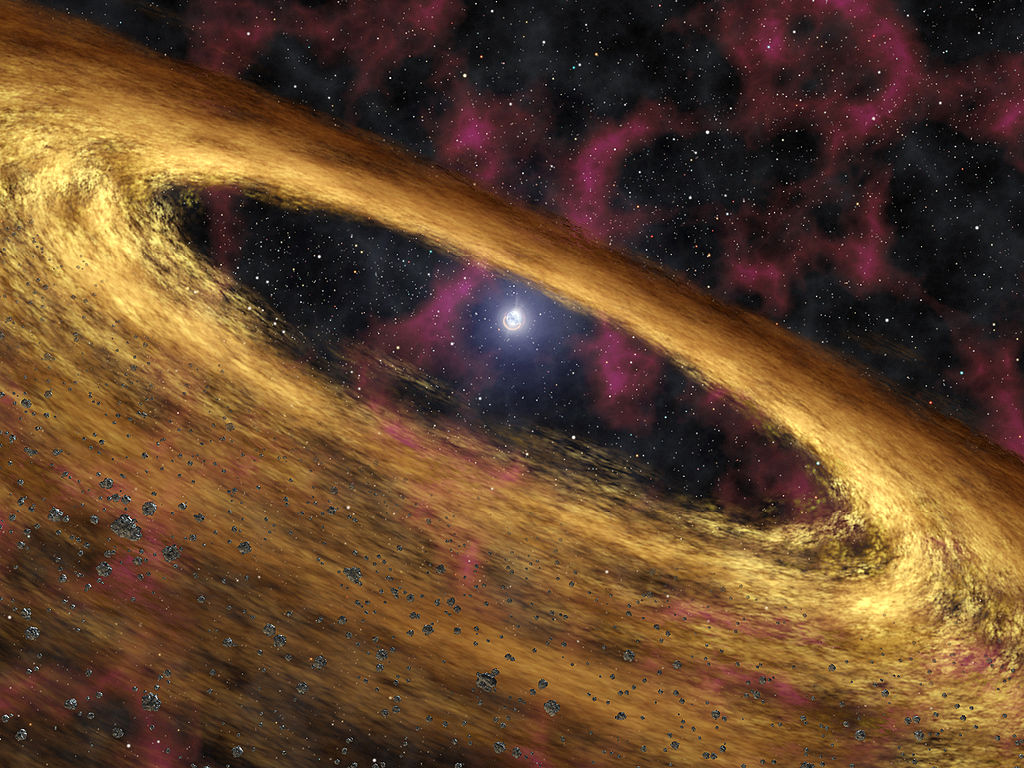 Artistic illustration of magnetar 4U 0142+61. Image: NASA/JPL-Caltech/R. Hurt (SSC), Public domain, via Wikimedia Commons
Polarization analysis (directions in whichmoving light waves) showed that X-rays from a magnetar are not affected by the atmosphere. The gas envelope acts as a filter, the scientists explain. Therefore, when it is present, the polarization of light increases, that is, more waves move in one direction.
Astrophysicists also found that the anglepolarization for a particle of light with higher and lower energies changes exactly by 90°. By simulating various conditions, the scientists showed that this is only possible if the star has a solid crust surrounded by an outer magnetosphere filled with electric currents.
The researchers note that the formation of a solid surface near a red-hot magnetar can only be explained by a super-powerful magnetic field, which is several orders of magnitude higher than that of ordinary stars.
Read more:
A massive impact from a space object triggered the Earth's magnetic field
Scientists Confirm Alternative Gravity Theory: Why It Changes Physics
Pig heart beats slower after transplant to human
On the cover: an art illustration of a magnetar. Image: ESO/L.Calçada, CC BY 4.0, via Wikimedia Commons