An international team of researchers has presented a paper that describes what supernovae look like.
In their work, scientists studied supernovae of the typeII-P. Unlike other supernovae, these explosions remain bright long after the initial outburst. Using observational data from several famous examples, astrophysicists combed through old catalogs and found images of stars before they exploded.
The study showed that a few years beforesupernova explosions were surrounded by a dense veil of material. It is he who makes supernovae of this type glow longer. Computer simulations based on historical observations have shown that such a veil is formed quite quickly just a few years before the explosion.
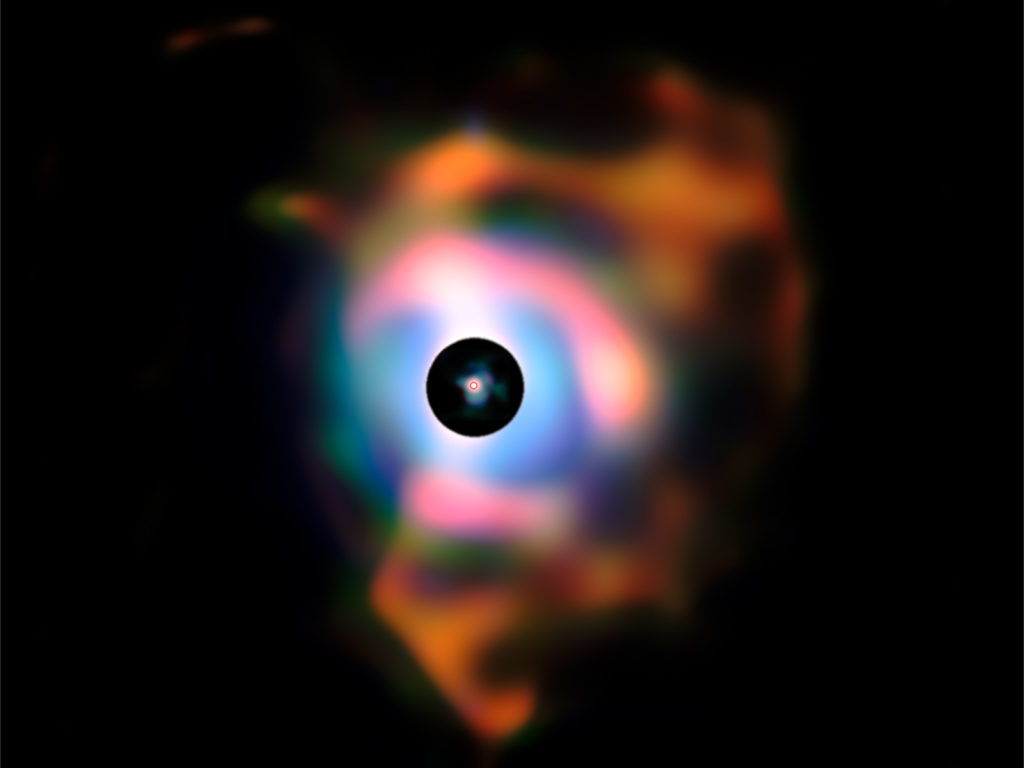 The red supergiant Betelgeuse is one of the candidates for becoming a supernova. Image: ESO/P. Kervella
As stars evolve, they go through different phases.Deep in the core, hydrogen fusion is gradually replaced by heavier materials: helium, carbon, magnesium and silicon. When it comes to iron, the star is close to death. The fact is that this substance absorbs rather than releases energy in the process of synthesis.
As a result, at the last moment, such stars are onlyin a few minutes they explode with a dazzling radiance that can be seen from afar. Despite the fact that the internal processes are changing, outwardly the star can remain stable until recently. More precisely, it increases to extreme sizes and becomes very bright, but this process can take a very long time.
A new feature will help to better determine the approach of the end. For example, Betelgeuse, the explosion of which astrophysicists have been waiting for many years, apparently has not yet reached the extreme line.
Read more:
The space plane will deliver cargo to the ISS and land at a regular "airport"
A swarm of galaxies orbiting a single hyperluminous star was found in the early universe
Physicists explain Hawking's 'cosmic mismatch': how it will change science
Cover image: NASA, ESA, J. Hester and A. Loll (Arizona State University)