Scientists at the Harvard-Smithsonian Center for Astrophysics have developed a new way to detect these elusive
For their study, the scientists used newdata obtained by the ALMA telescope for the protoplanetary disk LkCa 15. It is located in the constellation Taurus, 518 light years from Earth. Previous observations have shown that planets are actively forming in this region.
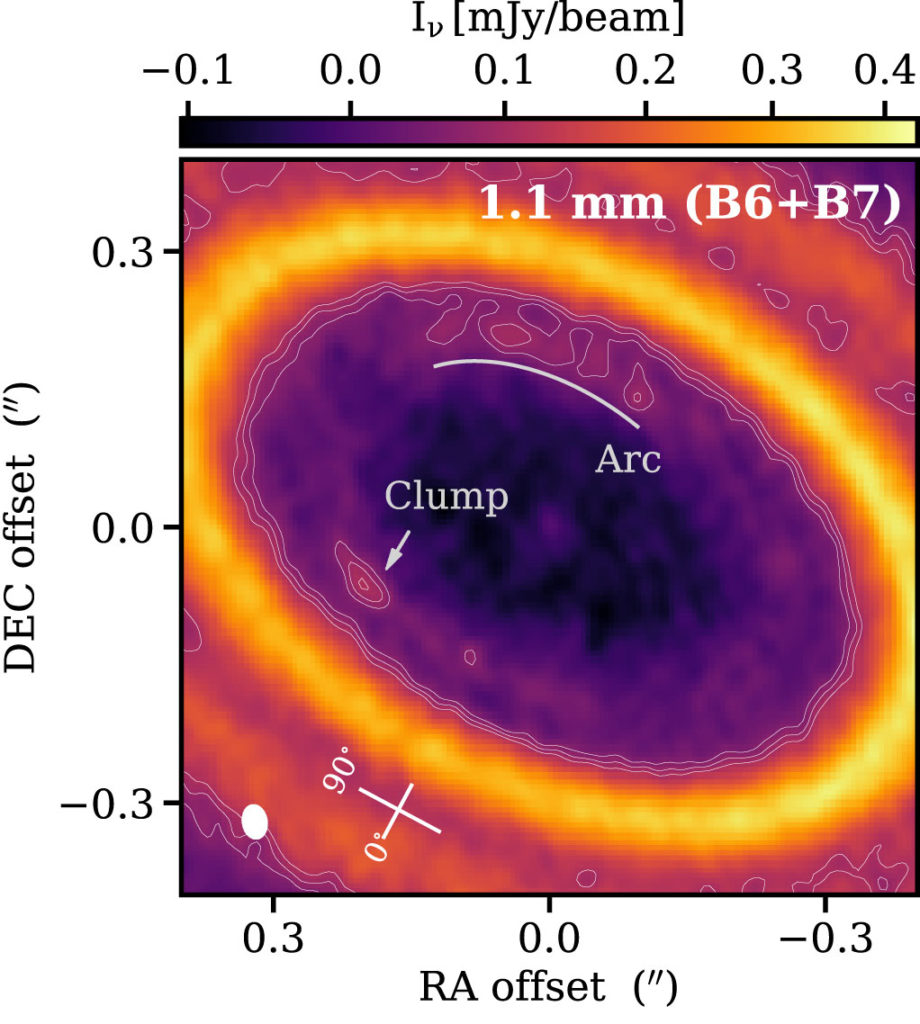 Seal and arc in the protoplanetary disk. Image: Feng Long et al., The Astrophysical Journal Letters
In a new study, researchers looked atthat about 42 astronomical units from the star (42 times farther than the Earth is from the Sun) a dust ring is formed with two separate and bright clumps of matter rotating inside it. The first of them looked like a small lump, and the second - a large arc. Two areas with material concentrations were separated by approximately 120° orbits.
The researchers came to the conclusion thatthe division is not accidental. The clot itself does not resemble a planet, but the two areas in which the material accumulates resemble the Lagrange points L4 and L5. Recall that Lagrange points are called points in a system of two bodies at which an object with a negligible mass in the absence of other forces remains motionless relative to these two bodies.
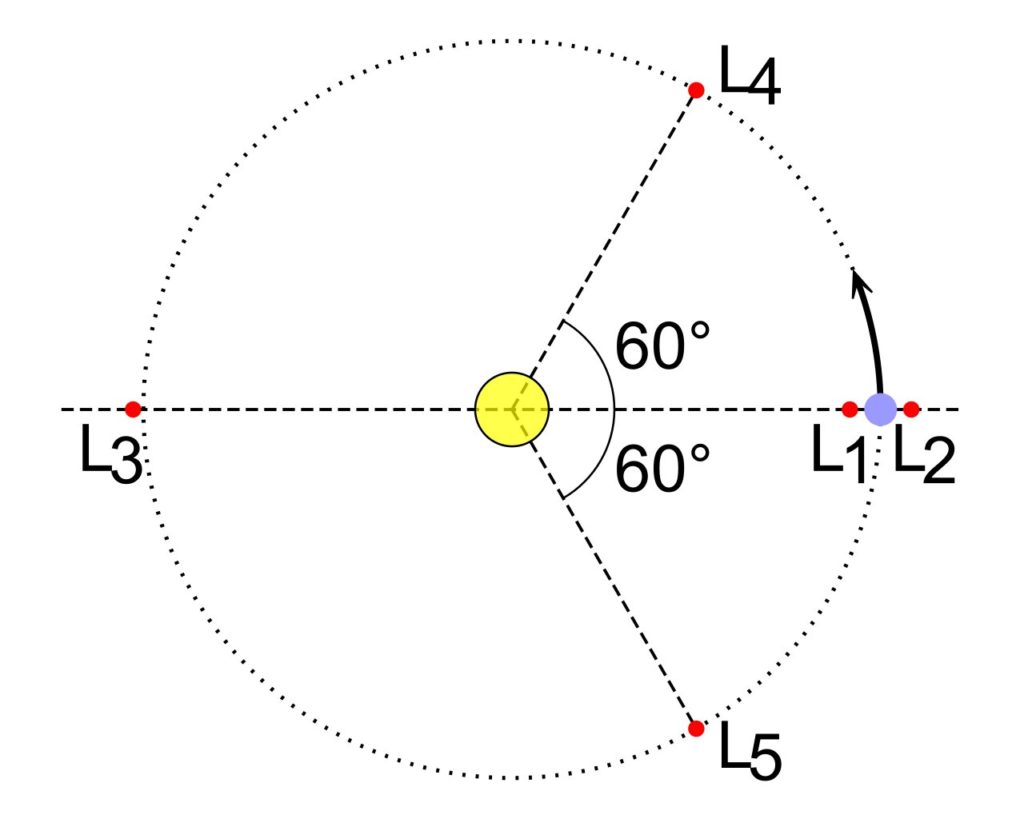
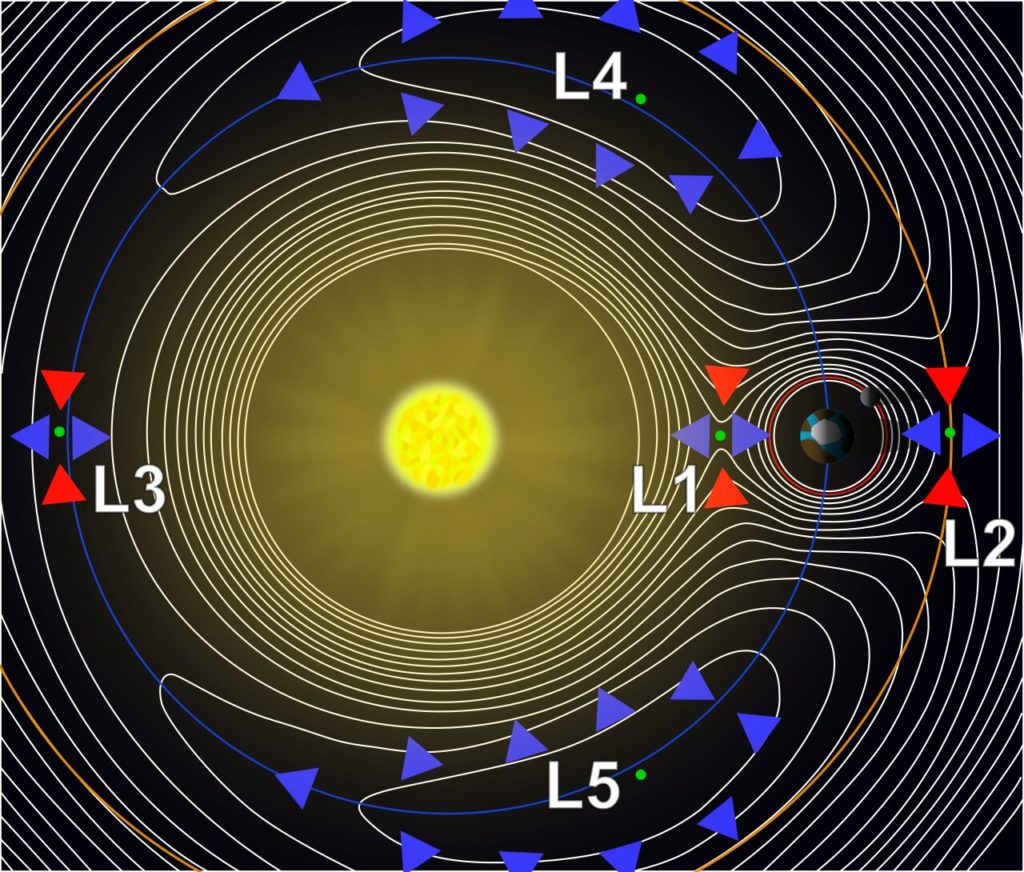
Lagrange points. Image: EnEdC, Public domain, via Wikimedia Commons (left), Lagrange_points.jpg: created by NASA derivative work: Xander89, CC BY 3.0, via Wikimedia Commons (right)
Although the planet itself cannot be seen due toa large amount of dust, the concentration of matter at points L4 and L5 indicates the presence of a young planet. It is 60° in orbit from each dust cluster. It is the effect of the gravity of this object and the star that ensures the formation of dense clumps. The results of the calculations show that this is a planet about the size of Neptune or Saturn and an age of 1 to 3 million years.
The researchers believe that a new method based on searching the protoplanetary disk for dust clumps separated by about 120° will help find many new young planets.
Read more:
Physicists explain Hawking's 'cosmic mismatch': how it will change science
See photos of the Sun in record resolution
The space plane will deliver cargo to the ISS and land at a regular "airport"
On the cover: an artistic illustration of a young planet. Image: M. Weiss, Center for Astrophysics | Harvard & Smithsonian