Astrophysicists from the Max Planck and Göttingen Institute for Solar System Research
With the help of numerical simulations, scientistsanalyzed the influence of the chemical composition of stars on the ozone content in the atmosphere of exoplanets. Recall that the ozone layer protects the Earth and the organisms living on it from dangerous ultraviolet radiation that damages living cells. The presence of such protection is an important prerequisite for the emergence of complex life on exoplanets.
On the surface, about half of all knownstars around which exoplanets revolve, the temperature ranges from 5,000 to 6,000 ° C. In their calculations, the researchers turned to this subgroup. They also considered for the first time the influence of metallicity - heavy elements in the composition of a star. There are more than 31,000 hydrogen atoms for every iron atom in the Sun. The scientists modeled stars with lower and higher iron abundances.
The researchers calculated the amount and propertiesultraviolet radiation generated by stars with different compositions. After that, they studied how the calculated radiation would affect the atmospheres of planets orbiting at a safe distance around these stars - in the potentially habitable zone.
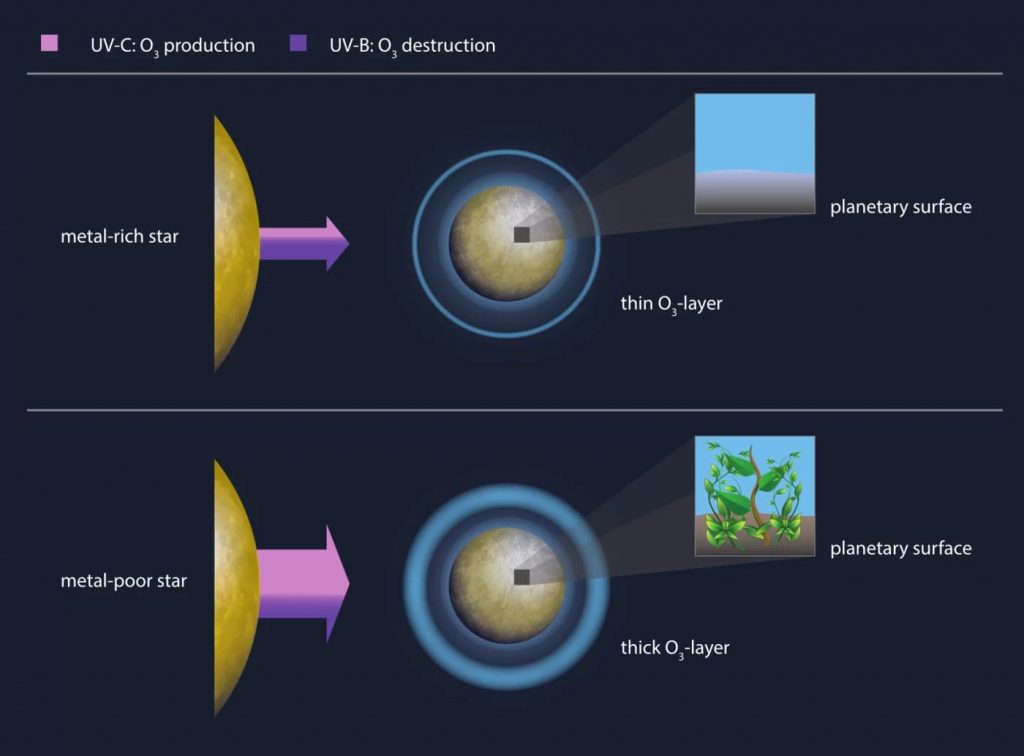 The influence of the chemical composition of stars on the formationozone layer: in the weak radiation of metal-rich stars, rays that destroy ozone predominate, the powerful radiation of stars poor in metals, on the contrary, contributes to the formation of a powerful protective layer. Image: Max Planck Institute for Solar System Research
The result was amazing.In general, metal-poor stars emit more ultraviolet light than their heavy-element-rich counterparts. But the ratio of UV-C radiation, which affects the formation of ozone, and UV-B, which destroys the protective layer, is also different. In stars with low metallicity, radiation predominates, which helps form protection.
This means that despite the great "activity"in the ultraviolet range of stars with a low abundance of heavy elements, it is these stars that contribute to the formation of a protective layer in the atmosphere, which is necessary for the preservation of complex life forms. The results of the study clarify the necessary conditions for the formation of habitable exoplanets and help select targets for the search for biosignatures with powerful telescopes.
Read more:
No longer a toy. What will the evolution of GPT and Midjourney lead to?
In space, no one will hear your cry: 7 action-packed books about the secrets of the universe
"Sea" of quarks inside one proton: what does an elementary particle consist of