In many galaxies located close to the Milky Way, star formation has long ceased.
In the part of the cosmos that we inhabit, inmost large galaxies have long ceased to be born new stars, scientists explain. With powerful observational tools, you can look back into the past of the universe, find galaxies whose light has been traveling to Earth for billions of years, and find out why the birth of new stars stops at some point.
Astrophysicists used research dataThe Sloan Digital Sky Survey, which has cataloged several million galaxies using observations from the Apache Point Observatory in New Mexico. Complementing these observations with data from the ALMA radio astronomy network, the researchers found the galaxy SDSS J1448+1010, seven billion light-years from Earth, which had recently stopped star formation and which still had enough fuel for the birth of new stars.
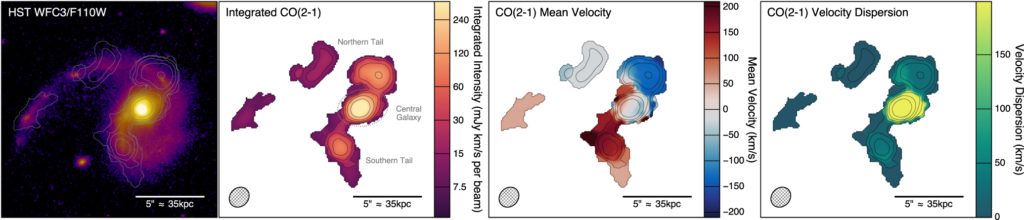 An infrared image of the SDSS J1448+1010 galaxy and an analysis of the carbon monoxide tail ejected from it. Image: Justin S. Spilker et al., The Astrophysical Journal Letters
A detailed study of this galaxy usingThe Hubble Space Telescope showed an unusual gaseous "tail" coming out of it. Using computer simulations and observations, the scientists found that such a structure could only have formed as a result of a collision between two galaxies. The powerful gravitational force of this process tore apart the stars and threw a stream of gas at a distance twice the size of the Milky Way.
It is the release of cold gas from the galaxy, likeScientists believe it deprives it of fuel for the formation of new stars. They note that, apart from the gas trail, the rest of the galaxy looks the same as the others, its structure does not show signs of impact. This means that in about 200 million years, when the gas “tail” dissipates, it will look exactly the same as other dead galaxies.
This means that, perhaps, in the past, many objects close to us survived similar collisions, from which there is no trace, astrophysicists conclude.
Read more:
The first images of the underground part of Mars surprised scientists
A galaxy located 12 billion light-years from Earth 'curled up' into an Einstein ring
From the body to the mouth: scientists have understood where the teeth came from
On the cover: star-forming region N11B in the Large Magellanic Cloud. Image: NASA, ESA, and The Hubble Heritage Team (AURA/STScI)