Researchers from China and the United Kingdom have shown that even in an era that was characterized by the highest
According to the snowball hypothesis, about700 million years ago, the Earth's surface was almost completely covered in ice. Traces of these glaciers are found even in tropical latitudes. The question of how far they extended is a matter of scholarly debate. Some scientists claim that ice covered the entire Earth in a thick layer up to the equator, others that there could be areas of exposed ocean.
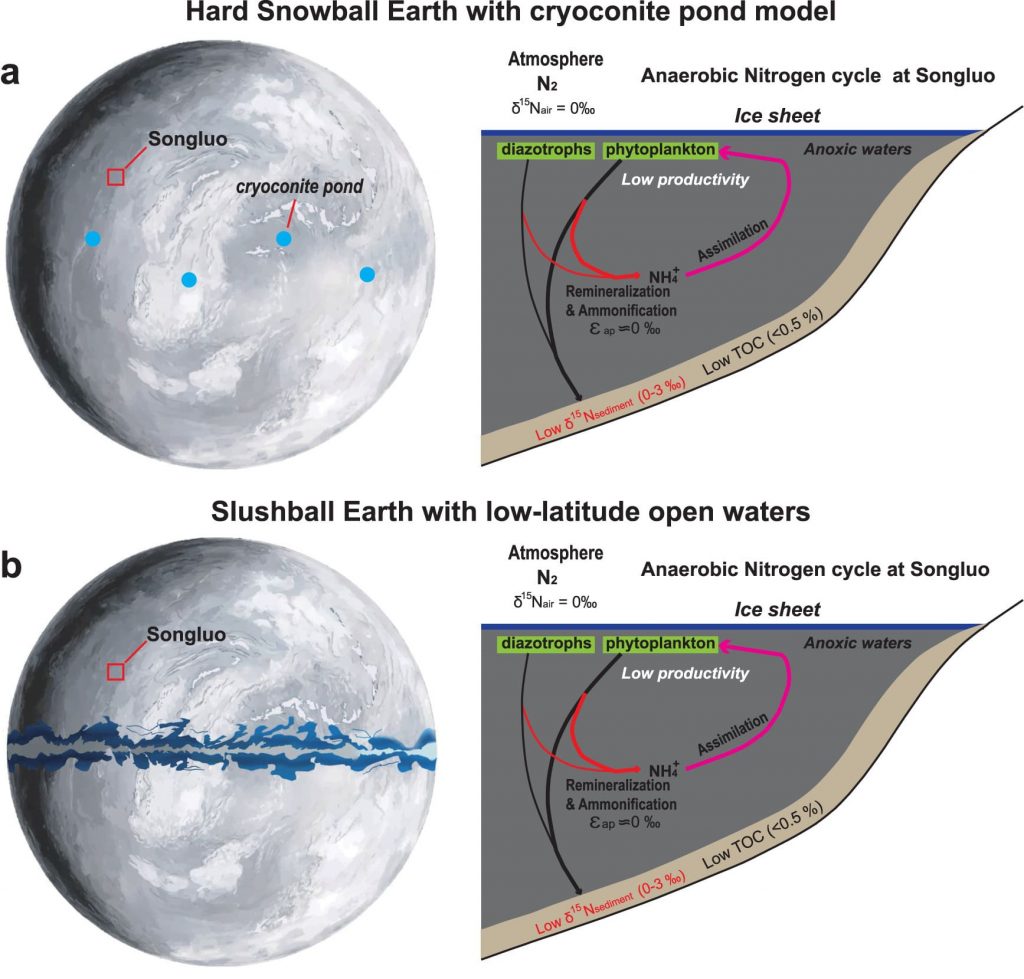 Glacier distribution patterns and their corresponding nitrogen cycles, in which the Earth is completely covered by ice (A) or only the near-equatorial regions (B) are open.Image: Huyue Song et al., Nature Communications
Researchers studied thin shales from the formationNantuo in southern China, which were formed during the era of the Marinoan glaciation, which began about 650 million years ago. These rocks were under water and represent the "chronicle" of the deposits of that period.
Inside the rock, scientists have found macroscopictraces of complex algae. An analysis of the isotopic composition of carbon, nitrogen and iron helped the researchers reconstruct the processes that took place in these plants. The researchers found signs of a complex aerobic nitrogen cycle. This means that the organisms used photosynthesis, which means that both light and oxygen were available to them.
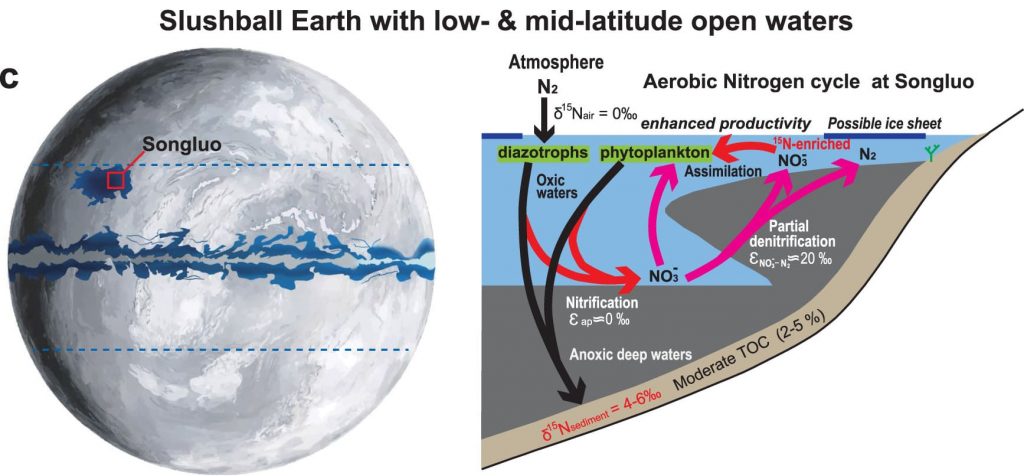 A model of glacier distribution and their corresponding nitrogen cycles, in which open areas are observed in mid-latitudes.Image: Huyue Song et al., Nature Communications
Comparing the collected data with the resultsstudies in other areas, scientists came to the conclusion that the “Snowball Earth” was covered by open areas of the ocean, which were observed not only in tropical regions, but also in mid-latitudes. Apparently, these oases for photosynthetic organisms served as the basis for the restoration of biodiversity after the end of the glaciation.
Read more:
Scientists have figured out the nature of strange radio signals from a planet similar to Earth
Experts have predicted how many people will live on Earth by 2100
New type of black hole found lurking in Earth's 'cosmic backyard'
On the cover: an artistic illustration of a model of the Earth with open areas of the ocean during the maximum glaciation. Image: Huyue Song