Wind turbines on Mars could theoretically provide scientists with enough energy to
Solar energy is enough for researchMars is near the equator, scientists say, but to live closer to the poles all year round, other sources of energy are needed. In their work, the researchers showed that properly positioned wind turbines could provide enough power for a group of six people to live and work on Mars year-round without the radiation risks associated with nuclear power.
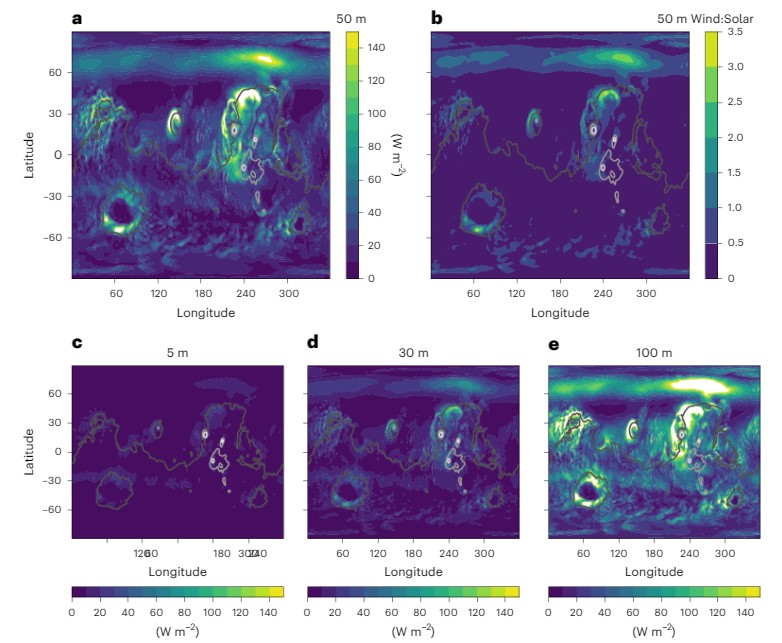 Potential of a wind turbine installed at50 m above the surface of Mars (a), the ratio of wind and solar energy (b) and the potential for wind energy production at another altitude (c — e). Image: Hartwick et al., Nature Astronomy
Scientists have adapted the global climatea model that was originally developed for Earth, taking into account conditions on Mars. Based on data collected during various missions to the Red Planet, the researchers modeled different wind speeds on the planet, day and night, in different seasons and even years.
Scientists have calculated for various sitesthe maximum power that could be produced by an ideal wind turbine with 100 percent efficiency and four types of real wind turbines used on Earth. They compared the data obtained with the estimated energy requirement to support six people on Mars during a mission lasting 500 Martian days.
Researchers have found that wind power cannot only to supplement solar energy, especially at night and during strong dust storms that block sunlight, but also to completely replace it in some regions of the planet, especially at the poles, on the edges of Martian craters and on volcanic highlands.
Read more:
Two planets have been found not far from Earth. Perhaps they are inhabited
A unique meteor rewrote the history of the solar system: where did it come from
The prototype module of the new ISS was blown up at the NASA center. Look how it was