Using the high-resolution HIRES spectrometer at the Keck Observatory, as well as spectrographs at the Bolshoi
Due to the fact that there are very few Jupiter moonsgases, their radiance is 15 times brighter than those that occur at the Earth’s poles. However, a human telescope cannot see them on Europa and Ganymede. Sodium gives Io's aurora a yellow-orange glow, like that of city street lights. The new measurements also showed potassium auroras on Io in infrared light. They were observed for the first time.
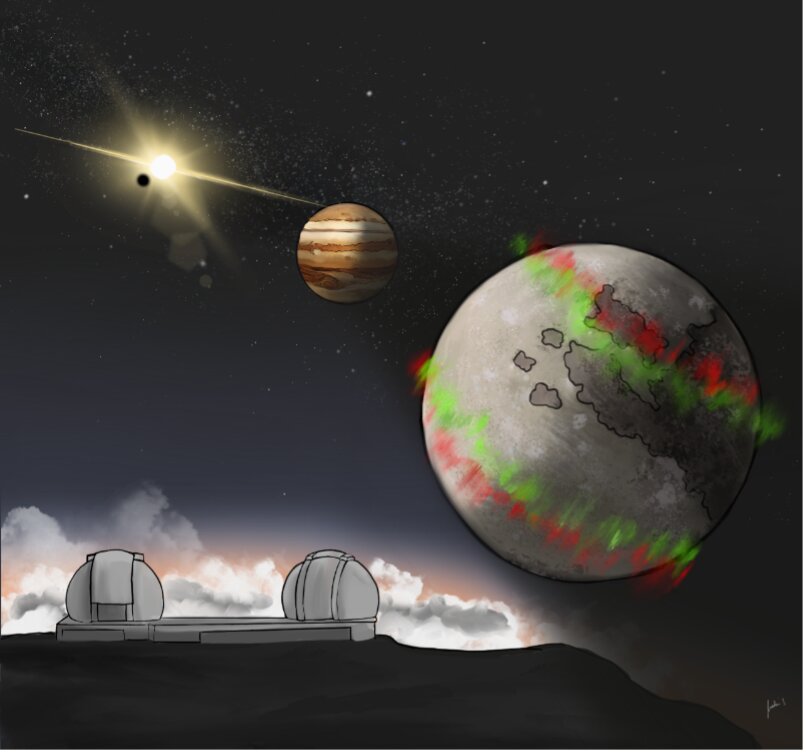 Artist's impression of the oxygen aurora on Ganymede as seen from Mauna Kea on the island of Hawaii using two Keck Observatory telescopes. Photo: Julie Inglis
Because Jupiter's strong magnetic fieldtilted, the auroras on these moons change brightness as the planet rotates. In addition, the atmosphere may respond to the rapid transition from the warm sunlight to the cold shadow of the gas giant.
It is noteworthy that new measurements showminimal evidence of water. This has sparked intense scientific debate about whether the atmospheres of Jupiter's moons contain significant amounts of water vapor.
The scientists' findings were published in two articles:“Optical auroras of Europa, Ganymede and Callisto,” The Planetary Science Journal (2023), Carl Schmidt et al., “Optical auroras of Io in the shadow of Jupiter,” The Planetary Science Journal (2023).
Read more:
A powerful flare erupted on the Sun: it has already affected the Earth
Medieval fortress accidentally discovered in the forest: the find surprised scientists
Scientists have found a new genetic disease in children: how it manifests itself