Engineers from Binghamton University used spore-forming bacteria to create a biobattery
The coin-sized fuel cell was sealeda piece of Kapton tape, a material that can withstand high and low temperatures. This made it possible to preserve the material for long-term storage. When the tape was removed and moisture got in, the bacteria mixed with a chemical seed that stimulated the microbes to produce spores.
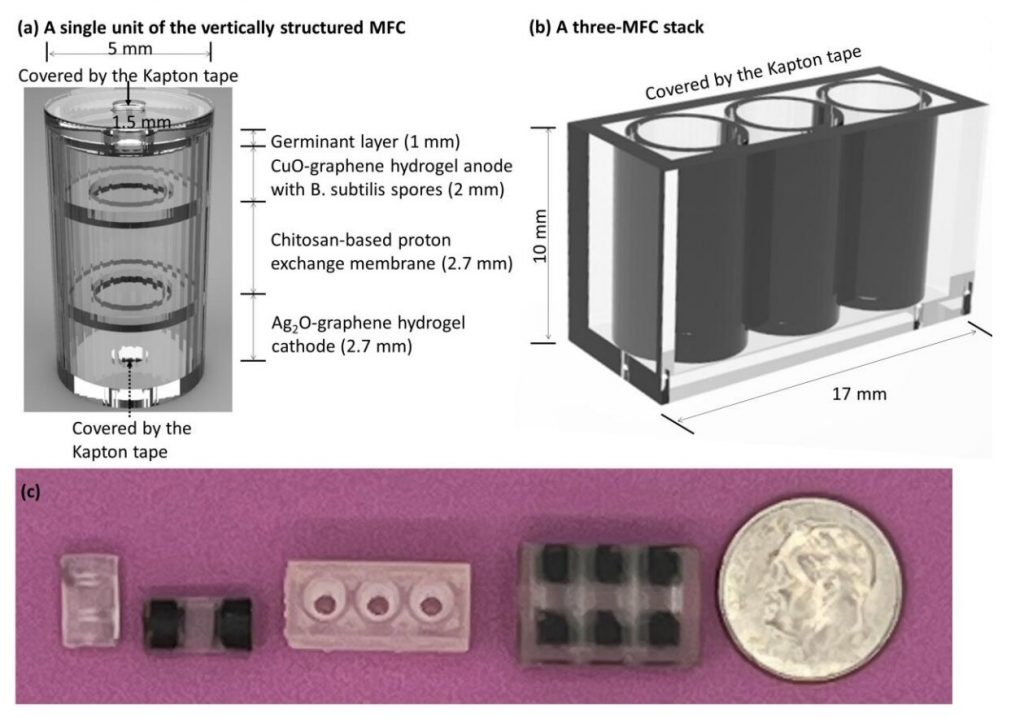 Diagram of the structure of a bioaccumulator. Image: Maryam Rezaie, Seokheun Choi, Small
The energy of biochemical reactions was sufficient forpower LED, digital thermometer or small clock. The researchers also found that thermal activation of bacterial spores reduced the time to reach full power from 1 hour to 20 minutes, and increased humidity increased electrical output. After a week of storage at room temperature, power generation decreased by only 2%.
The overall goal is to developa microbial fuel cell that can be stored for a relatively long period of time without degrading biocatalytic activity, and quickly activated by absorbing moisture from the air.
Seohun Choi, study co-author
The researchers note that the current prototype isonly the beginning of research. Although it shows good results for the full implementation and replacement of traditional batteries with bioaccumulators, such a fuel cell must turn on faster and generate more voltage.
Read more:
Scientists have studied an ultra-bright object that violates the law of physics
"Sea" of quarks inside one proton: what does an elementary particle consist of
Look at the highest resolution map of Mars: 110,000 frames and 5.7 trillion pixels
On the cover: various devices powered by biobatteries. Image: Bioelectronics and Microsystems Laboratory, State University of New York at Binghamton