World War II ball tank
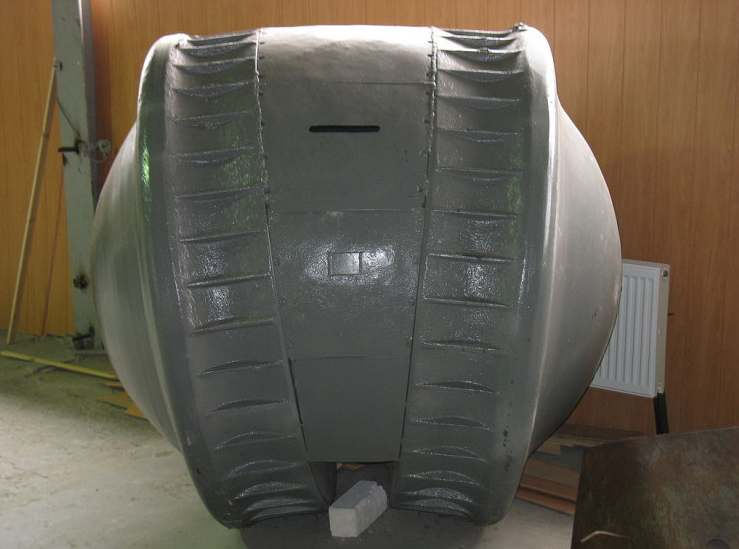
An incredible fighting vehicle, called the Kugelpanzer or Rollzeug,
Source: Morpheios Melas / Wikimedia Commons
Little is known about this enigmatic militarycar, but one surviving copy can be found in Russia. It is known that the tank was built by the German company Krupp and, apparently, was designed as a reconnaissance vehicle armed with a single 7.62 mm machine gun.
Its armor is quite thin, about 5 mm thick,it is therefore unlikely that it is intended for use as an armored fighting vehicle (AFV). The propulsion system was driven by a single-cylinder two-stroke engine.
The remaining famous example can be seen at the Kubinka Tank Museum in Moscow.
Combat Vespa
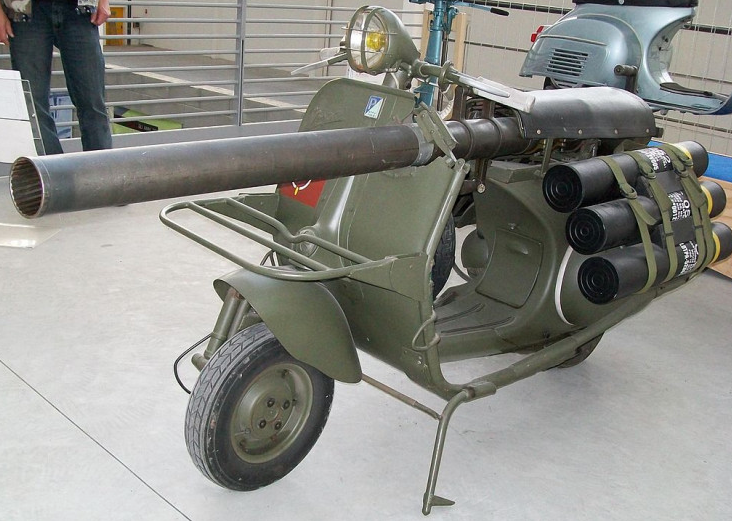
Another of the most bizarre war machines of alltimes - Vespa 150 TAP. The modified Vespa motorcycle is intended to be used as an anti-tank gun platform for use by French paratroopers.
Source: RIVARS / Wikimedia Commons
The motorcycle was first introduced in the mid-1950s. Each vehicle is equipped with one 75mm US M20 rifle, capable of firing shells that penetrate 100mm of armor.
The idea behind the scooter was to bewas dropped by paratroopers during operations to support the paratroopers. The rifle could be dismantled and re-mounted on a Browning machine gun tripod.
Exploding mini tanks
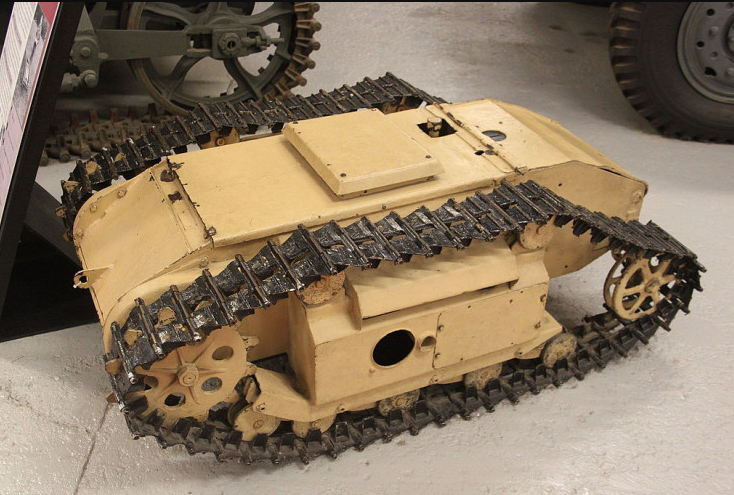
Did you know that during World War IIDid the Germans really develop remote-controlled explosive mini-tanks? These tiny tracked devices could be controlled using a joystick and a cable thousands of meters long.
 Source: Rodw / Wikimedia Commons
Each device was driven by either dual electric motors or small gasoline motors. Such a tank carried a payload of 60 kg to 100 kg of explosives.
The idea behind mini-tanks was toduring the battle, spend them under the tanks of the allies, and then detonate them in the right place. They could also be used to destroy enemy infantry formations or demolish buildings and bridges.
Rockets for pigeons
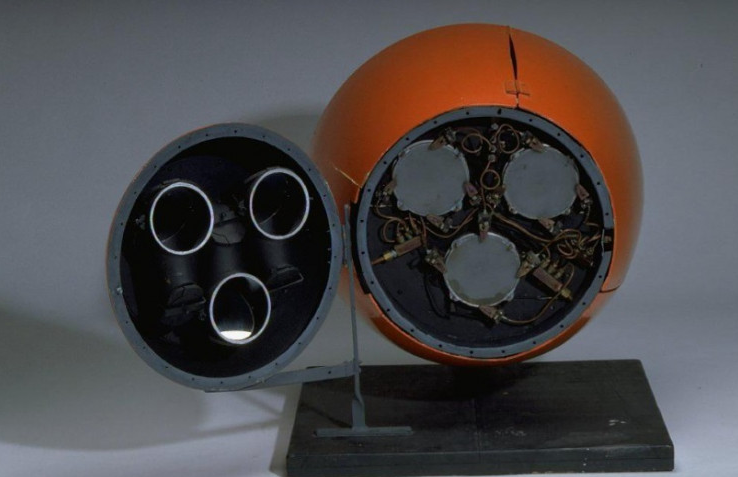
Another very unusual combat unit wasbombs that were launched by pigeons. To do this, engineers created specially designed rocket nose cones that could contain three birds at the same time. The whole project was called "Dove".
 Source: National Museum of American History.
Project Pigeon (later Project Orkon, abbreviated fromOrganic control- "Organic Management") - Americana World War II research project by the US Army, led by the American behavioral psychologist B.F. Skinner, aimed at creating guided weapons with a biological guidance system, which was carried out by carrier pigeons. The project was sponsored by the US Office of Scientific Research and carried out within the framework of the federal research program on the creation of guided weapons and other forms of combat use of various warm-blooded animals and birds (torpedo, missile, aircraft and other weapons).
The control system included a series of lenses (up tothree), located on the nose of the rocket and projecting the image of the target onto the screen in front of the pigeon. Birds, one to three in number, trained using Skinner's technique called Operant Learning, had to peck at the silhouette of the intended target, thereby directing the missile.
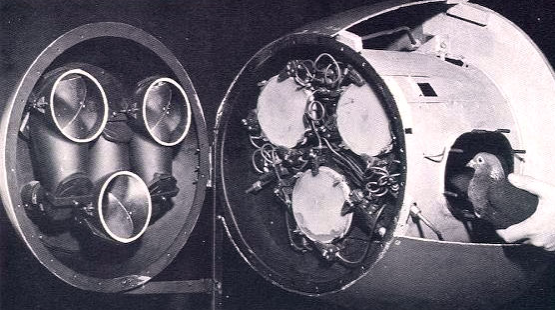 Author Milos Stevanovic~srwiki
Although the National Research Committee fordefense ”and was initially very skeptical of this idea, nevertheless, financial resources in the amount of $ 25,000 were allocated for its implementation. Skinner had a positive track record with pigeon training, but the idea of bird-guided missiles seemed to too many impractical and insane. As the researcher himself said about this: "Our problem was that no one took us seriously." The program was canceled on October 8, 1944.
Vertical fighter
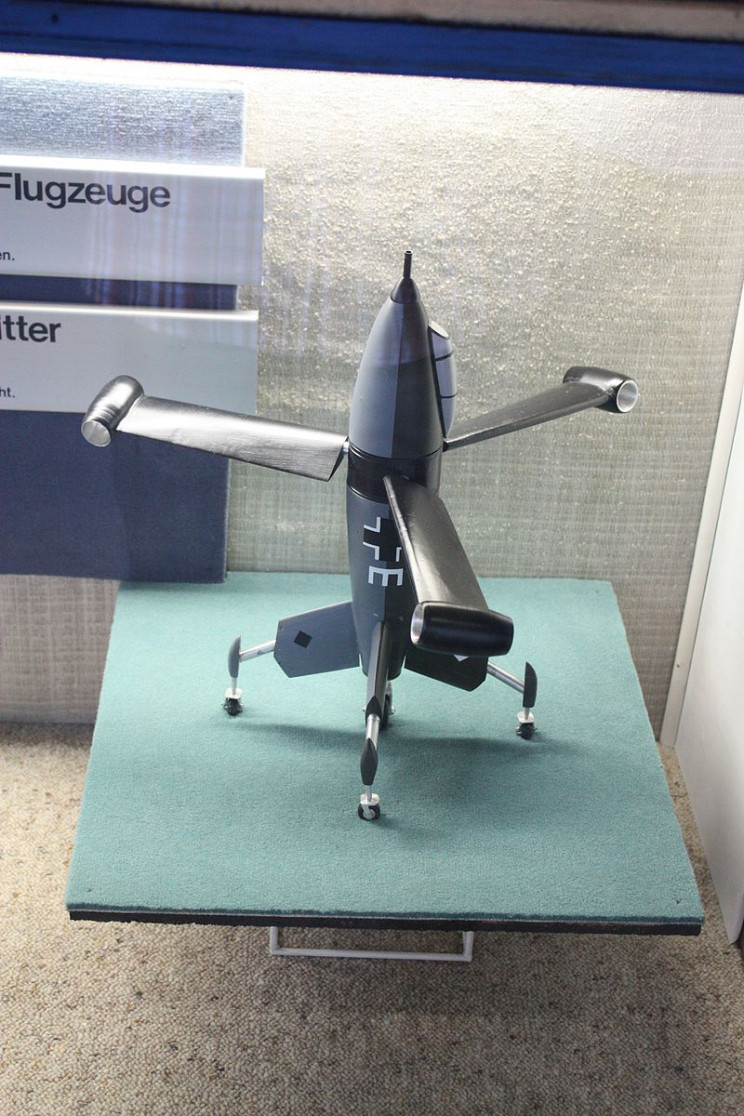
Under Hitler, Germany developed manyvarious projects of vertically taking off fighter-interceptors. The strangest of them can be called the Focke-Wulf Triebflugel jet interceptor project, which was developed in 1944 by the famous aircraft designer K. Tank together with D. Klucheman and H. Haliman.
 Source: Bin im Garten / Wikimedia Commons
Triebflugel translated from Germanlike a wing-propeller, which most accurately reflects the design of an aircraft that did not have a wing in the video in which people are accustomed to seeing it. For vertical takeoff and landing on the tail, as well as for horizontal flight, the aircraft had to use a three-blade propeller-wing with a diameter of 11.4 m, which was driven by ramjet engines of the O. Pabst design installed at its ends with a thrust of 839 ;kgs. It was assumed that the engine would run on non-scarce fuels.
By the end of the war, the aircraft had just completed the test phase of the wind tunnel design, the military captured its production facility. As far as is known, no working prototype has been built.
Read more
Nebulae, comets and stellar nurseries: showing the best astrophotography of the year
Changes in the Earth's orbit contributed to the emergence of complex life on the planet
Data from spy satellites helped to find out the cause of melting glaciers in Asia