How climate threatens the world
Global warming is the planet's response to rising greenhouse gas levels
NASA's latest climate studyNovember 2020 showed that the level of carbon dioxide is 415 ppm (parts per million by volume - "Hi-Tech"). The same high figure was 2.6 million years ago, during the Pliocene. Then in the Arctic it was 8 ° C, and the water turned into ice only in winter. With less ice, the sea level was about 25 m higher than today. That's enough to flood several metropolises like New York, London, Miami and Shanghai.
Climate change is having a strong impact on the economy.From 1980 to 2020, warming cost humanity $ 1.825 trillion. For example, Munich Re, one of the world's largest insurance companies, blamed climate change for $ 24 billion in damages due to California wildfires.
Warming is not only having a seriousimpact on the environment and people, but also is one of the biggest threats to economic stability. Gradual climate change is making people unable to work and reducing their productivity. Drought is cutting crops, making it harder to feed the world's population, which is expected to reach 10 billion by 2050. The World Bank warns that if we don't do something immediately, climate change could lead to another 100 million people living in poverty by 2030.
Largely a key reason for the globalwarming is considered mining. The mining industry produces between 1.9 and 5.1 gigatons of greenhouse gas equivalents annually. Most of this in this sector comes from volatile coal bed methane, which is emitted from coal mining (1.5 to 4.6 gigatons) during underground operations. To solve this problem, it is necessary to focus on the development of alternative energy sources.
Impact of global warming on Russia
Russia ranks fourth in terms of the number of sources of greenhouse gas emissions in the world: the country accounts for about 4.6% of the global global indicator, and per capita - 15.5%.
The vast majority of greenhouse gases in Russiagenerated by the power industry (78.9%). Almost half of these emissions are related to the production of heat and electricity. The rest falls on the processing of hydrocarbons for transport.
Russia is a country dependent on gas andoil refining business. Almost 70% of all exports come from these industries. This is attributed to the existence of huge companies such as Lukoil or Gazprom, which are on the list of giants emitting the most greenhouse gases from the Carbon Disclosure Project, a British research organization, traditionally occupy high positions. For example, Gazprom has been holding the third place in the world in terms of emissions for more than 30 years, second only to Chinese and Arab companies.
Virtually unlimited land available forbuildings, as well as a long service life create favorable conditions for the construction of renewable energy sources. The impact of newly installed capacities of wind, solar and hydroelectric power plants on electricity generation became most noticeable in 2018, when the production of wind energy in Russia increased by 69.2%, and solar - by 35.7%.
As the revolution continuesSince solar energy is deployed all over the world, the potential of new energy in Russia will not be fully utilized until the country gains access to an ESS (energy storage system - "Hi-tech") based on lithium-ion batteries at an affordable price. By then, for example, instead of diesel-fueled thermal power plants, Russia will switch to renewable energy sources and storage at ESS.
This transition has already begun: the Russian state atomic energy corporation Rosatom has created a new subsidiary, Rener, to deal with
renewable energy sources.Its specialists will produce modular lithium-ion traction batteries for electric vehicles, energy storage systems (ESS) for emergency power supply, renewable energy and load balancing.
How Israel is feeling climate change
Israel is a land rich in minerals.About 2.4 trillion cubic feet of natural gas from the Karish and Tanin gas fields, as well as the previously discovered Tamar and Leviathan fields.
Major gas fields in Israel:
Leviathanis the largest gas field in Israel.According to experts, the reserves amount to453 billion cubic meters.
Karish— a large field in the Mediterranean, with initial gas reserves estimated at 45–57 billion cubic meters.
Tannin- the fourth largest gas field in the country, it stores 30 billion cubic meters of gas.
Tamar— a gas field discovered in 2009 in the Mediterranean Sea, experts estimateThe volume of minerals is 300 billion cubic meters.
The country strives to become non-volatilethe state. Economically ambitious Israel is even preparing to enter foreign markets, becoming a major exporter of natural gas: on January 19, this year, Israel agreed to export 44 billion cubic meters of gas to Egypt.
Israel is not afraid of climate change, becausethe country wants to turn this around, avoiding negative economic consequences. Energy Minister Yuval Steinitz announced in the summer that the renewable energy target by 2030 has been officially raised from 17% to 30%, according to a plan that will cost about $ 22 billion over the next decade. About 100 officials heading local government environmental committees across the country, called on Steinitz to rethink expanding the use of natural gas and instead set much more ambitious targets for renewable energy.
Global warming has greatly affectedthe country's economy. Since 2015, the global community has been focused on reducing greenhouse gas emissions, which affects the gas business. While the entire planet is switching to renewable energy sources, Israel is discovering new gas fields and building a strategy for the development of the state based on the extraction of hydrocarbons.
World response to global warming
The European Union has set targets to reduce emissionsgreenhouse gases. The first package of EU climate and energy measures was agreed in 2008. Then they set goals to reduce emissions and increase the number of renewable energy sources.
The EU has developed and reformed the EU Emissions Trading System (ETS) aimed at reducing greenhouse gas emissions, in particular in energy-intensive industries and power plants.
Europe has long been focused on improvementclimate situation: from 2030, new cars will emit an average of 37.5% less CO2, and new vans will emit an average of 31% less CO2 compared to 2021 levels.
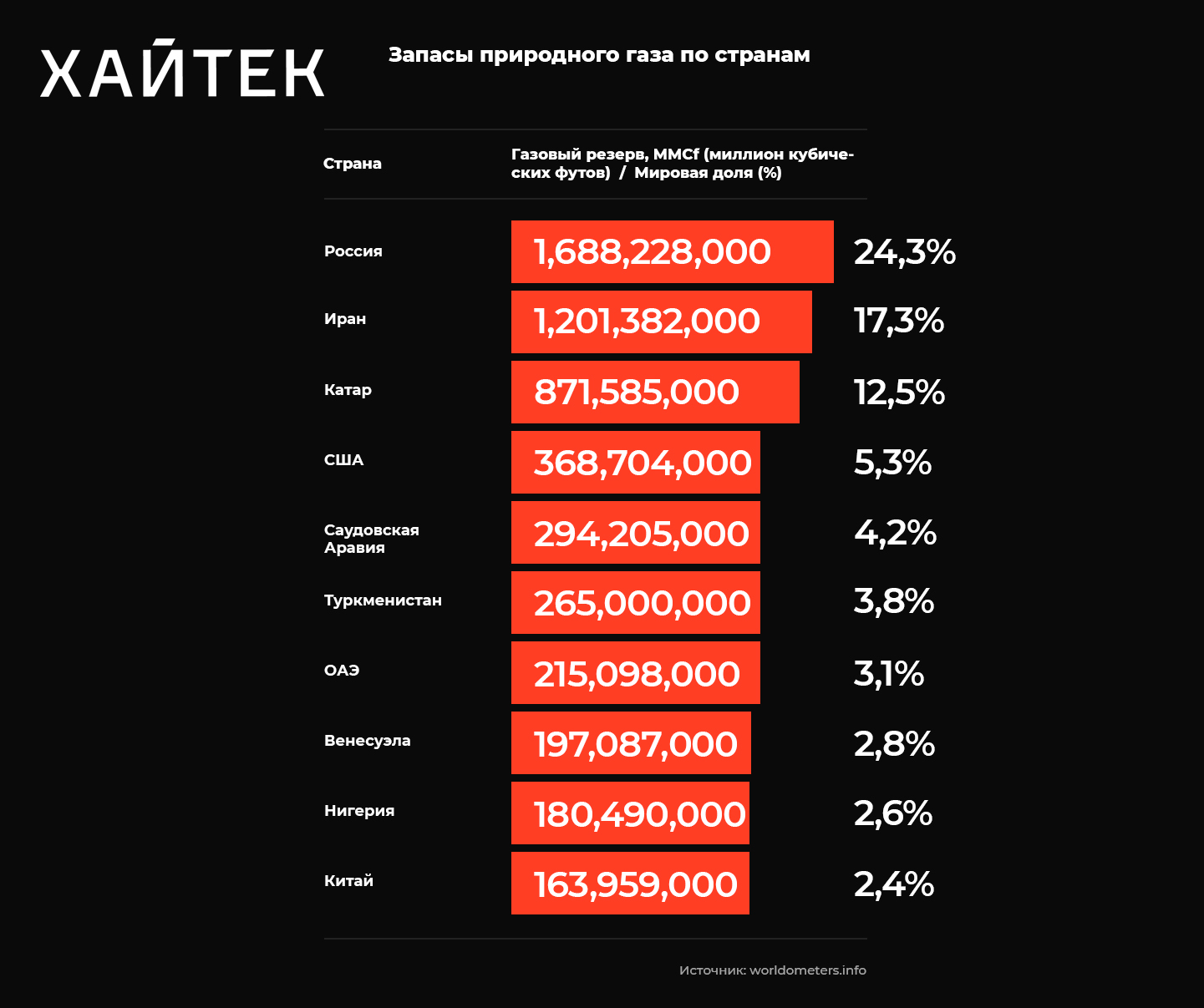
Countries in the Middle East wherelarge reserves of gas, only now are they beginning to think about creating renewable energy sources. One of the states facing serious problems due to global warming is Qatar. More than 12.5% of the world's gas reserves are located in this state. Almost all exports are for oil and gas products. Because of this, the country ranks third in terms of the amount of greenhouse gas produced per capita, which negatively affects the climate. Qatar cares about the well-being of its residents, so the government plans to diversify development so that money comes not only from the oil refining business. How they plan to do this is still a mystery, because no official statements about the built strategy have yet been released.
Chief Executive Officer Qatar InvestmentAuthority Mansour bin Ebrahim al-Mahmood said the Qatar Sovereign Wealth Fund plans to move to greener assets and that 44% of the fund's infrastructure projects are zero-emission investments.
Qatar is fully prepared to fight changeclimate, but the country has a lot of work to do. Accordingly, the decision was made to produce safer, more affordable and cleaner energy. Diversified development is central to Qatar's development planning despite significant gas reserves. The country is smartly balancing between compliance with the rules of the Paris Agreement and the extraction of natural resources. With this approach, Qatar can be less worried about the problems of global warming than, for example, Israel, which cannot achieve mutual understanding between investors and the government.
Development is progressing at a high pace:the first large-scale solar power plant was built in Qatar. Al-Harsaah has a capacity of 800 MW, but so far only on paper. The first 350 MW phase will be connected to the grid in the first quarter of 2021 and the project is expected to be fully operational in April 2022.
See also:
Look at an 8 trillion pixel image of Mars
Scientists have developed a replacement for the theory of relativity. What is the essence of the "theory of everything"?
Abortion and science: what will happen to the children who will give birth