The scientific community rejects the idea of a large unknown ape-like creature roaming the
However, over the past half century, thousands of eyewitness accounts have been recorded from across the United States and Canada. Here are some of the most famous Bigfoot sightings.
"Deposition" by William Rowe, 1955
One of the most famous observations of snowperson supposedly occurred on Mount Mica in British Columbia in 1955 A man named William Rowe stated that during the hike he saw “half man and half animal.” In 1957, he testified under oath that the creature was 1.8 m tall and was covered in brown hair with silver tips. The “Bigfoot” had thick arms that hung down to his knees, wide feet and chest.
“Looking at this creature, I wonderedwondering if any film company is filming a film in this place. Suddenly it’s an actor in makeup. But as I watched him, I realized that it was impossible to fake.”
Before Roe's testimony about the ape-likeIn humans, Bigfoot has been repeatedly described as “an indigenous inhabitant of gigantic proportions” (we are talking about the indigenous inhabitants of America, the Indians). In other words, it was in 1955 that the concept of the “modern Bigfoot” appeared (although such a term would appear later). Scientists argue that eyewitness testimony is not always reliable, so this and other observations cannot be considered conclusive evidence.
"The Kidnapping" of Albert Ostmann in 1924
Prospector Albert Ostman claimed to have spentabout a week with a Bigfoot family near Toba Bay, British Columbia in 1924. Ostman stated that he was held captive by the creature's family, but eventually managed to escape when "Bigfoot's father ate Ostman's chewing tobacco and became ill."
Ostman's descriptions of his captors are similarRowe's 1957 story. However, the "eyewitness" stated that the meeting took place in 1924; he did not record it until the mid-twentieth century. He “made up his mind” only after hearing Rowe’s story. Therefore, perhaps he inspired or influenced him.
Patterson-Gimlin video, 1967
The most famous “meeting” with the snowa person was filmed on camera in 1967. "Patterson-Gimlin Footage" is a minute-long video that shows a "female Sasquatch" walking through a clearing in Northern California. She was later nicknamed "Patty". Bigfoot supporters still often consider this video to be the best evidence of the creature's existence. The scientific community, however, believes that this is an ordinary person dressed in a specific costume.
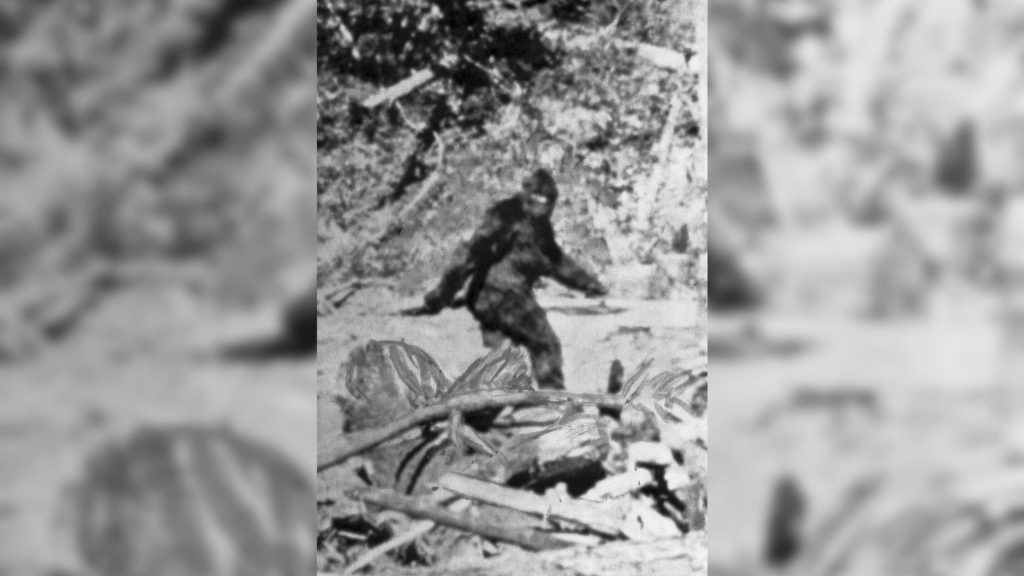 Screenshot of Bigfoot video taken northeast of Eureka, California in 1967.
Geoffrey Meldrum, professor of anatomyand of Anthropology at the University of Idaho and the author of Bigfoot: Legend Meets Science is one of the few scientists to publicly support the authenticity of the video and the existence of Bigfoot. He told Live Science that he's not sure the film is real, but he thinks the idea of the subject's "false gait" is incorrect. As an argument, he cites the discovery of Lucy, a 3.2-million-year-old extinct human ancestor (Afarensis Australopithecus). The study of the remains showed that our ape-like ancestors walked upright.
Meldrum noted that the anatomical features,that can be seen on on film, such as facial proportions, are consistent with ancient people. For example, Paranthropus boisei is a species that lived from 2.3 to 1.2 million years ago. The size of the creature in the video is estimated to be approximately 1.8 to 2.1 m in height.
However, most expert personneldon't convince. Darren Naish, paleozoologist and author of Monster Hunt: Cryptozoology and the Reality Behind the Myths, cited many reasons to doubt the film's authenticity on social media in 2020. In particular, he emphasizes that the author of the video monetized the story about Bigfoot even before its release. But he adds that Patty's skin shines and moves like a real animal, and her muscle movements look authentic. “Everything suggests that this is a very good deception,” he emphasizes.
Brian Regal, associate professor of history of scienceKean University in New Jersey and the author of Finding Bigfoot: Crazy People, Eggheads, and Cryptozoology strongly condemns the film and told Live Science that people are projecting their own views onto Patty. “You look at this and see what you want to believe,” he said.
“Meeting” in Provo Canyon, 2012
There are many videos about snow on YouTubeman, but few are as popular as the clip from Provo Canyon, Utah. The footage shows a large black animal hunched over the trees, possibly feeding or foraging for food. As the camera approaches, the huge creature stands on both legs, as if it were bipedal. The couple who filmed the video turn and run away.
Video published on October 30, 2012and has over 7.6 million views on YouTube. According to the caption, the couple went on a hike, hoping to get a closer look at the deer on the hill. “On the way up, we thought we saw a bear until the monster stood up and looked straight at us,” wrote user Beard Card (who uploaded the clip) in the video description. — After that we ran to the car, leaving the tent and everything else. He's probably still there."
Short video about Provo Canyonand unconvincing. Eric Ricart, curator of vertebrate zoology at the Utah Museum of Natural History, told FOX 13News Utah that science does not support the story that "Bigfoot lives in this state."
“What is the probability that there are largeanimals that have gone unnoticed by scientists and trained observers? There are many unknown creatures in the natural world, but they are nothing like the giant apes that run around populated areas of the world,” he said.
Fake bodies, in 2008 and 2012
In 2008, two men, Rick Dyerand Matthew Whitton, said they have a “frozen body of Bigfoot.” They said they found him while walking through the woods in northern Georgia. Their story made headlines, but the “body” turned out to be a rubber gorilla suit, reports Reuters.
Despite this, Dyer's story made the news again in 2012 when he claimed to have shot another Bigfoot in San Antonio, Texas.
Bigfoot footprints
Although Bigfoot footprints don't countobservation as such, they are mentioned most often when talking about the Bigfoot phenomenon. Even the name “Bigfoot” comes from a seemingly bogus 1958 story about giant footprints in northern California found by a man named Ray Wallace. His children later claimed that the prints were a joke by their father. However, a scientist who believes in the existence of “Bigfoot” claims that hoaxes are fewer than real ones are rare and that he has many “real” traces confirming a lot of observations. There are more than 300 of them in total.
“The simplest answer is that they were left by a species of primate not recognized by science,” he concludes. Other scientists are still waiting, at a minimum, for the body of the creature.
Read more:
The tomb of the “midwife of Jesus” was unearthed: scientists told what they found there
Einstein is wrong again and his main theory was rewritten: how it changes the world
Published test video of the world's first propeller with 11 blades
</ p>