Biochemists at Rutgers University have named the chemical that likely triggered the transition from...
Somewhere between 3.5 and 3.8 billion years ago on Earththere was a turning point associated with the emergence of life. The researchers believe that the reason for this change was the appearance of small precursor proteins that triggered metabolic reactions.
In search of such substances, biochemists have studiedexisting modern proteins associated with metabolic processes. Knowing that proteins are too complex to appear at an early stage, they reduced them to a basic structure - peptides consisting of several amino acids. As a result of a series of experiments, they came to the conclusion that a Peptide of 13 amino acids and two nickel ions is best suited for this role.
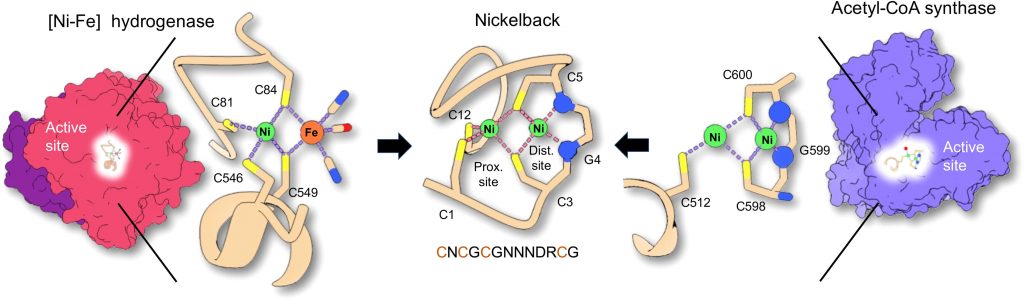 Nickelback peptide (center) and modern complex enzymes: [Ni-Fe] hydrogenase (left) and acetyl-CoA synthetase (right). Image: Jennifer Timm et al., Science Advances
Nickel was a common metal in the earlyoceans, scientists say. When bound to a peptide, the metal atoms become powerful catalysts, attracting additional protons and electrons and producing hydrogen gas. The researchers concluded that hydrogen was also abundant on the early Earth and would have been an important energy source for metabolism.
The results of the study showed thatNickelback is a simple enough structure to spontaneously form in a primordial broth. At the same time, it is chemically active enough to receive energy from the environment to start the biochemical process.
Our work shows that simple protein metabolic enzymes are not only possible, but also that they are very stable and very active, making them a likely starting point for life.
Vikas Nanda, co-author of the work from the Center for Advanced Biotechnology and Medicine at Rutgers University
Read more:
2,700-year-old temple found in Sudan He surprised scientists
Astronomers find two planets around the Sun's twin star
Named the country where the inhabitants have decreased IQ