In the laboratory of Alberto Pappalardo, physician and postdoc specializing in dermatology and tissue
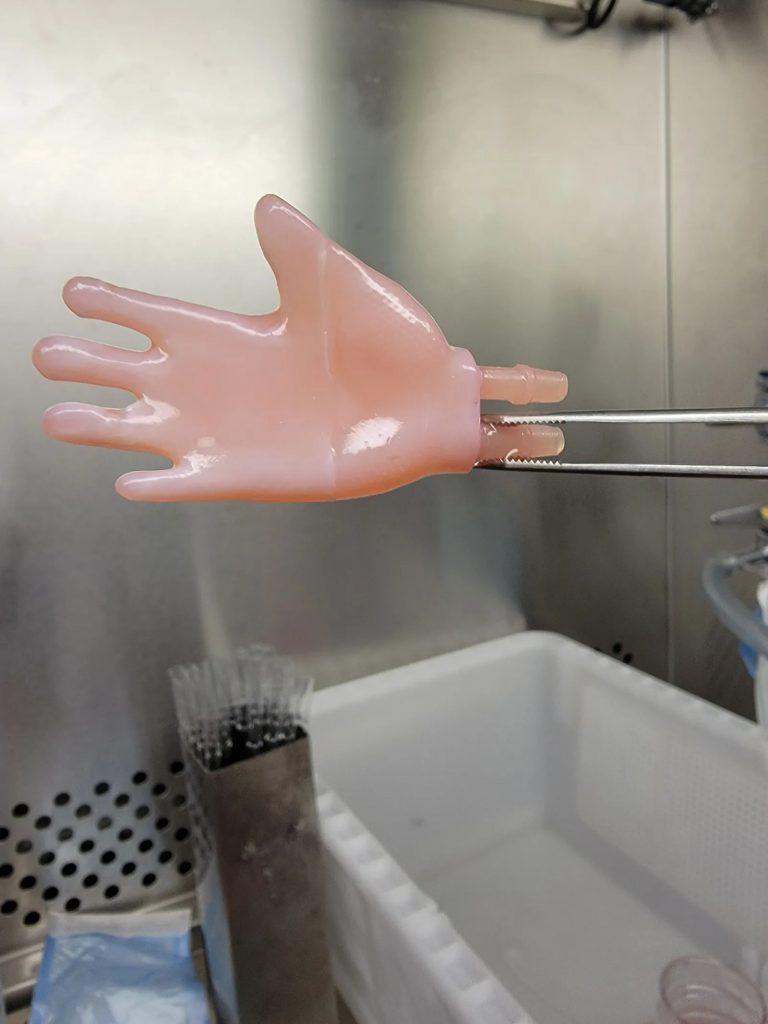 Skin construction in the form of a hand
The technology for growing skin structures is nothas undergone significant changes in 40 years; they are usually flat rectangular or round patches. That's a problem, says Hassan Erbil Abachi, an assistant professor, bioengineer and Pappalardo's advisor, because these shapes don't match the shapes of body parts such as fingers and faces. Applying 2D patches to 3D contours requires more patches, which means more stitches and longer surgeries. It looks worse aesthetically and works worse mechanically.
In an article in Science Advances, the teamdescribed her process for making a three-dimensional graft, which they call "endless," meaning it is shaped to fit a body part and has no seams. They started by 3D printing a scaffold that allows skin cells to grow into the desired shape. Pappalardo seeded human cells in layers around the scaffold and then waited for those cells to build a dense network of structural molecules. The engineered skin more closely follows form and function than any before it, and when tested on a mouse, it integrated as if it were native skin—it took 30 seconds to apply and 10 minutes to complete.
The Abacha team began their experiment withcultivation of the skin of a simple cylindrical shape. They used a 3D scan or digital model to print a permeable plastic scaffold for cells in two layers of skin—the inner dermis and the outer epidermis. Pappalardo cast fibroblasts (dermal cells) with collagen around scaffolding. Within two weeks, the layer matured, and then the scientist sowed keratinocytes - epidermal cells. This combination was exposed to air on one side and liquid on the other for a week - like our skin. And it worked. “We thought: if we can make a cylinder, then we can make any shape,” Abatsi says.
The breakthrough sparked a debate within the scientificgroups: one group of scientists wanted to grow a face, but the one who wanted to try the hand won. They envisioned a five-fingered structure that could be opened at the wrist, worn like a glove, and then stitched. “You will only have to bandage the wrist area and that will be the end of the operation,” Abatsi says.
Therefore, the laboratory printed a five-fingered framethe size of a packet of sugar, prepared the cells as before, and then tested how well the design held up compared to traditional grafts. When tested for mechanical deformation, “borderless” structures outperformed flat ones by 400%.
But can such a skin graftreally settle down? Pappalardo's demonstration in mice, which he ended up doing 11 times, says yes. He chose the hind limb of the mouse because the geometry of this area is very complex. Four weeks after skin replacement, the artificial construct was fully integrated into the surrounding skin of the mouse.
Read more:
Land in China drilled to a record depth
It's not about the Earth: scientists explained why the solar system is the rarest
Giraffe mating is even stranger than previously thought