Scientists use mathematical modeling to control the assembly of two-dimensional bacterial systems with
Biologists at MITInstitute used mathematical modeling to control genetically modified bacteria of Escherichia coli (E. coli). They managed to program bacterial systems to turn into arbitrary two-dimensional structures with the desired properties.
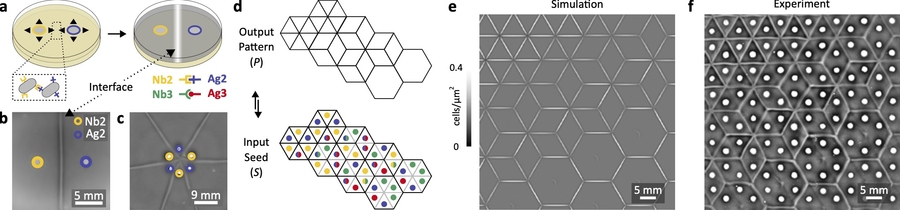 The controlled growth of modified bacteria allows the creation of structures of a given shape. Image: Riedel Kruse lab/University of Arizona
Researchers have created a toolkit forbioengineering to control the intercellular adhesion properties of motile bacterial cells. Genetically modified bacteria grow certain molecules on their cell walls that act as docking gateways for suitable partner cells.
As in the LEGO constructor, only cells withmatching molecules can connect, scientists explain. When two cell populations with their respective adhesion molecules collide, they form a visible solid border, the position and shape of which is determined by the initial seeding positions and cell concentrations.
With the help of computer simulations, scientists calculate the growth and spread of colonies of different variants of bacteria in order to create the desired flat structures at the junction of bacteria.
In their study, the researchers showed howusing controlled growth, it is possible to form flat living surfaces, including channels for transporting fluids. In addition, the researchers believe that the development will be useful for creating biosensors that are sensitive to various external stimuli.
Biologists will continue to study controlled livingsystems. In future experiments, they want to move on to creating three-dimensional structures and systems that produce various chemicals at certain points.
Read more:
"James Webb" sent a photo of the collision of two huge galaxies
"Useless" bacteria on Earth will provide life to the colonists of Mars
On the pyramid in China found a portrait of the "king of ancestors". He ruled over 4,000 years ago