A research group at the University of Tokyo led by Toshihiro Kobayashi
Scientists used fluorescent markers totracking the expression of genes that provide the transition from stem cells to germ cells. As Kobayashi points out, it was their deep understanding of the changes in germ cell gene expression over time that helped them create viable sperm.
At the first stage, the researchers grew fromrat embryonic stem cells are epiblast-like. Epiblasts give rise to almost all other structures in fetal development. Scientists placed the grown cells in a special medium, which formed them into primordial germ cells (somatic cells from which sperm are formed in the testes).
Formed pre-sperm researcherscultured in a special medium filled with somatic cells of the gonads. The conditions created in vitro simulated the maturation of sperm in a real organism.
The resulting cells were transplanted into the testiclesrats deprived of their own germ cells, in which they turned into mature spermatozoa. To confirm the performance of the resulting sperm, the researchers injected it into the eggs of rats. As a result of the procedure, healthy offspring were obtained, capable of reproduction.
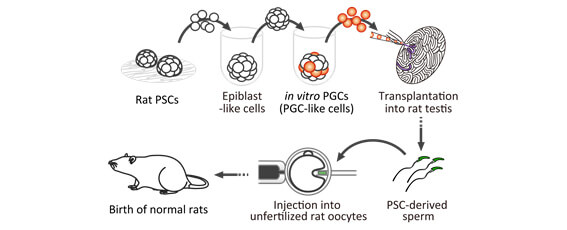 Process diagram. Source: Kobayashi, University of Tokyo Institute of Medical Sciences
Scientists note that previously a similar proceduremanaged to do about ten years ago for mice. However, no other animal species has been able to replicate this method. According to Kobayashi, they had to significantly modify the procedures used in mice in order to replicate the technology in rats.
Researchers say they have not been able toensure the creation of offspring using artificial sperm in natural mating. However, they plan to continue working in this direction.
The authors of the work believe that since ratsphysiologically more similar to humans, the use of artificially created sperm could enhance research into the causes and effects of various genetic diseases.
Read more:
There is another “planet” inside the Earth: how it saved nascent life
New study refutes light energy transfer theory
Everything you knew about the tyrannosaurus is not true: how science is changing its Hollywood image