Researchers from Moscow State University, the Institute of Inland Water Biology of the Russian Academy of Sciences and foreign universities have previously discovered
External new types of microorganisms already resembleexisting. These are unicellular organisms that move quickly with the help of a special flagellum. They feed on other living organisms, consisting of a single cell.
For "hunting" Provora uses specialized"harpoons" that capture prey. Moreover, it can even exceed the size of the "predator" cell. At the same time, the cells themselves are equipped with special "teeth" - a special ribbon of microtubules that helps grind and process food.
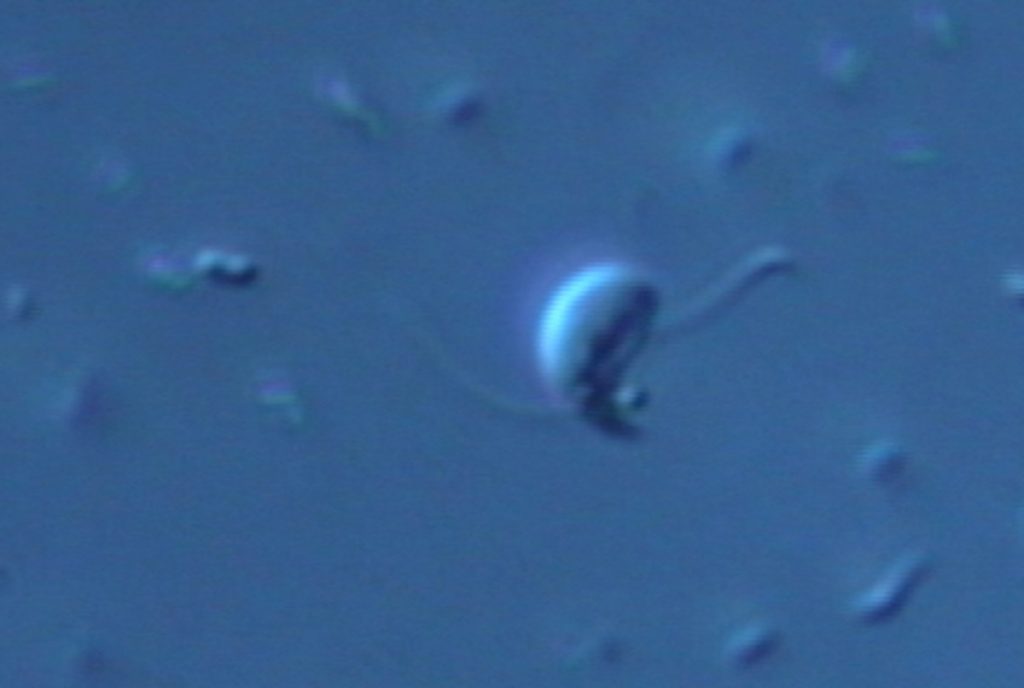 Tiny microorganisms under a microscope. Image: Moscow State University named after M.V. Lomonosov
Genetic research has shown that Provoracannot be attributed to any of the types of known eukaryotes - organisms in whose cells there is a nucleus. The separation of these species from other supergroups is estimated to have occurred more than a billion years ago, and all this time the organisms survived through predation and retained primitive ancestral traits, scientists say.
Technological progress of the twentieth century, discoveryMolecular and genetic analysis have changed scientists' understanding of the relationship of organisms and have made it possible to rebuild "family trees" for all known living organisms. For example, analysis of the genes of kelp, radiolaria, ciliates, and malarial plasmodium has shown relationships between these species.
Due to changes in approach to replace traditionalkingdoms—plants, fungi, protozoa, animals—came to be classified based on related supergroups. Under these conditions, the discovery of a completely new group seems surprisingly rare. Especially when you consider that microorganisms were found in water samples from the most common sources - the Red, Black, Caribbean Seas, as well as the Pacific and Arctic Oceans.
All this time they were under our noses, but because of their unremarkable appearance and relatively low numbers, it took painstaking work of cultivation and microscopy to detect them.
Kirill Mikhailov, researcher at Moscow State University and co-author of the work
The study was published Dec. 7 in the journal Nature.
Read more:
Hydrogen energy, material against cold weather and bioadditives against COVID-19: what scientists are creating in the North
The egg was dropped from space: look what happened to it
"The Walking Dead" existed millions of years ago: scientists told how they appeared