A combination of Antarctica's extreme climate, the secluded lifestyle of this species, and its deadly
In the first study funded by the NationalScience Foundation, biologists have set themselves one common goal: to learn more about leopard seals. For two years, the research team studied 22 leopard seals off the western Antarctic Peninsula, an area that is rapidly warming and changing. They weighed and measured each seal and monitored each seal's activities and dive patterns using satellite/GPS tags.
In a study published in the journalFrontiers of Marine Science - "Plasticity in the morphometry and movement of the Antarctic marine predator, the leopard seal" - Kienle (first author) and his team document the species' flexible behavior and traits that may give leopard seals the resilience they need to survive the extreme climate and environmental conditions of Antarctica .
“We show that leopard seals havehigh variability (or flexibility) of various traits. Throughout the animal kingdom, variability is vital for animals to adapt and respond to changes in their environment, so we are pleased to see the high variability of this Antarctic predator,” says Kinle.
One of the conclusions that biologists have made is thatadult female leopard seals much larger than adult males; in fact, females are larger and 1.5 times longer. The team measured one of the largest leopard seals ever to exist, an adult female nicknamed "Bigonia", which weighed 540 kg. Female-biased sexual dimorphism (where females are larger) is unusual among marine mammals, but leopard seals are the most striking example of female-biased dimorphism among 130 species.
Judging by the data on movements, the females of the marineleopards spent more time “getting out” of the water to rest on the ice or on land than males. Two adult female leopard seals in this study spent two weeks on an ice floe in the middle of the ocean without eating or entering the water. Kinle and colleagues suggest that during this two-week resting period, female leopard seals give birth and feed their cubs.
Male and female leopard seals swim onshort and long distances in both coastal and open ocean habitats. One leopard seal swam only 46 km from where the team worked with the seal, staying in and around the islands of the Antarctic Peninsula. However, another seal traveled 1,700 km from the tagging site during the same period, arriving at an island more than a thousand kilometers away.
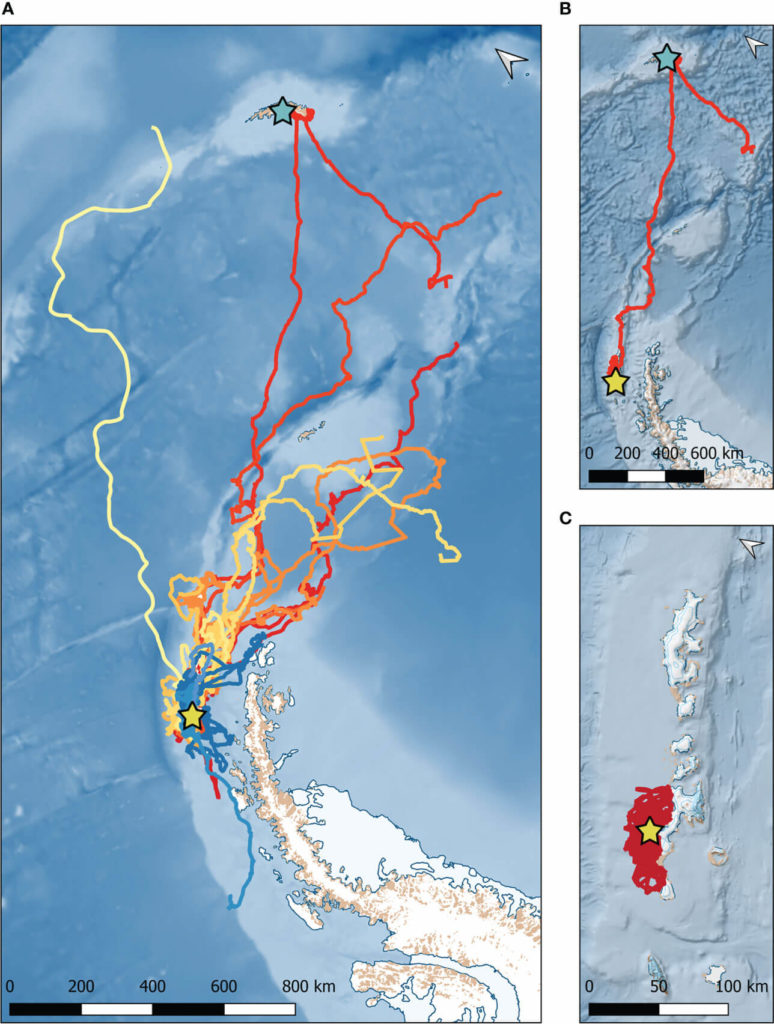 Scheme of the movement of sea leopards
Other seals can dive thousands of meters indepth and hold your breath for more than 40 minutes. However, the research team recorded the longest and deepest dive ever recorded for a leopard seal by a male nicknamed "Deadpool" who dived 1,256 meters in 25 minutes.
Read more:
Earth-sized sunspot grows 10 times in 2 days: it is directed at us
This is the "twin" of the Earth in the past: a unique planet-ocean was found not far from us
Einstein was right again: after half a century, physicists proved the stability of black holes