An international team of researchers recently discovered a fossil of the species that gave rise to brachiopods.
Scientists have reported in a new study that the fossil species, named Wufengella bengtsoni, is a member of an older group of shelled organisms called tommothiids.
The find adds a new piece to the puzzle forscientists: how animals evolved during the Cambrian explosion, a time during the Cambrian period (from 541 to 485.4 million years ago) when early life on Earth diversified rapidly.
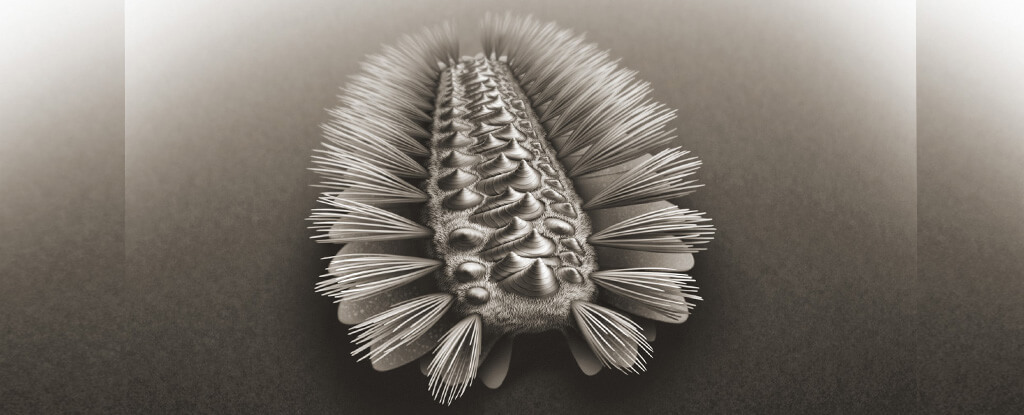 Reconstruction of the appearance of the armored worm
Brachiopods are bivalve creatures with a shell;bryozoans have a soft body with tentacle crowns, while phoronids are encased in protective tubes made of chitin, a material that strengthens organic structures such as exoskeletons, beaks, and carapaces.
Before the opening of W.bengtsoni taxonomists have suggested that the segmented worm-like tommotid may have been the ancestor of all these animal groups, based on similarities in the embryonic development of the groups in modern animals.
But while the researchers had some idea of what this hypothetical ancestor might look like, they weren't sure they would ever find it.
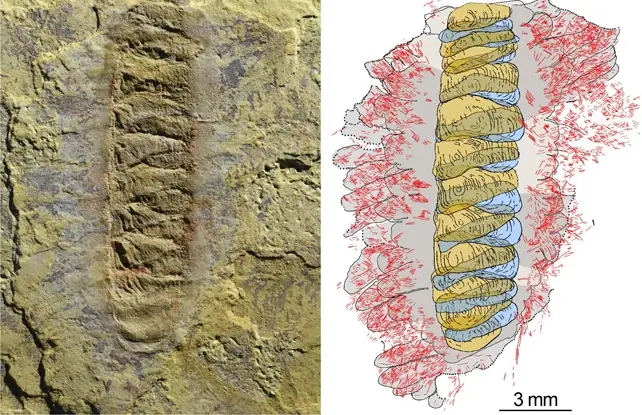 Discovered fossil
"One of the things that we often mentioned,when we sat in the pub and fantasized about what we might hope to find one day, there was this elusive tommothyid,” co-author Jacob Winter, associate professor of macroevolution at the University of Bristol.
The fossil was found at the siteFossils of the Chengjiang biota in Yunnan province in southwest China. This is a rare find because such animals are usually not well preserved for paleontologists to study them in detail.
“They roamed the reefs in the shallow tropical waters that existed then,” Winter said.
In these ancient reef systems of dead animalsusually bathed until their bodies decayed, and their soft tissues often decomposed in oxygen-rich reef waters before petrification could occur.
“This particular animal, fortunately for us, was washed into deep water, where it was buried in mud, where it was preserved,” Winter said.
Although the researchers predicted the general appearance of the body of W.bengtsoni, some features of the fossil came as a big surprise. It had flaps on its body that could be used for suction to attach the animal to the reef when there were waves, Winter suggested.
The species also had long bristles on the sides, which may have been used for detecting prey or for protection from predators.
The authors of the study are not sure what the animal ate,but its body was not adapted to filter water or immobility, so they know that it was not a filter feeder that attached itself to the sea floor like its descendants.
Researchers are sure that this is the ancestor of brachiopods,bryozoans and phoronids because it shared a skeletal appearance with these groups. As life evolved during the Cambrian explosion, animals filled different ecological niches and adopted different body builds.
“Sometimes ancestors can be very different from their closest living relatives,” Winter said.
Martin Smith, Associate Professor of PaleontologyDurham University in England, which was not involved in the study, called the new study a "flawlessly executed" example of science. “This is fantastic research,” Smith said.
“We really see how these bandsfit together and how they came from the same common ancestor. This brings us up a rung in the evolutionary tree,” Smith added. “This is the next frontier, we go a little deeper into time, and we really start to see the origin of the Cambrian explosion, when all the complex plans of the body appear.”
Read more:
It turned out what happens to the human brain after one hour in the forest
Look at the "cosmic angel". He was photographed while flying around the Earth
Strange sea creatures in the depths of the ocean turned out to be similar to humans