The high concentration of huge young stars at the center of the Milky Way has long puzzled astronomers. Because of
Young stars around a supermassive black hole
Massive young stars at the center of the Milky Waymoving in narrow orbits around a supermassive black hole. A study conducted in 2000 found that most of them move in the same clockwise direction around Sagittarius A*.
Further analysis of a sample of 13 stars,located within 0.4 parsecs (1.3 light years) from the galactic center, discovered an unusual feature: 10 of them lie inside a thin disk tilted relative to the galactic plane. Later, scientists suggested the presence of a second disk, also consisting of young stars, but slightly different in inclination to the plane of the Galaxy.
Until now, it was not known how the stars canform so close to a black hole. At such a close distance, all objects must experience powerful tidal forces: a very strong and inhomogeneous gravitational field of a black hole stretches objects that are nearby. This phenomenon is called spaghettification. Often it leads to the death of already formed stars. Clots of matter in such conditions simply cannot come together to start a thermonuclear reaction.
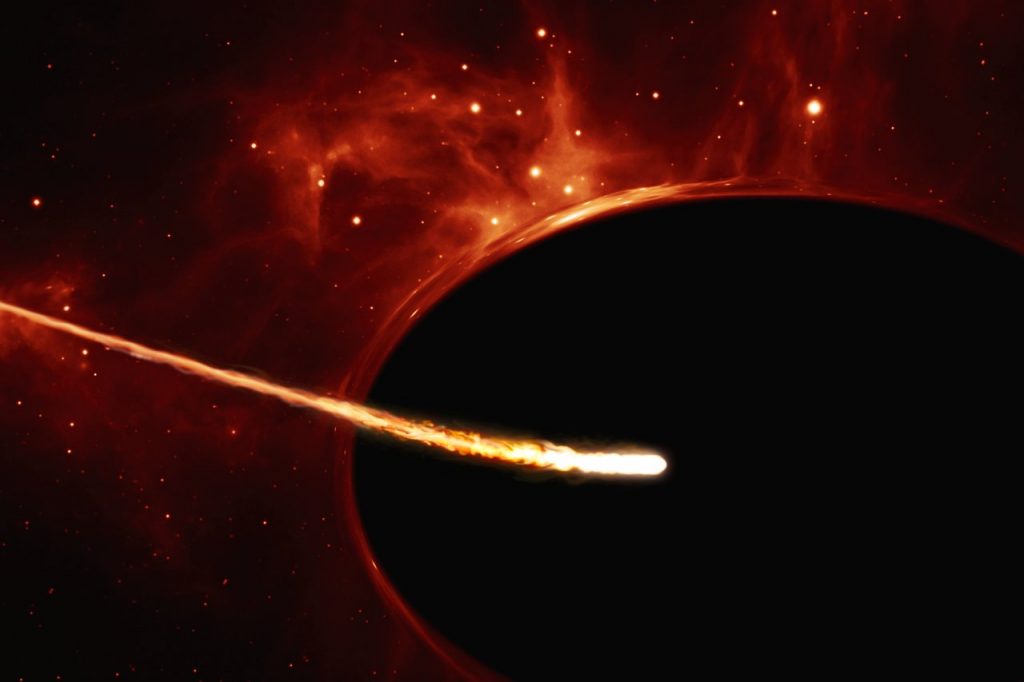 Artist's illustration of a star stretching when approaching the black hole's event horizon too close. Image: ESO, ESA/Hubble, M. Kornmesser
What hypotheses explain this phenomenon?
Having two separate star disks requiresindividual episodes of star formation. Between them could pass about a million years. The researchers proposed several models for the origin of these stars, which can be divided into two types: formation in place or migration after formation in a distant cluster.
First, as a result of tidal destructionmolecular cloud could form an accretion disk. Such a process leads to the formation of a fine structure with a diameter of about 100,000 times the size of the Sun. Under the influence of its own gravity, such a disk could theoretically fragment into several stars. Similar processes can also cause the collision of several molecular clouds.
Secondly, these stars could have formed ina massive cluster far enough away to avoid tidal disruption. After that, as a result of dynamic processes, they can migrate to the center of the galaxy.
Both options are plausible. But in order to form disks inclined at different angles to the plane of the Galaxy, complex dynamic processes are required.
What alternative did the astrophysicists suggest?
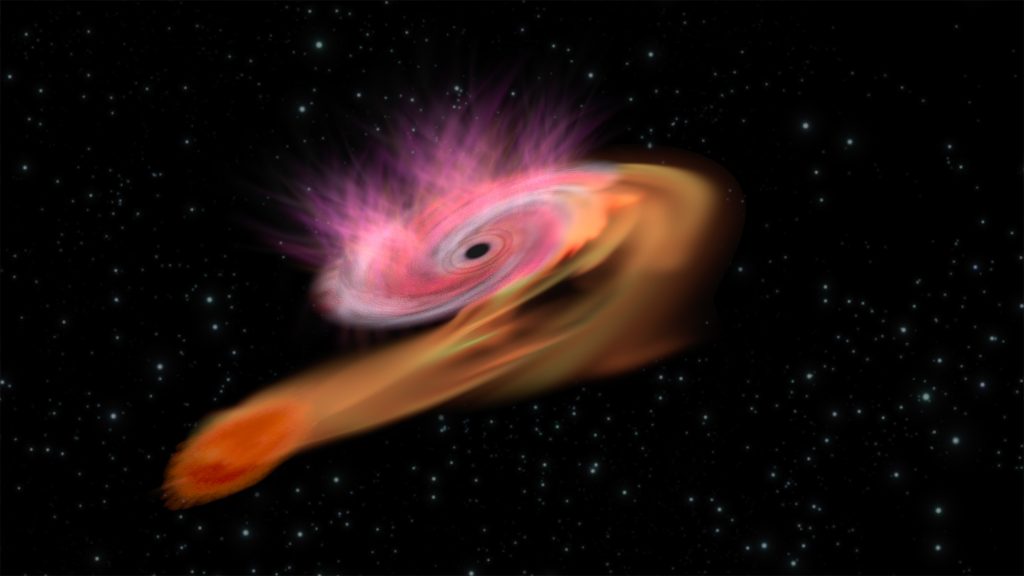 Artistic illustration of a burst of tidal disruption. Image: ESA/C. carreau
Researchers at Stony Brook and Monash Universities have suggested that when a star is destroyed by the tidal forces of a supermassive black hole, it sets the stage for new ones to form.
On rare occasions when a star breaks intopart of a black hole, it ejects a jet of matter, scientists explain. The gas cocoon surrounding this jet expands perpendicular to the jet. It compresses the surrounding gas and creates enough pressure so that the clumps of gas can overcome the black hole's tidal pull and form new stars.
While the expanding cocoon stimulatesstar formation is perpendicular to the jet, the jet itself creates a cone of superheated gas that suppresses star formation along its entire length. Simulations show that the combination of these factors leads to star formation in the thin disk, with the disk's orientation being related to the orbit of the collapsed star.
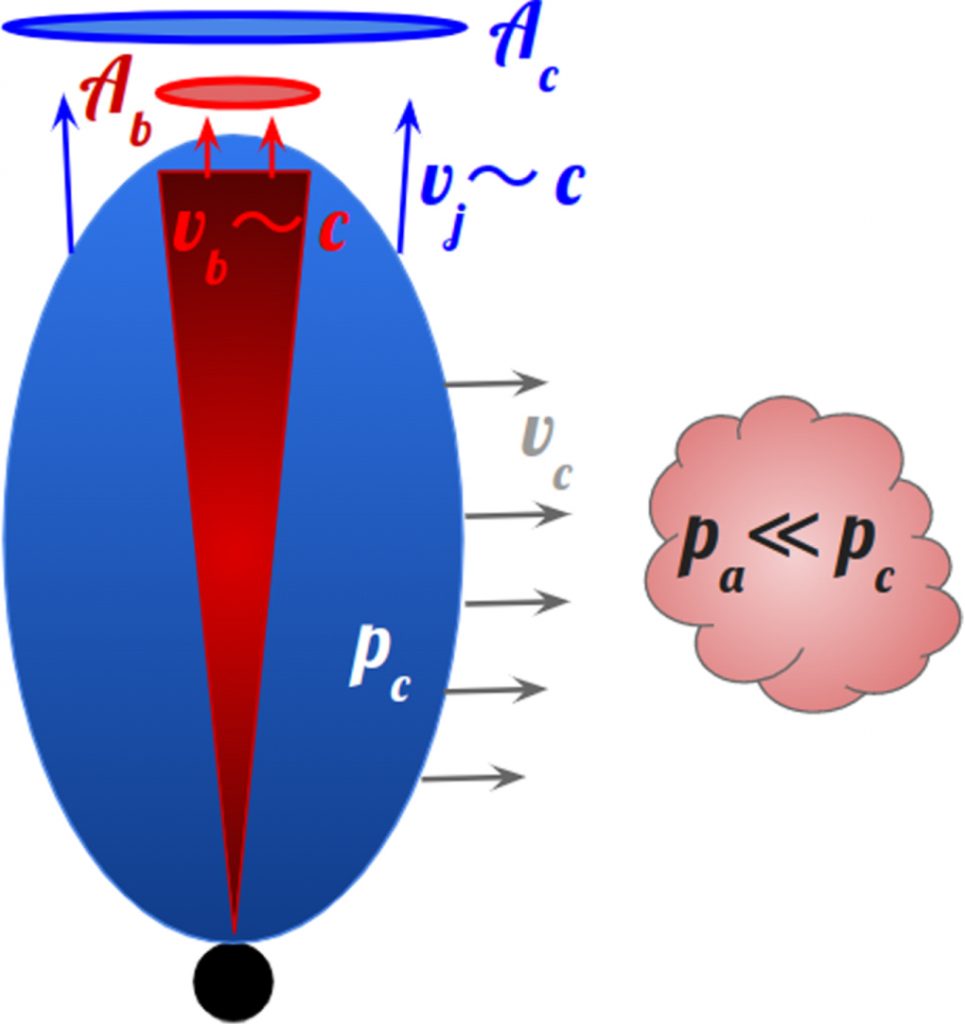 Modeling the formation of stars from a cocoon formed after a burst of tidal disruption. Image: Rosalba Perna, Evgeni Grishin, The Astrophysical Journal Letters
Researchers note that it is this method that ensures the formation of disks from several stars inclined at a random angle to the galactic plane of the disks.
How often does this happen?
The Milky Way's supermassive black hole is causingtidal disruption of a star every 10,000–100,000 years, and tidal disruption ejections occur once every 1–10 million years. However, since this method leads to the formation of massive stars, the disks should quickly disappear, and the stars formed as a result of tidal destruction will live only a few million years.
This model also explains the unusual arrangementstellar disks, and the fact that so far only two of them have been found. All the rest have simply already collapsed, scientists believe. Although the hypothesis needs further experimental verification, it is by far the simplest explanation for the observations.
Read more:
An ancient amulet rewrote the history of Europe's most mysterious language
Cows were fed hemp and checked what happened to their milk
Created a navigation system that is more accurate than GPS
Cover: Composite image of the center of the Milky Way taken at different wavelengths. Image: NASA, ESA, SSC, CXC, and STScI