Why does the future seem bleak to teenagers?
Attitudes and the Value of Higher Education
The right choice of profession is impossible withoutcalled agency - the ability to act independently and analyze their capabilities. According to the HSE study of educational aspirations, middle-class teenagers are more likely to show agency, while children from families with low social status are more passive in choosing a career and prefer to live one day at a time.
A vague idea of the profession is oftenmakes students blindly choose a faculty, and the proportion of high school students who do not know what they will do after graduation has more than quadrupled over the past 10 years. Schoolchildren do not have sufficient information about what educational opportunities are available to them. According to the international study PISA 2021, schoolchildren from different countries at the age of 15 know, on average, about 10 professions that are associated with the immediate environment - parents and their friends. However, there are thousands of specialties in the world. Some of them may completely disappear by 2030 due to automation. McKinsey estimates that 75-375 million people may need to learn new skills and change career paths. Children do not know what options are available within the different majors. For example, not only developers work in the IT sector, but also designers, analysts, and project managers. As shown by a joint study by Skillbox and VK, the vast majority of Russians (73%) believe that modern schools need career guidance in order for high school students to have an idea of the prospects in the labor market.
How Career Guidance Is Developing in Russia
Outreach activities can beregular and one-time, paid and free, conducted online or in person. HSE research shows that practices differ depending on the stakeholder, which is the state, commercial educational agencies, NGOs, and business. For example, the state organizes large-scale national projects, such as "Ticket to your future" or "Russia - the land of opportunity." The Ticket to the Future early career guidance project, which any school can join, is designed for children from grades 6 to 11, as well as their parents. The goal of the program is to develop in schoolchildren the ability to make an informed choice of education and qualifications. Students undergo diagnostics to determine their readiness to choose a specialty and the most interesting areas for themselves, participate in practical activities and professional tests.
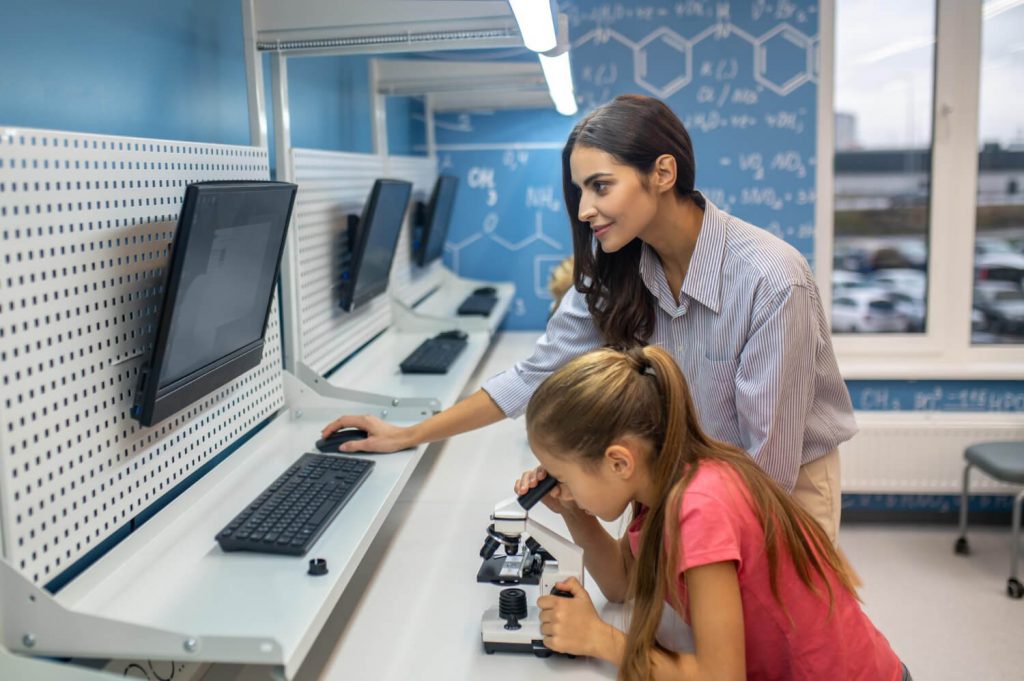 By the 8th grade, schoolchildren should determine their career development vector, however, teachers cannot always analyze each student
How schools improve student career literacy
The federal law on education determines thatone of the tasks of school education is vocational guidance and preparation of children for an independent choice of professional activity. However, in Russian educational institutions there is still no single standard of assistance in choosing a specialty. Most often, psychologists, deputy directors for extracurricular activities and teachers are responsible for career guidance in schools. The latter, at their own discretion, can devote one hour a week to training in special classes, conduct excursions to enterprises or give recommendations based on the results of psychodiagnostic or career guidance testing.
By the 8th grade, students should determine theircareer development vector, however, teachers cannot always analyze each student, understand the modern labor market and its needs. Educational institutions have begun to resort to digital tools with interactive and engaging formats to help children choose their future profession. For example, in October 2022, schools in the Moscow Region launched the Career Literacy course, the methodology and IT stuffing of which was developed by the Profilum company, which specializes in digital career guidance services. In the classroom, children explore 28 industries and more than 400 professions that help shape their career horizons.
How IT solutions affect education and vocational diagnostics
EdTech projects differ from schoolsflexibility. Online courses can be updated at any time to improve the materials. With the help of technology, you can create an individual educational track or involve them in learning using gamification, increasing the child’s motivation and interest. Finally, EdTech projects are able to grow quickly, add new interesting scenarios and varied content.
Digital also enhances opportunitiesteacher, for example, regarding career guidance. There are tens of thousands of professions on the market, including those at the intersection of different industries. A school teacher who teaches career counseling as part of an extracurricular activity simply cannot know all the career opportunities that exist on the market. And not only teachers - even career consultants do not have the full amount of data on all industries and all professions.
“Our mission as a technology company is toto teach schoolchildren career literacy and give them access to an objective and complete picture of the modern labor market. It is important that the information on professions is up-to-date, so the system is constantly updated. We have created a service that helps a child figure out if a particular profession suits him or not, and explore huge knowledge bases. Technology helps to narrow the choice with the help of special psychometric tests, which, based on the skills and interests of the child, select a personal rating of professions for him. The student has the opportunity to get acquainted with each industry, see what kind of education is required on the way to the profession. By the end of the training, technologies form a list of the most suitable professions and offer a personal educational trajectory for the student,” says Vitaly Altukhov, Russian scientist in the field of psychometrics, director of development and research at Profilum.
Natalya Tsarevskaya-Dyakina, head of the EdTech direction of the IT cluster of the Skolkovo Foundation, believes that any educational processes that can be automated should be given to technologies:
“EdTech does a great job of creatingdigital content, knowledge testing systems, gamification and others. Artificial intelligence allows you to analyze huge amounts of data and a student's digital footprint, identifying gaps in knowledge, finding the relationship between different parameters in the learning process: learning rate, interests, goals. All this makes it possible to build those very individual educational trajectories that the school is striving for. And the teacher should be given the place of honor as an escort from the goal to the result.”
The algorithm cannot replace the teacher, since the task of teachers is not only to “deliver” knowledge, but also to motivate the student. However, AI can significantly help educators.
“One example of the use of AI in education isit is the personalization of the educational process, adjusting it to each student. For example, there are developments that analyze the facial expressions of students during the lesson and, based on this, draw conclusions about how much they are involved in the process, whether they understand the material. These data make it possible to predict at the lecture stage whether the material needs to be repeated, whether this topic is interesting to students and which ones, ”says Pavel Spetsian, managing partner of the TOR Computer Academy.
Prospects for the development of online career literacy courses
Career guidance helps high school students understandown interests and make an informed choice of profession. So, parents can be calm about the choice of their children, which is made taking into account their abilities and interests. Career guidance programs take into account the modern labor market and help children choose a specialty to their liking, which will be in demand for many years.
However, the mass introduction of career trainingliteracy influences more global processes. If we look at the statistics, 27% of Russian children have not decided on the profession they will take up in the future. It also follows from this problem that schoolchildren approach the choice of an educational institution without a specific goal, in an unsystematic manner. This, in turn, has consequences in adult life: 43% of technical school graduates and 30% of university graduates do not work in their specialty. And these are only those people who have found a way and opportunity to move to another field.
Understanding the applicability of their skills and talents will help teenagers build a career trajectory and more clearly and consciously understand their potential in professions.
Read more:
The strongest class X flare occurred on the Sun
"Anti-cancer sponge" stopped the spread of metastases in 100% of cases
The secret of the durability of Roman concrete is revealed: it can be restored