Since their discovery in 1877, the tiny moons of Mars have causedAstronomers have a lot of questions.
For example, the Soviet academician Shklovsky at the endThe 1950s suggested that Phobos was an artificial hollow metal object. The scientist was prompted to this idea by the strange spiral orbit of the satellite and the erroneous calculation of its density. This hypothesis was soon refuted, but the question of the origin of the Martian moons remains open to this day.
Phobos. Video: ESA/DLR/FU Berlin (G. Neukum)
How could the moons of Mars form?
Now there are three main hypotheses for the origin of Phobos and Deimos:
- former asteroids;
- fragments of Mars formed due to a collision with a large planetesimal;
- a secondary object formed in orbit from a single moon.
The moons of the Red Planet make up a tinypart of the earth's moon. The diameter of Phobos is only 22.7 km, and Deimos is 12.6 km (for comparison, the diameter of the Earth's satellite is 3.5 thousand km). They are fixed by tidal forces and always face Mars on one side. But the first orbits in 7 hours 39 minutes, which is much faster than the Martian day (24 hours 39 minutes), which is why tidal forces gradually bring it closer to the surface of the planet, and the second, on the contrary, rotates longer (in 30 hours 18 minutes) and is gradually removed.
Due to the small size and irregular shapePhobos and Deimos are like asteroids. In addition, the spectral analysis of the luminosity of the satellites of Mars also corresponds to the "simplest" objects of the solar system. According to their characteristics, they correspond partly to class C asteroids and to a greater extent to class D. These are the most common carbon asteroids and asteroids with low albedo (poor reflective properties) and red glow, respectively.
Not surprisingly, one of the earliest hypothesesThe origin of Mars' satellites suggests that they were once Main Asteroid Belt objects that were ejected by interactions with other asteroids and captured by the Red Planet's gravity.
This hypothesis has only one drawback:both moons have near-perfectly circular orbits that traverse the equatorial plane of Mars. In this case, the axis of the planet is inclined to the plane of the ecliptic of the solar system by 25.2°. Such synchronization required a long time, which satellites might not have had.
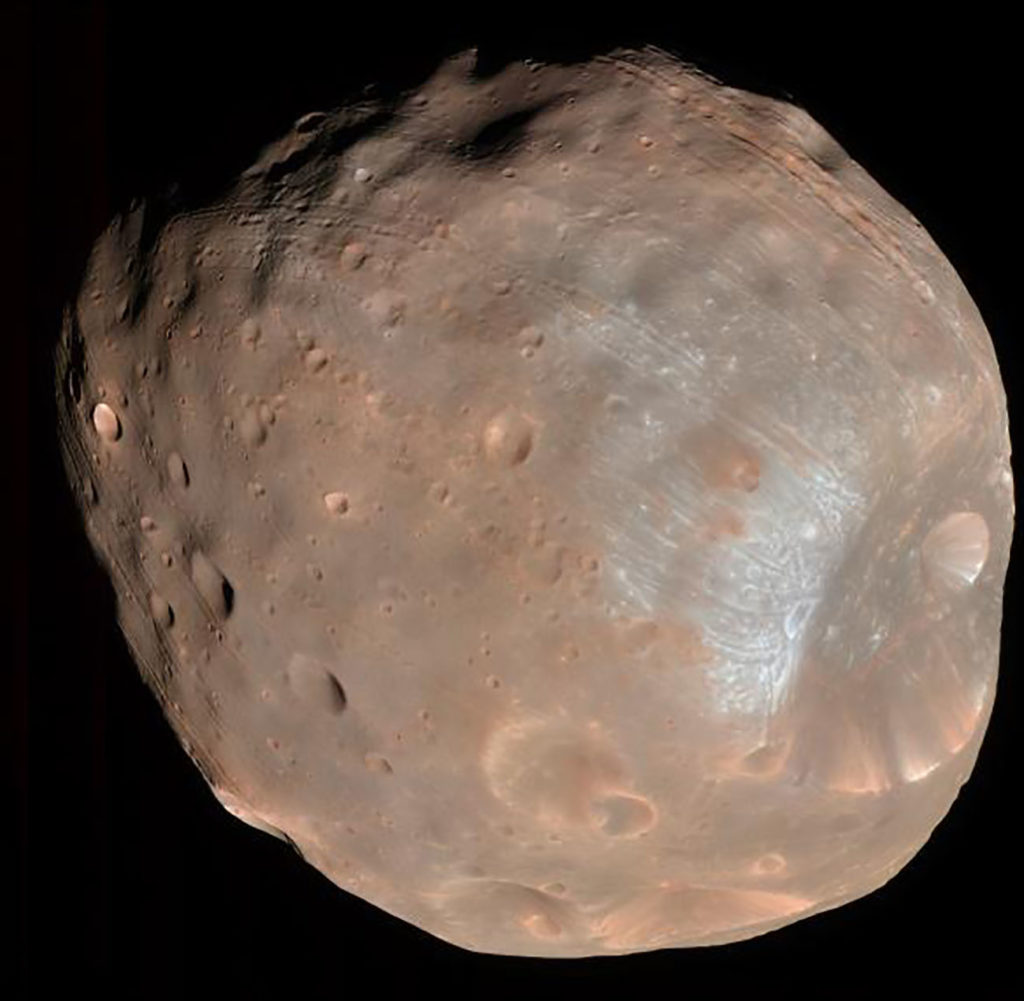 Phobos. Photo: NASA, JPL-Caltech, University of Arizona
The second theory suggests that Mars was oncesurrounded by many moons the size of Phobos and Deimos, which were thrown into orbit when Mars collided with a large planetesimal. This is one of the objects of the early solar system, formed as a result of the gradual collision of sticking particles of the protoplanetary disk. It is believed that it was because of the collision of the Earth with a similar object that the Moon was formed.
As a result of a collision in the orbit of Mars,form a ring of ejected materials. At the same time, the inner part of the ring formed a large satellite. And the gravitational interactions between it and the outer ring formed Phobos and Deimos. According to this hypothesis, later, under the influence of tidal forces, the inner moon crashed into the surface of the planet.
This hypothesis is supported by the supposedhigh porosity and composition of Phobos. The estimated density of this satellite suggests that from 25 to 35% of its total volume are voids, which is not typical of asteroids. In addition, based on the results of the study in the thermal infrared range, scientists concluded that its composition contains mainly phyllosilicates, common on the surface of Mars, but rare for known classes of asteroids.
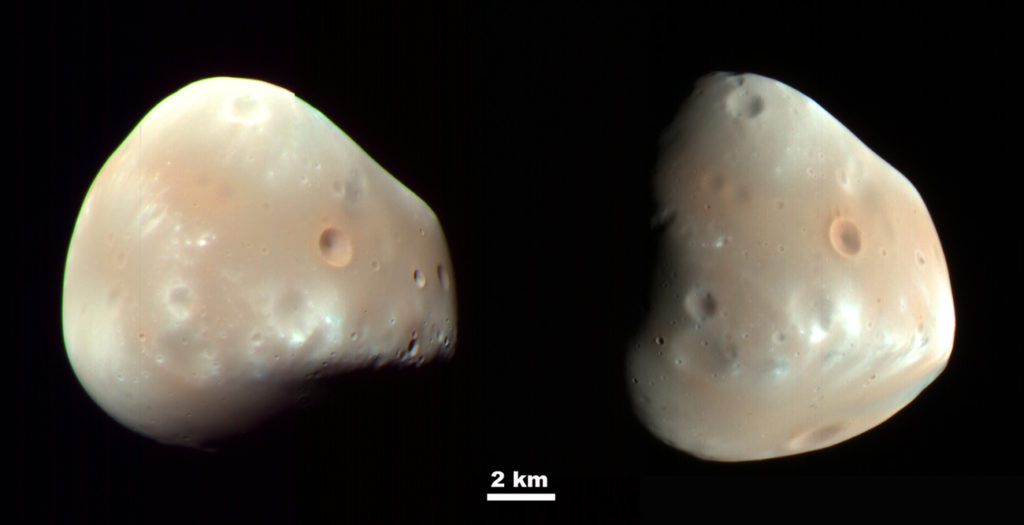 Deimos. Photo: NASA, JPL-Caltech, University of Arizona
Discontinuous origin
In 2021, scientists from the Higher Technical SchoolZurich and the US Naval Observatory proposed a new hypothesis for the origin of the satellites of Mars. Analyzing seismic and orbital data from NASA's InSight mission, planetary scientists have suggested that the satellites of Mars could have formed as a result of a collision of the ancient moon of the Red Planet with another object. Because of this, the primary satellite split and formed new ones - Phobos and Deimos.
According to this hypothesis, this progenitor satellitewas torn apart from 1 to 2.8 billion years ago. In addition to external influences, the hypothesis that the old satellite was torn apart by the planet's tidal forces was also considered. Regardless of the cause, according to the calculations of scientists, as a result of the destruction of the protosatellite in orbit, a ring of debris was formed, which over time, as a result of numerous collisions, formed two separate satellites.
This idea was based on the observation that inIn the past, the orbits of Deimos and Phobos may have intersected. At the same time, unlike the theory based on the collision of Mars with a planetesimal, it explains well the current orbits of the two satellites.
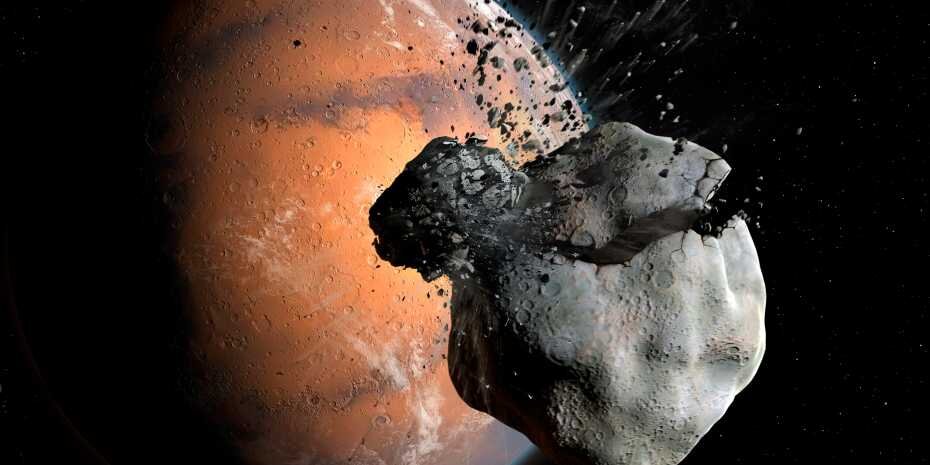 Artistic illustration of the discontinuous origin of the moons of Mars. Image: Mark Garlick, ETH Zurich
What did the new study show?
To test the proposed hypothesis, scientists fromThe Institute of Space Research and Astronautics of Japan (ISAS) built a computer model based on the theory that Phobos and Deimos were once a single body. The planetary scientists then performed numerical simulations that combined geophysical models and the tidal evolution of the system from Mars and the moon.
The study showed that two moons,formed from one object, with a probability of 90% should have collided within 10 thousand years. Moreover, in the process of such a collision, both satellites would be completely destroyed into small fragments. As a result, a ring similar to those seen around Saturn would form around Mars. However, it would have survived to this day.
However, numerous observations were not found onorbit of Mars, no relatively significant debris other than the two main satellites. This model casts doubt on the hypothesis of a discontinuous origin of the Red Planet's satellites.
Each of the three hypotheses proposedresearchers at different times, provides a partial answer to the question of the processes that formed satellites in the orbit of Mars, but none of them fully explains all the observations. Perhaps scientists could understand more about the origin of the two unusual moons if they were able to study them. But so far, missions to Phobos are failing one after another.
Back in 1988, the Soviet Union launched twosatellite of the Phobos program, but due to problems, none of them were able to make their planned jump landing on the moons of Mars. Later in 2011, the Russian Phobos-Grunt probe burned up in the atmosphere due to equipment failure after entering Earth orbit. At the same time, the developed missions of NASA, the European and Canadian space agencies to the satellites of Mars were rejected.
In the mid-2020s, the Japan Space Agencyplans to send a mission to Phobos, which will have to deliver the soil from the satellite. If it does not suffer the same setbacks, perhaps scientists will still learn how the Martian moons formed.
Read more:
Russia has invented an alloy that can withstand the energy of a thermonuclear reactor
The largest migration in the history of the Earth will affect all living organisms on the planet
Nearly half of cancer cases linked to preventable risk factors