The researchers analyzed data collected by the Compact Muon Solenoid (CMS) during experiments on
CERN notes that for measurementsextremely precise calibration of the CMS data and a deep understanding of the remaining experimental and theoretical uncertainties and their interdependencies were required. The researchers have worked out in detail the uncertainties associated with the accuracy of measurements of particle properties by the CMS detector and with theoretical descriptions of the formation of top quarks.
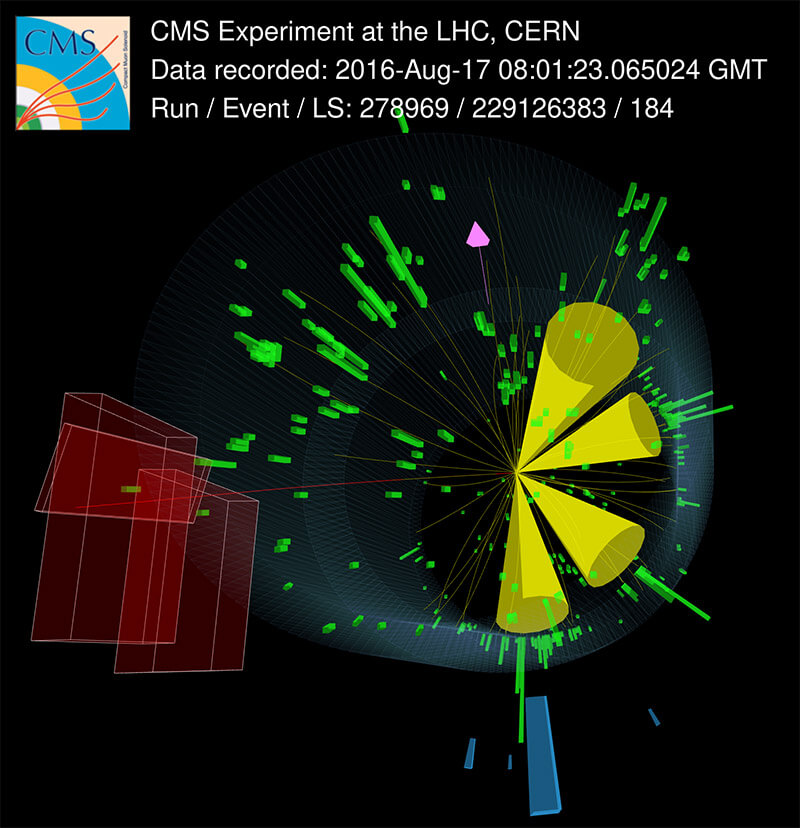 Signature of two quarks: 4 hadron jets (yellow cones), one muon (red line) and missing neutrino energy (pink arrow). Image: CMS, CERN
Researchers note that accurate knowledge of the massThe top quark is essential for understanding our world on a microscale. Getting as close as possible to the mass of this heaviest elementary particle allows us to test the internal consistency of the Standard Model. For example, given the exact masses of the W boson and the Higgs boson, the Standard Model can predict the mass of the top quark, and the mass of the W boson can be determined using the mass of the top quark and the mass of the Higgs boson.
Scientists say that understanding the degreeThe stability of our Universe depends on the exact masses of the Higgs boson and top quark. Current measurements show that the Universe is very close to a metastable state. But if the mass of the top quark is even slightly different, the Universe will be less stable in the long term and potentially end up disappearing in a Big Bang-like event.
The researchers hope to get even better measurement accuracy when the new approach is applied to data from experiments in 2017 and 2018.
Cover image: CMS, CERN
Read more:
It has been hunted for centuries: what do we know about the planet Vulcan next to the Sun
Astronomers have found a planet near the Earth: it has a very strange orbit
Scientists from China have proved that modern plate shifts date back 2.5 billion years