10th place. Tracking a pulsar in the Crab Nebula
Initially, astronomers thought that
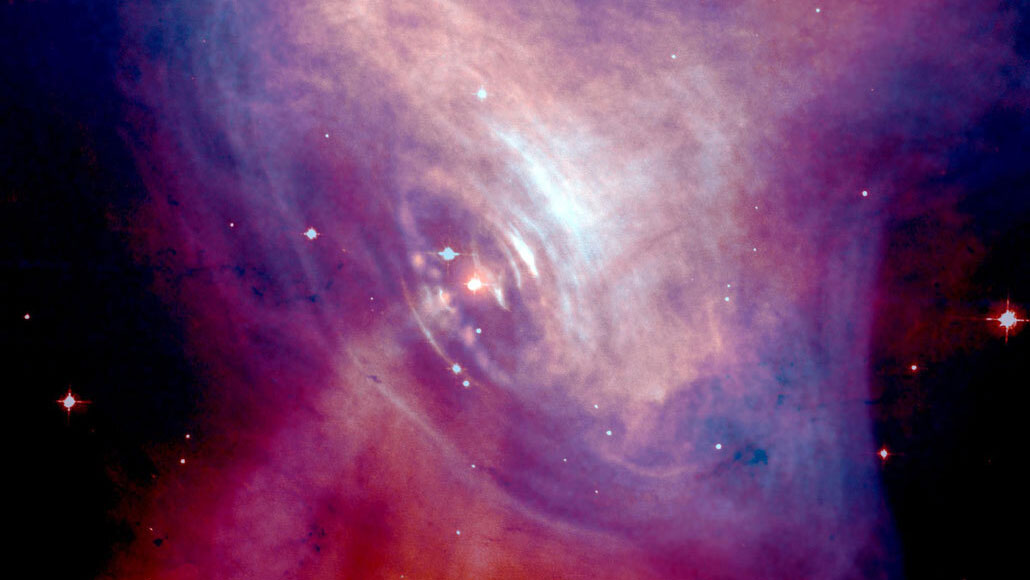 Arecibo observations of radio flash frequenciespulsars in the center of the Crab Nebula (red star in the center) confirmed the idea that pulsars are rapidly rotating neutron stars. Image: NASA, HST, ASU, J. HESTER ET AL
9th place. Discovery of new pulsars
In 1982, Arecibo registered a pulsar,dubbed PSR 1937 + 21. It blinked every 1.6 milliseconds, becoming the fastest pulsar known. This finding was initially perplexing because PSR 1937 + 21 is older than the Crab Nebula pulsar, and pulsars were thought to rotate more slowly with age.
Then astronomers realized that old pulsars could“unwind”, taking mass from the companion star. Scientists use such ultra-fast pulsars to search for ripples in space-time - gravitational waves.
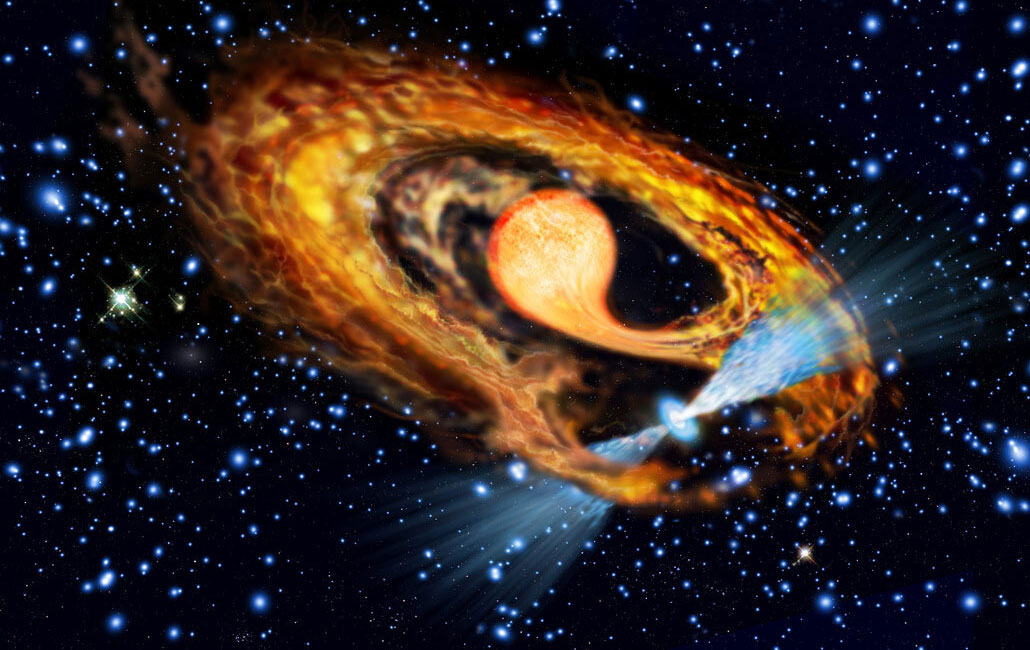 Pulsars typically rotate more slowly as they age.But data from Arecibo showed that pulsars can "spin up" to spin hundreds of times per second, pumping material away from a nearby star (as seen in this artist's image; the pulsar is shown in blue). Photo: ESA, FRANCESCO FERRARO / BOLOGNA ASTRONOMICAL OBSERVATORY
8th place. Ice on Mercury
It seems that Mercury is an unlikely placeto detect water ice. The fact is that the planet is too close to the Sun. But Arecibo observations in the early 1990s made it clear to scientists that there is still ice on the planet, hiding in permanently shadowed craters at Mercury's poles. NASA's MESSENGER spacecraft later confirmed these observations. The discovery of ice on Mercury raised the question of whether it could exist in shadowed craters as well as on the Moon. Recent spacecraft observations indicate that this is the case.
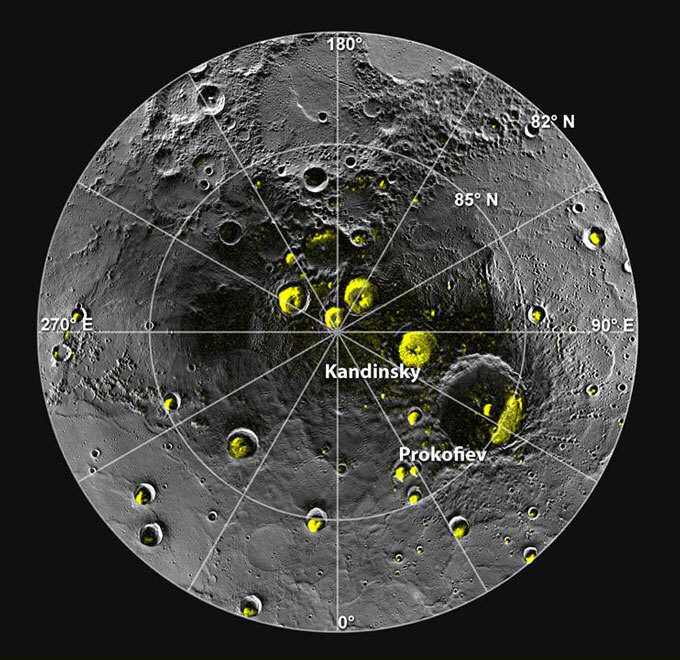 Images of Mercury taken by spaceby NASA's MESSENGER spacecraft in 2011 and 2012, confirmed that hints of water ice (yellow) seen on planet Arecibo are in dark areas at the poles of Mercury (north pole shown; two craters marked) Photo: NASA, JHUAPL, WASHINGTON INSTITUTE CARNEGI, ARESIBO OBSERVATORY
7th place. Discovery of Venus
Venus is covered with a thick layer of clouds,but Arecibo's radar beams could cut through this haze and be reflected from the rocky surface of the planet. This allowed researchers to map its varied terrain. In the 1970s, Arecibo's radar "vision" produced the first large-scale images of the surface of Venus. Its radar images showed evidence of past tectonic and volcanic activity on the planet, including ridges, valleys and ancient lava flows.
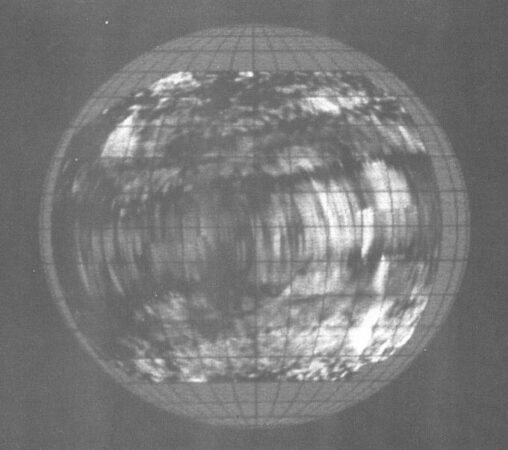 Arecibo provided this early view of the surface of Venus with radar in 1971. Photo: D.B. CAMPBELL / CORNEL UNIVERSITY
Later technological advances allowed Arecibo to obtain clearer views of Venus. This 2015 image shows the planet's northern hemisphere.
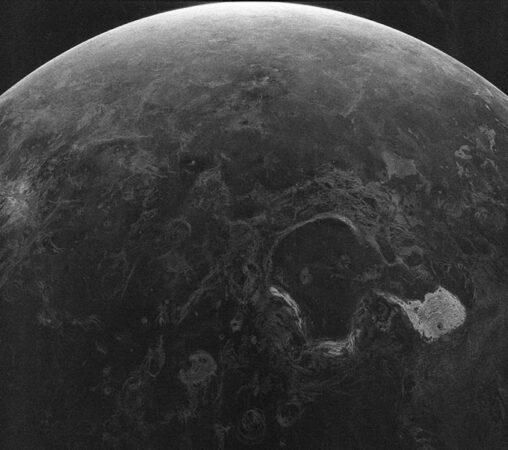 Photo: SMITHSONIAN INSTITUTE, NASA GFSC, ARECIBO OBSERVATORY, NAIC
6th place. The mystery of the temperature of Mercury
In 1965, radar measurements at Areciboshowed that Mercury rotates on its axis every 59 days, not every 88 days. This observation cleared up a long-standing mystery about the planet's temperature. If Mercury rotated around its axis every 88 days, as previously thought, then the same side of the planet would always be facing the Sun. The fact is that the planet also takes 88 days to complete one revolution around the Sun.
As a result, this side will be much hotter than the dark side of the planet. But the 59-day rotation better matched observations of a uniform temperature distribution on the surface of Mercury.
 Early radar observations of Arecibomeasured the 59-day rotation rate of Mercury (shown in this fake-color image from the spacecraft MESSENGER, which shows the chemical and mineralogical features of the planet's surface). Photo: NASA, JHUAPL, WASHINGTON CARNEGIE INSTITUTE
5th place. Asteroid mapping
Arecibo has cataloged the features of many near-Earth asteroids. In 1989, the observatory created a radar image of asteroid 4769 Castalia.
Arecibo also discovered a strangely shaped asteroid,resembling a dog bone. Understanding the characteristics and motion of near-Earth asteroids helps determine which ones could pose a threat to Earth and how they can be deflected safely.
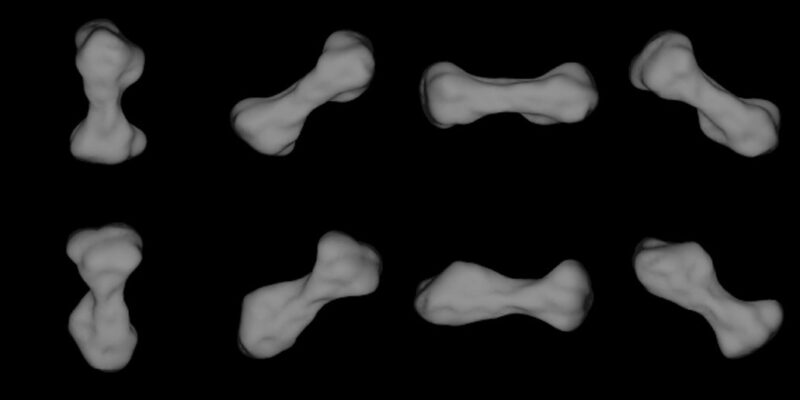 Radar images of Arecibo in 2000 showed a strangely shaped canine bone of an asteroid called 216 Cleopatra (shown from different angles).
Photo: WSU, NAIC, JET LABORATORY / NASA
4th place. The first radio message intended for aliens
Arecibo Observatory transmitted the firsta radio message intended for an alien audience in November 1974. This famous message was the most powerful signal ever sent from Earth, intended in part to demonstrate the capabilities of the observatory's powerful new radio transmitter.
Message directed to a cluster of 300,000stars approximately 25,000 light-years away consisted of 1,679 bits of information. This line of binary code detailed the chemical formulas of the components of DNA, a drawing of a stick figure, a diagram of the solar system, and other scientific data.
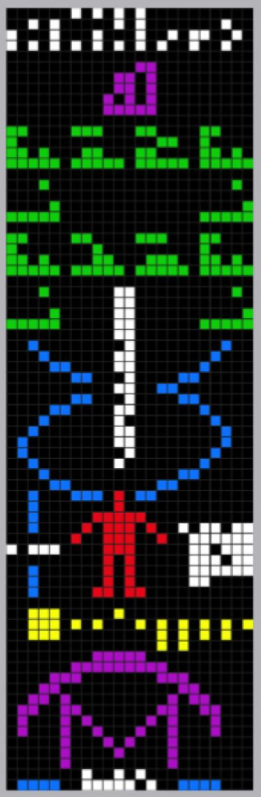 The first radio message intended for an alien audience. Photo: ARNE NORDMANN (NORRO) (CC BY-SA 3.0)
3rd place. Fast radio bursts of unknown origin
Fast radio bursts or FRBs are shortbright flashes of radio waves of unknown origin. Arecibo first discovered FRBs in 2012 and again in 2015. The discovery of a repeating FRB ruled out the possibility that these bursts were caused by one-time cataclysms such as stellar collisions.
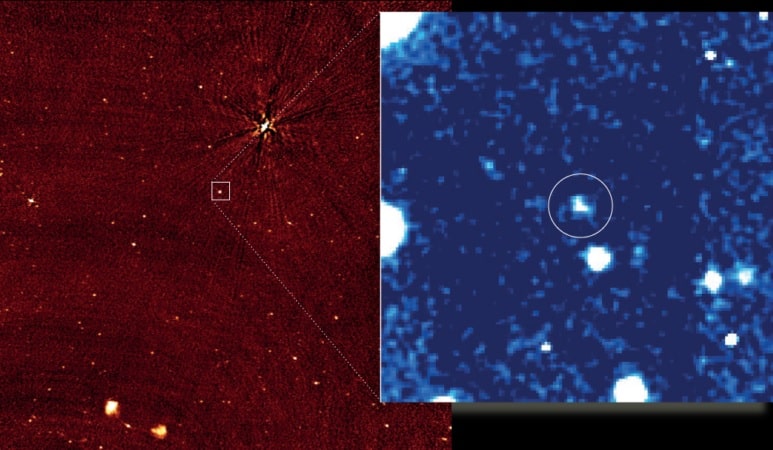 A repetitive radio wave source detectedArecibo (radio image, left) was the first fast radio burst traced back to its home galaxy. The flare originated in a dwarf galaxy about 2.5 billion light-years away (visible light image on the right) Photo: H. FALKE / NATURE 2017
2nd place. Indirect observation of gravitational waves
Gravitational waves were first discovered in2015, but astronomers saw the first indirect evidence of ripples in spacetime decades ago. The first pulsar discovered orbiting another star, PSR 1913+16, spotted by Arecibo in 1974, provided indirect evidence of ripples in spacetime called gravitational waves
This indirect observation of gravitational waves was awarded the 1993 Nobel Prize in Physics.
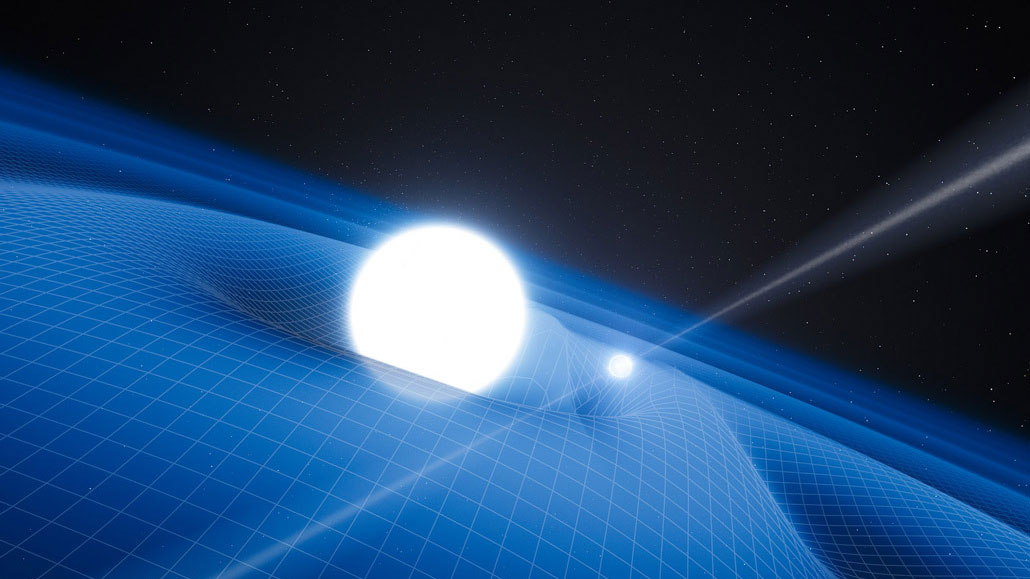 Photo: ESO, L. CALZADA
1 place. Pulsar planet detection
The first planets to be discovered aroundanother star - three small, rocky worlds orbiting the pulsar PSR B1257 + 12. The find was accidental. In 1990, Arecibo was being repaired, and so it got stuck in one place in the sky. During observations, due to the rotation of the Earth, the PSR B1257 + 12 star came into the field of view of the telescope. Small fluctuations in the arrival time of radio bursts from the pulsar indicated that the star was wobbling as a result of the gravitational pull of invisible planets.
Since then, thousands of exoplanets have been discovered,orbiting other stars, including stars similar to the Sun. However, recent studies of exoplanets indicate that planets orbiting pulsars are rare.
 The first worlds ever seenoutside the solar system, there have been three rocky planets (illustrated by this artist) orbiting the pulsar PSR B1257 + 12. NASA, JET LABORATORY-KALTECH, R. HORT / SSC
What will replace Arecibo?
Nestled among the mountains in southwest Chinathe world's largest radio telescope could help Beijing become a global center for scientific research. The 500-meter aperture spherical telescope (FAST) - the only significant instrument of its kind since the crash of the Arecibo telescope - is about to open its doors to foreign astronomers in hopes of attracting the attention of world leaders and scientific talent.
Wang Qiming, Chief Inspector of the Operations Center andFAST, told AFP during a rare visit to the foreign press last week that he had visited Arecibo: "We took inspiration from his design, which we gradually improved to build our telescope."
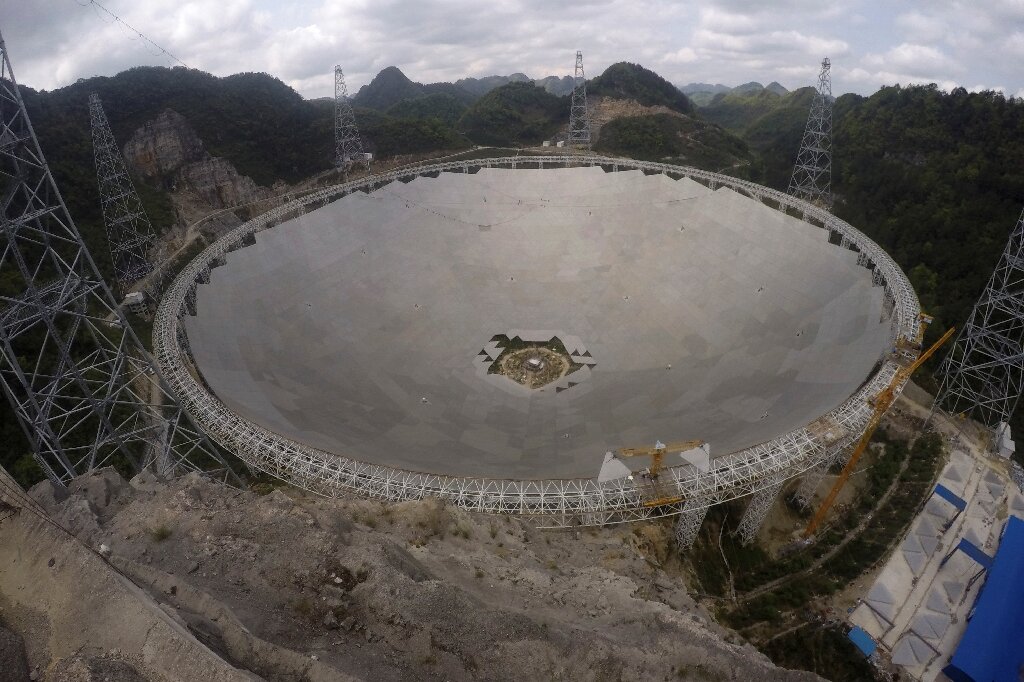 A 500-meter aperture spherical radio telescope (FAST) in Guizhou province in southwest China
Chinese plant in Pingtang, Guizhou province,three times more sensitive than Arecibo, and surrounded by a five-kilometer “radio silence” zone in which mobile phones and computers cannot be used.
Work on FAST began in 2011 and he beganbecame fully operational in January of this year, working primarily to capture radio signals emitted by celestial bodies, particularly pulsars - rapidly spinning dead stars.
The giant satellite dish, 500 meters long, is the largest in the world - covering an area of 30 football pitches - and is worth 1.1 billion yuan ($ 175 million).
The data collected by FAST should allow betterunderstand the origin of the universe and help in the search for alien life. China said it would accept requests from foreign scientists wishing to take measurements in 2021.
Read also
Named a plant that is not afraid of climate change. It feeds a billion people
A wearable sensor signals that a person has COVID-19
Earth is in the process of the sixth extinction. How will this affect humanity