Small changes in DNA structure have been linked to breast cancer and other diseases, but there have been none so far
“If the DNA sequence is folded, it iswill prevent the transcription of a gene associated with a specific region of DNA, explains study author and UCR chemistry professor Wenwan Zhong. "In other words, this phenomenon has a positive effect - by suppressing a gene that can cause cancer or the development of tumors."
Conversely, DNA folding can also have a negative effect.
“Turning DNA could potentially interfere with the production of viral proteins to minimize the immune response,” Zhong adds.
To understand how such DNA turns affectliving beings, positive or negative, you need to find them first. For these purposes, UCR scientists used (but completely changed) a concept that had previously been used to determine the chemical components in wines of different varieties.
The chemicals in the system are designed tosearch for virtually any target molecule. Usually, however, such a "nose" cannot detect DNA. It was only after scientists added non-standard components to the system that he found the target DNA.
The new chemical nose consists of three parts:host molecules, fluorescent guest molecules, and target DNA. When unusual turns are found in DNA, fluorescent molecules light up, alerting scientists to their presence in the sample.
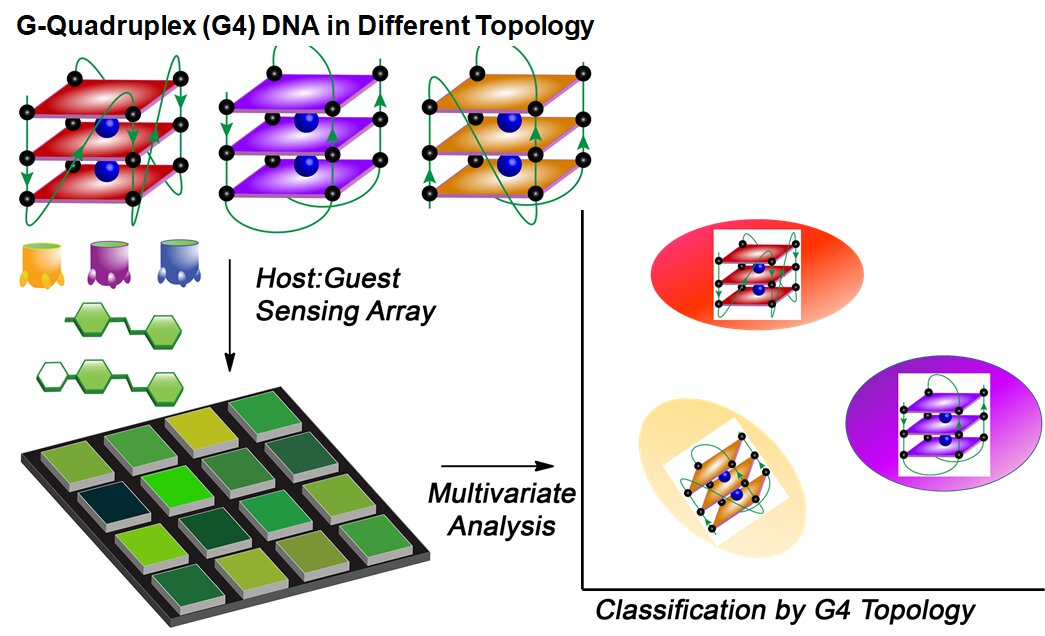 Illustration of a system responsive to G-quadruplex detection. Credit: Richard Hooley / UCR
DNA is made up of four nucleic acids:guanine, adenine, cytosine and thymine. Most of the time, these acids form a double helical structure resembling a ladder. Guanine-rich patches sometimes rotate differently, creating a so-called G-quadruplex. The parts of the genome that make up these quadruplex structures are extremely complex. In doing so, they regulate gene expression and play a key role in maintaining cell health.
In their work, the researchers wanted to find one specific type of quadruplex, consisting of four guanines. They succeeded.
Scientists will soon explore how the forcesdamaging DNA, affect their turns. Biologists will also study RNA folding. The structures of ribonucleic acid are more complex than those of deoxyribonucleic acid. At the same time, understanding the structure of RNA, which performs important functions in the cell, will advance humanity in the study of diseases, scientists conclude.
Read more
Elon Musk: the first tourists to Mars will die
The first accurate map of the world was created. What's wrong with everyone else?
Ingenuity completes fourth longest flight
G-quadruplexes - nucleic acid sequencesacids rich in guanine and capable of forming four-chain structures. Nucleic acid chains from guanosine oligo- and polynucleotides are able to bind to each other in the presence of a small monovalent cation, most often potassium.
DNA - deoxyribonucleic acid -macromolecule providing storage, transmission from generation to generation and implementation of the genetic program for the development and functioning of living organisms. A DNA molecule stores biological information in the form of a genetic code, consisting of a sequence of nucleotides.