A baby born with a heart defect became the first patient on record to receive the injection
Baby Finley was born with an unusual defect - twoThe main arteries that carry blood away from the heart were reversed in his case. Four days after birth, the baby underwent 12 hours of open-heart surgery to return the arteries to their normal position. Complications arose and Finley's cardiac function worsened.
After several weeks in the intensive care unittherapy, Dr Massimo Caputo, professor of congenital heart surgery at Bristol Medical School, suggested the baby's parents consider another treatment option: injecting stem cells directly into the heart.
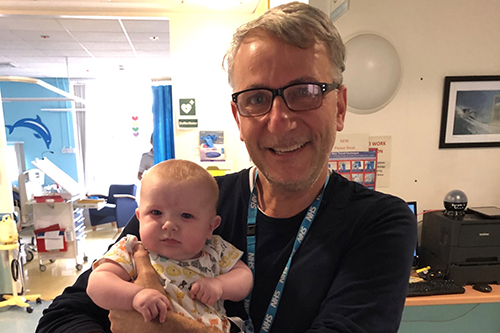 Professor Massimo Caputo holds Finley on the day of his discharge from the hospital. Photo: BHF
“He warned us that he couldn’t predictoutcome of the procedure. But we had absolutely nothing to lose,” Melissa Hudd, Finley's mother, said in a statement. “We had to try to give Finley every possible chance at life.”
At the University of Bristol, Caputo has alreadydeveloped a “stem cell patch” that can be sewn into the heart during surgery. Unlike standard synthetic patches or replacement heart valves, in theory, they do not need to be changed as the child gets older. The patches reduce or eliminate the need for repeat open-heart surgery in children, the researchers say.
 New stem cell patch [left] original surgical material [right]. Photo: BHF
"We're trying to create living tissue, whether it's a valve,a blood vessel or patch that will grow with the baby and not deteriorate. I think it will make a big difference in their quality of life,” explains the doctor.
According to a statement from Bristol Medicalschools, the patches have been proven safe in animal experiments, and with a grant from the British Heart Foundation, Caputo plans to begin human clinical trials within two years.
In Finley's case, he received stem cells“on compassionate grounds” and not as part of a clinical trial. In addition, he was not given a patch. Instead, he received a stem cell injection during a second open-heart surgery.
“Within two weeks of stem stem treatmentcells, we noticed changes in Finley,” said the baby’s mother. “We don't know what the future will bring, but we are so grateful that Finley's life has changed since stem cell treatment. Now he has a chance to live."
Read more:
17-year-old engineer came up with a magnetless motor: it can be used in electric vehicles
A shock wave from the Sun has opened a crack in the Earth's magnetic field
It turned out how old the water we drink today
Cover photo: CC 3.0 - Jacobs School of Engineering, UC San Diego