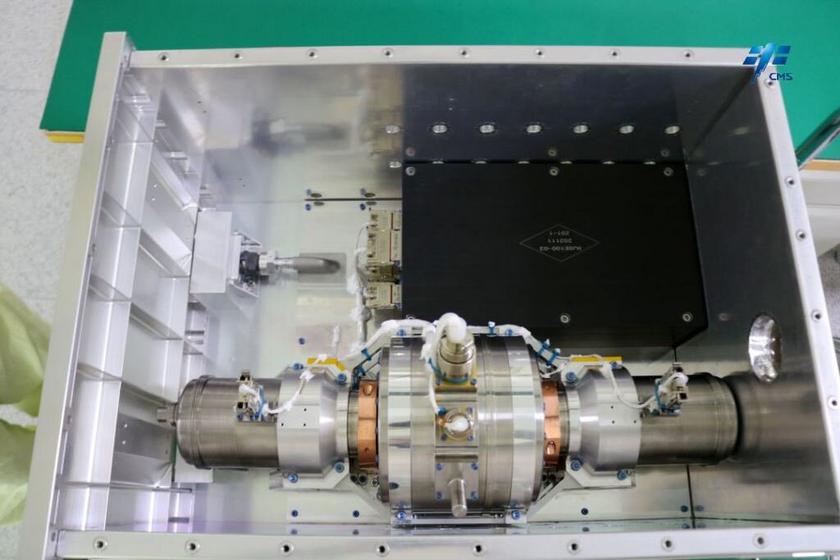
The People's Republic of China was the first in history to test the Sterling engine in space.
What is known
Chinese National Space Agency(CNSA) has been able to make significant progress in the space sector. The Celestial Empire has advanced on the creation of the Long March 5 rocket, completed the construction of the Tiangong-3 space station, and now announced the successful testing of the Stirling engine in orbit.
Also, do not forget that in June 2021CNSA has announced plans for the International Lunar Research Station (ILRS). She will try to impose competition on the American program Artemis. In addition, China intends to send manned missions to Mars by 2033.
Space bases cannot be fully relied uponexclusively on the energy of the Sun, since it is not available everywhere. In this regard, the leaders of the space sector are working on nuclear installations, which will become a key source of energy. China is no exception.
Stirling engines, which are a typeinternal combustion engines are inferior to nuclear reactors in terms of peak power, but their advantage is the work on any heat source. In addition, they are characterized by light weight, simple design, quiet operation and fast start-up cycle.
The device can convert heat intoelectrical energy due to piston-driven magnets. When expanding, the working fluid pushes the pistons with magnets through the drive coil, as a result of which a current is generated in the windings. This continues until the external heat source runs out.
This technology is attractive forengineers and mission planners. They see it as a sustainable means of powering both spacecraft and bases where astronauts will reside. The Stirling engine, combined with nuclear reactors, will reduce dependence on solar energy. It is limited by solar cell efficiency and may not be available. For example, around the South Pole of the Moon, where the American and Chinese stations should appear by 2030, the night lasts for two weeks.