Developed by Chinese scientists, the tweezers use electrostatic induction to “attract” and
The researchers named the electrostatic drop tweezer technology DEST.
The DEST system consists of two parts:tweezers with an external voltage applied to the electrode tip, and a substrate that is electrically grounded. Drops are deposited on a substrate, and when the electrostatic tweezers are connected to a power source, the electric charges of the droplets and the substrate are redistributed by electrostatic induction. This allows the electrostatic tweezers to accurately "catch" the droplets and guide them to the electrodes at the tip with the appropriate voltage.
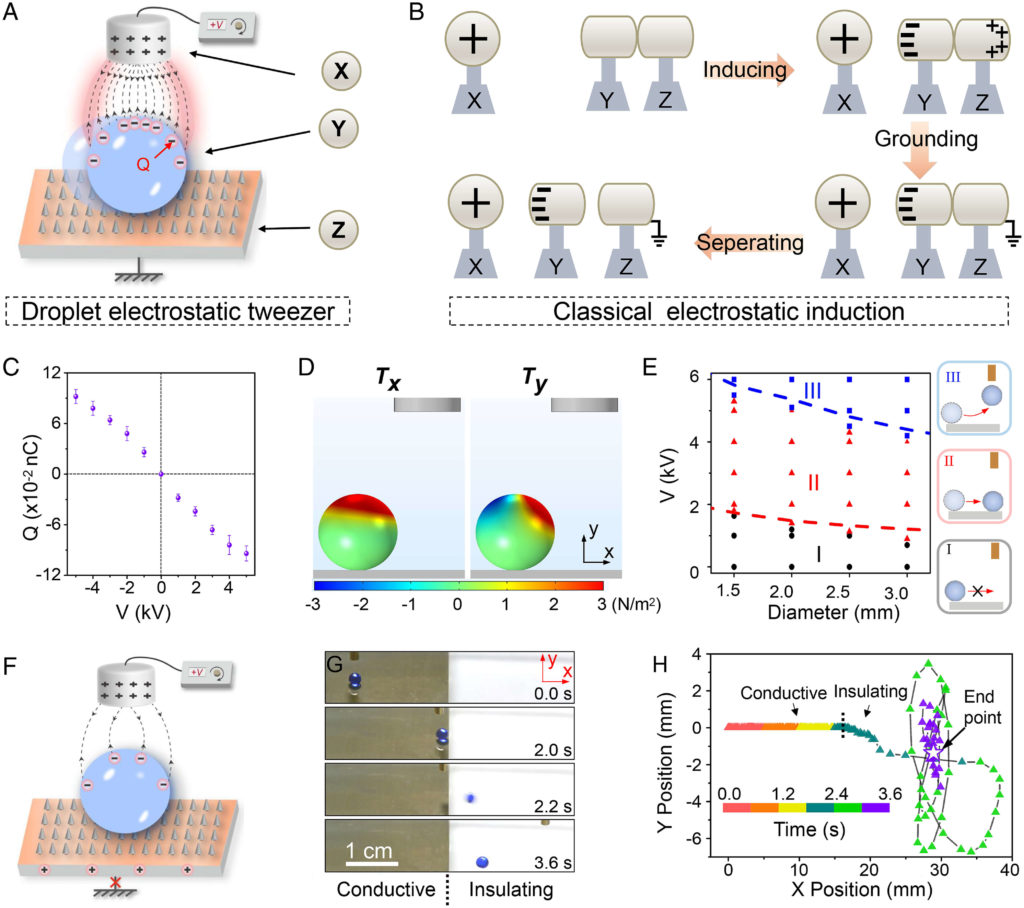 How DEST works
“DEST is programmed,” said Professor Wang,head of the research group. “Our experiments have shown that DEST can direct the movement of liquid droplets in open spaces, closed channels, and even in oil. DEST also allows us to manipulate droplets from tens of nanoliters to several milliliters and in different quantities,” said Professor Wang.
Compared to other technologiesdrop handling, DEST provides precise and programmable drop handling with high speed, unlimited distance and flexible direction control. Another advantage of DEST is that it eliminates the need for precise focusing of the laser on the droplet, which greatly reduces measurement time and enables high throughput detection of droplet information.
Modern approaches to manipulating droplets inmainly take advantage of the surface force gradient or the force directly applied to the droplets. These methods always require the substrates or droplets to respond to external influences.
Droplet manipulation has important applications in areas such as heat management, water collection, and chemical reactions.
</ p>Read more:
Nuclear fusion no longer needs millions of degrees: how the new method works
Aircraft A380 completes first vegetable oil flight
Engineers have created a chip for sorting spermatozoa. It will help with infertility