Chinese scientists reported successful tests of a shuttle model that can take off using
The researchers launched the plane in 1/80 scalea meter-long carrier model, using a piston to simulate the ignition of a rocket engine. In a fraction of a second, the aircraft took off from the carrier in the JF-12 wind tunnel at a speed of Mach 7. Although the tests lasted only a second, it was enough to make all the necessary measurements and confirm the capabilities of the technology, the authors of the work say.
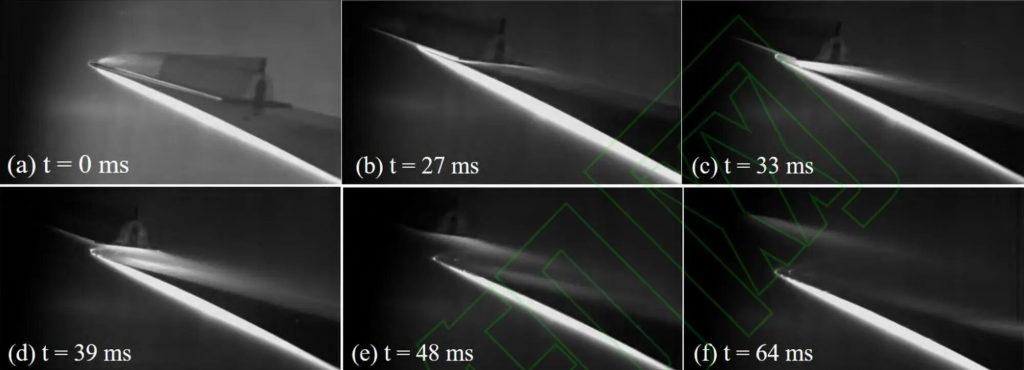 Separate takeoff of a model from a ship in a hypersonic tube. Image: South China Morning Post, Handout
Launching with a springboard was actively usedin the past on aircraft carriers. When a ship is moving into the wind at full speed (about 60 km/h), its short runway provides aircraft with enough lift to leave the deck under their own power. The key problem with this technology is that at extremely high speeds, high turbulence occurs, which prevents a smooth separation between the carrier platform and the take-off vehicle.
For the hypersonic version, the researchers smoothedslope the ramp upwards to create a perfectly flat surface and reduce the drag that can occur when two vehicles separate at extremely high speeds through the atmosphere.
During an experiment in a wind tunnelthe researchers noticed that the plane lifted slightly as it reached the end of the flat runway, due to the push from shock waves generated under the upper front of the spaceplane. But just before takeoff, another group of shock waves formed near the tail, forcing it to sink. The two opposing forces canceled each other out, resulting in a smooth, perfectly straight separation, the researchers said.
Researchers believe that full-sizean upper-stage spaceplane weighing 87 tons (about the same as a space shuttle) would be able to take off in about 8 seconds, powered by rocket engines with several times less power than a traditional one. This, as the authors of the work believe, will significantly reduce the cost and availability of flights to low Earth orbit.
Read more:
Hydrogen energy, material against cold weather and bioadditives against COVID-19: what scientists are creating in the North
10 scientific facts that turned out to be fakes. Cards
Unusual decoration in an ancient grave surprised scientists