The International Astronomical Union's Minor Planet Center has confirmed the discovery of a new long-period
Comet C/2023 A3 is namedTsuchinshan-ATLAS in honor of the two Zijinshan observatories in China and the ATLAS asteroid warning system associated with its discovery. A new object requiring confirmation was reported by Chinese astronomers in early January, but since it was no longer observed, by the end of this month it was removed from the list of potential objects for study.
Later, astronomers drew attention to earlieran unknown object detected by the ATLAS system in images taken on February 22 by an observatory in South Africa. An analysis of the orbit showed that this is the same object that Chinese astronomers had previously observed. At the time of observation, C/2023 A3 was at about 7.3 AU. from the sun.
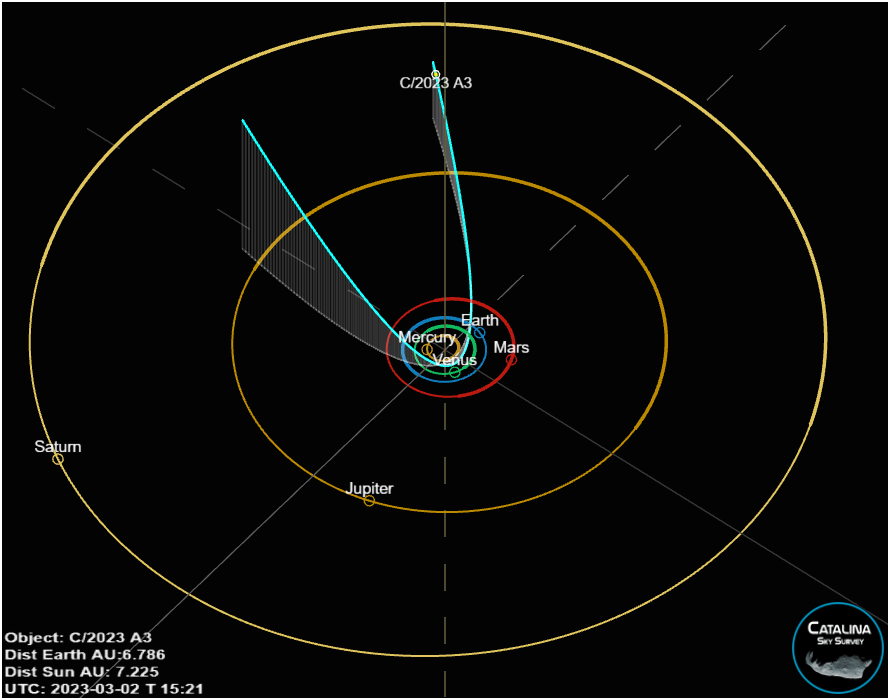 Approximate parameters of the orbit of C/2023 A3 and the planets of the solar system. Image: CSS, D. Rankin
Preliminary analysis of the parameters shows thatC/2023 A3 is a long-period comet that approaches the Sun approximately once every 30,000 years. Now it is slowly approaching the star, becoming brighter.
According to preliminary calculations, the comet will reachmagnitude 0.3 in October 2024. This is much brighter than the maximum magnitude of the green "Christmas" comet seen earlier this year. This estimate is preliminary and subject to change, since the change in luminosity depends on many factors that cannot be accurately predicted.
Read more:
It turned out that the monster from medieval manuscripts actually exists
How much you need to train a day to live longer: scientists called the exact figure
Asteroid Redirect Mission Exceeds Expectations