Chronic insomnia is usually the result of stress, life events, or disruptive habits.
Why is sleep deprivation dangerous?
Sleep is as important to health as healthynutrition and regular physical activity. Whatever the cause of sleep loss, insomnia can affect a person both mentally and physically, according to the Mayo Clinic. People with insomnia report a lower quality of life compared to people who sleep well.
 en.freepik.com
Complications of insomnia may include:
- Poor performance at work or school
- Slower reactions while driving and increased risk of accidents
- Mental health disorders such as depression, anxiety disorder, or substance abuse
- Increased risk and severity of chronic diseases or conditions such as high blood pressure and heart disease.
Who is at risk?
Almost everyone has sleepless nights. But under some conditions the risk of insomnia is higher:
- Hormonal hormones may play a roleshifts during the menstrual cycle and during menopause. During menopause, night sweats and hot flashes often interfere with sleep. Insomnia is also common during pregnancy.
- Due to changes in sleep patterns and health status, insomnia increases with age.
- Many problems that affect your mental or physical health lead to sleep problems.
- Stressful times and events can cause temporary insomnia. Severe or prolonged stress can lead to chronic insomnia.
- There is no fixed schedule. For example, changing shifts at work or while traveling can disrupt your sleep-wake cycle.
The molecular structure of sleep
Several recent studies have shown that protein phosphorylation is important in the regulation of sleep. Using this data, you can adjust your sleep and wake patterns.
Phosphorylation is the process of residue transferphosphoric acid from a phosphorylating agent-donor to a substrate, usually catalyzed by enzymes and leading to the formation of phosphoric acid esters
Under the phosphorylation reactionproteins understand the addition of a phosphate group through a phosphoester bond (O-phosphorylation) to the hydroxyl group of the side chain of a serine, threonine or tyrosine residue, the phosphate donor being ATP.
Scientists paid special attention to CaMKIIα and CaMKIIβ. These are protein kinases that promote sleep.
Protein kinases are a subclass of kinase enzymes. They modify other proteins by phosphorylating amino acid residues that have hydroxyl groups or a heterocyclic amino group of histidine.
Biologists have suggested that phosphorylationprotein is a probable molecular factor of drowsiness. Based on this, scientists have proposed the “sleep phosphorylation” hypothesis. CaMKIIα and CaMKIIβ themselves are abundantly expressed in nerve cells of the brain. They have been studied extensively to show their important role in functions such as memory. However, the functions and conditions of CaMKIIα and CaMKIIβ in sleep control remain unknown. Now scientists have decided to fix this.
How did you work with protein kinase?
It is well known that CaMKIIβ has severalphosphorylation sites and that its function is modulated according to its phosphorylation status. Based on these data, the research team created a series of CaMKIIβ mutants.
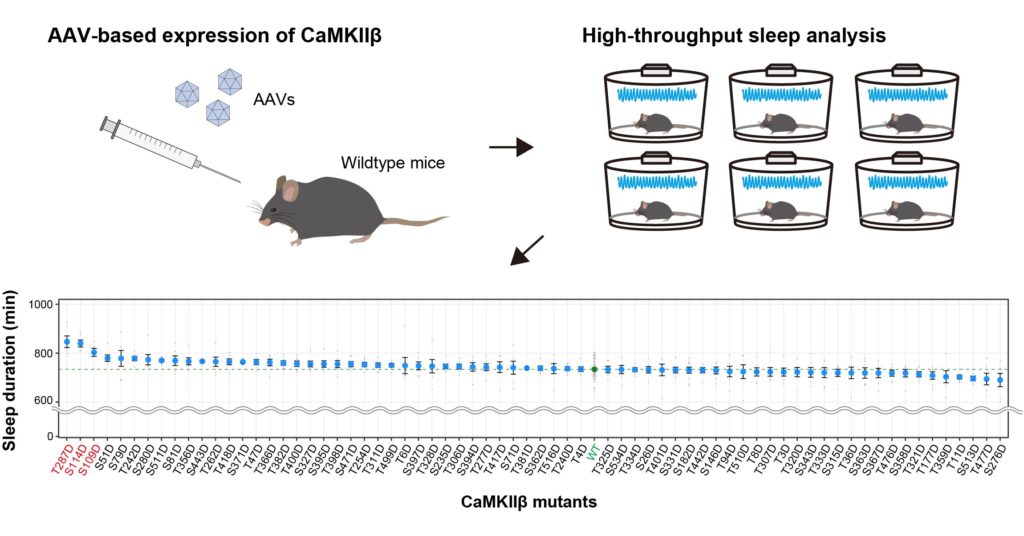 Screening of CaMKIIβ phosphomimetic mutants forbased on AAV. Wild-type mice were injected with AAV (adeno-associated viruses) to express the CaMKII mutant (top right) and their sleep phenotypes were analyzed (top left).
Comprehensive analysis of mice treated with 69AAVs corresponding to CaMKIIβ phosphomimetic mutants showed that T287D (T287D), a phosphomimetic mutant of T287, significantly increased sleep duration (below).
Illustration: Ton et al.
To do this, they entered into each sitemutated residues that mimic the phosphorylation state. The relationship between CaMKIIβ phosphorylation status and sleep regulation has been extensively studied in mice. The researchers found that in a certain state of phosphorylation, CaMKIIβ promotes the transition from the wakefulness to the sleep state. In addition, when an additional second or third similarly phosphorylated variant was introduced into CaMKIIβ in this specific phosphorylated state, the transition from the sleep to wake state was inhibited.
What did the scientists find out?
In a new study publishedIn PLOS Biology, scientists discovered that CaMKIIβ functions at every step of a multistep process. It prolongs the duration of sleep, depending on the state of its phosphorylation. Many hypnotics act on the stages associated specifically with sleep induction.
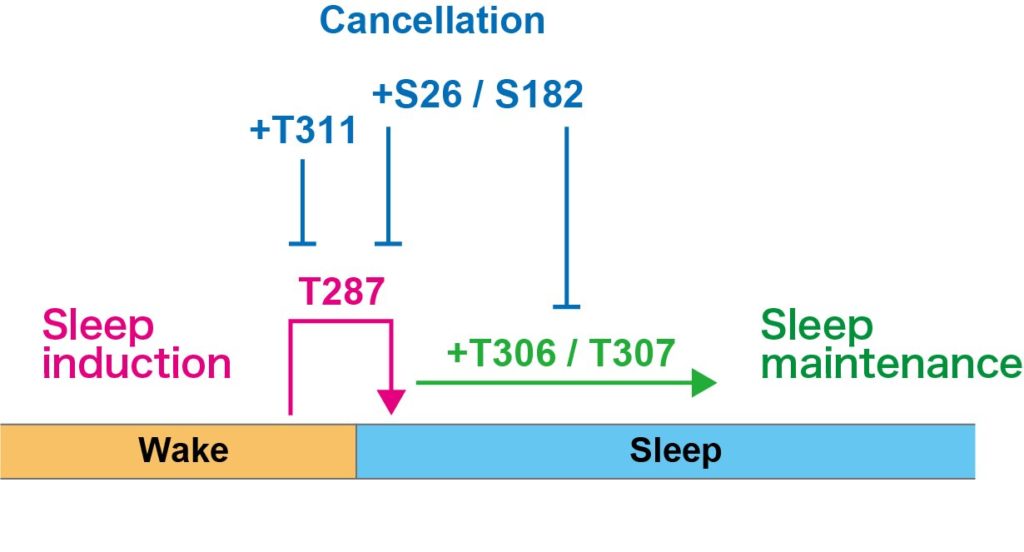 Schematic model of sleep regulation by statephosphorylation of CaMKIIβ. CaMKIIβ acts on sleep induction (T287), maintenance (T306, T307) and reversal (S26, S182 and T311) depending on its own phosphorylation state.
Illustration: Ton et al.
Sleep induction is a deliberate efforteuthanasia using various methods or drugs, which is practiced to lengthen periods of sleep, increase its efficiency and reduce or prevent insomnia.
It turned out that the bidirectional regulation of sleep by CaMKII T287D increases the duration of sleep. But the expression of the peptide-inhibitor CaMKII led to its reduction.
What's the bottom line?
A new study has partially elucidated the mechanismwhich underlies the induction and maintenance of sleep, and also provided clues for considering more ideal methods of sleep control aimed at maintaining sleep. It used to be difficult.
Read more:
Archaeologists have officially confirmed the legends from the Bible
It turned out what happens to the cells of the body when the heart dies
Starlink signal hacked to be used as an alternative to GPS