While there is plenty of evidence indicating that there was water on Mars in the past, finding it
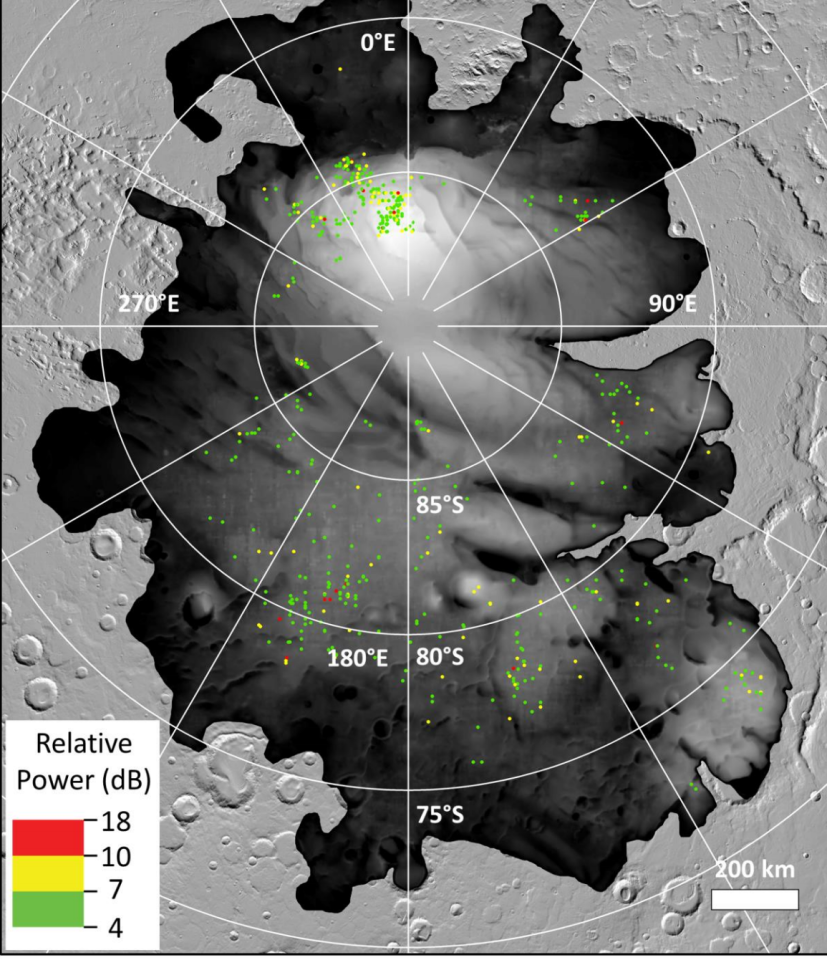 The colored dots are places of bright radar reflections around the south pole of Mars, detected by the Mars Express orbiter — once interpreted as lakes of liquid water beneath the surface, their sheer numbers have led scientists to begin to question this claim.
ESA / NASA / Jet Propulsion Laboratory – Caltech
Radar signals that can penetratethrough rocks and ice, changing as they are reflected from different materials. In this case, they produced particularly bright signals under the polar cap, which could be interpreted as liquid water.
However, after years of researching the data andexperiments in terrestrial laboratories, scientists have come to a disappointing conclusion. They hypothesized that clay, rather than water, could create such signals. Over the past month, three new studies on this topic came out at once, which destroy the hypothesis about lakes.
Thus, in particular, it is noted that many of thesesignals were detected in areas close to the surface. And there the temperatures are too low for the water to continue to remain liquid, even when mixed with salts that can lower the freezing point of water.
After analyzing the existing signals to see what else could generate them, the scientists identified possibilities that included clays, metal-containing minerals and salt ice.
All three studies were published in the journalGeophysical Research Letters[1], [2], [3].
Read more
New mini-antibodies block coronavirus 1,000 times better than previous ones
Scientists have managed to convert the energy of thermonuclear fusion into electricity
Researchers first created metallic water in terrestrial conditions