Previous estimates suggested that sauropodomorphs were a group of long-necked herbivorous dinosaurs, which included
New and more accurate assessment put the authorsbefore another question. Fossil records show that sauropodomorph dinosaurs first appeared in Argentina and Brazil about 230 million years ago. So why did it take them so long to expand their range to the Northern Hemisphere?
“In principle, dinosaurs could pass almost frompole to pole, ”Kent explained. “There was no ocean between them. There were no big mountains. Yet it took 15 million years. As if snails could do it faster. " He calculated that if a herd of dinosaurs only walked one mile (1.6 km) a day, the journey between South America and Greenland would take less than 20 years.
Interestingly, there was a significanta drop in the CO₂ content in the atmosphere at about the same time when the sauropodomorphs were supposed to migrate, 214 Ma ago. Until about 215 Ma ago, during the Triassic period, there was an extremely high level of CO₂, about 4,000 parts per million. This is 10 times higher than today. But between 215 and 212 million years ago, the CO₂ concentration dropped by half, to about 2,000 parts per million.
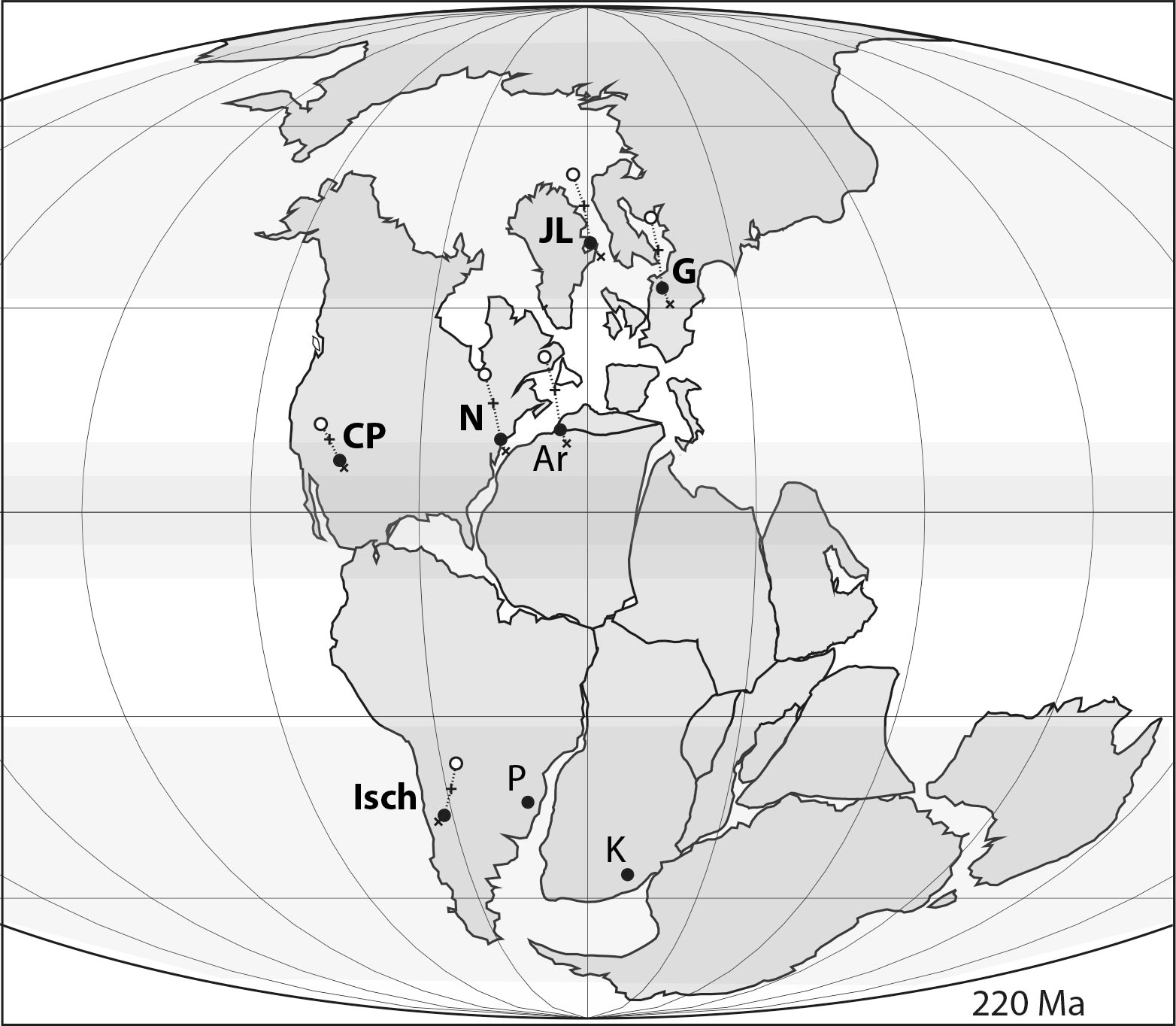 Map shows how the supercontinent PangeaThe main continents were located 220 million years ago. "Isch" and "P" denote sites with sauropodomorph fossils up to 233 million years old. Herbivorous dinosaurs only reached Jameson Land in Greenland ("JL") about 214 million years ago. Credit: Dennis Kent and Lars Clemmensen
Although the timing of these two events is a sharp fallCO₂ and sauropodomorph migrations - Could be pure coincidence, Kent and Clemmensen believe these events are related. In the paper, they suggest that more moderate CO₂ levels may have helped remove the climatic barriers that have kept sauropodomorphs in South America.
On Earth, the areas around the equator are hot and humid,while the surrounding areas at low latitudes are generally very dry. Scientists noted that on a planet pumped by carbon dioxide, the differences between these climatic zones could be huge - perhaps too dramatic for sauropodomorph dinosaurs.
When the CO уровень level fell 215-212 million years ago,perhaps the tropical regions have become milder and the arid regions less arid. Perhaps there were passages, for example, along rivers and lakes, which would help herbivores survive during the 10 thousand km journey from South America to Greenland to Greenland, where their fossils are found in abundance. At the time, Greenland would have had a temperate climate with mild winters because there were no polar ice sheets at the time.
According to Kent, the idea that declining levelsCO2 could have helped dinosaurs overcome the climatic barrier is plausible and appears to be supported by the fossil record. Sauropodomorph body fossils have not been found in tropical and arid regions during this time period.
Read more
Unknown animals resembling sponges found in the ice of Antarctica
The Brunt shelf in Antarctica is collapsing at a speed of 5 meters per day
Abortion and science: what will happen to the children who will give birth