Kunio Kaiho, a climate scientist at Tohoku University in Japan, has studied past mass extinction events.
Over the past 540 million years, there have beenfive mass extinction events have already been recorded - periods when the planet lost most of its species in a relatively short geological period of time. The climate model built by the scientist showed that the biggest mass extinctions occurred when the temperature dropped by about 7°C or rose by 9°C.
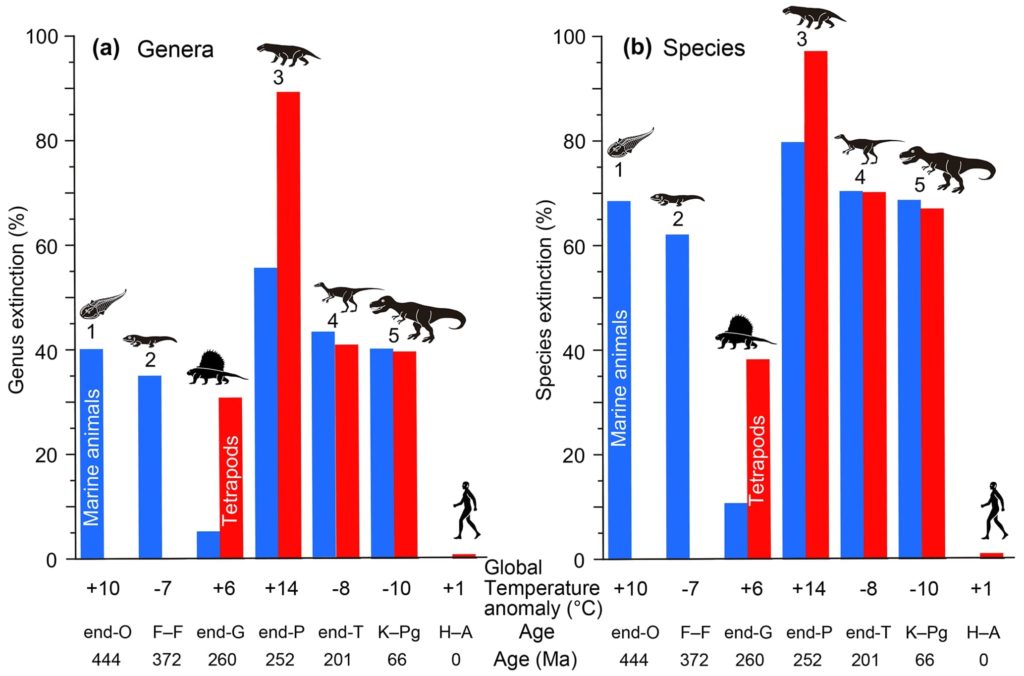 Percentage of extinct genera (left) and species (right)among marine animals (blue column) and tetrapods (red column) during mass extinction events. Image: Kunio Kaiho, Biogeosciences
This is much higher than previous forecasts.which suggest that a rise in temperature of 5.2°C to pre-industrial levels will lead to a major mass extinction of marine organisms, comparable to the previous five.
According to the UN, currently the averageEarth's temperature is about 1.1°C warmer than pre-industrial levels. If the current level of emissions is maintained, experts expect an increase to 4.4°C by the end of this century.
Global warming of 9°C will not occur in the Anthropocene until at least 2500 even in the worst case scenario.
Kunio Kaiho, climate scientist at Tohoku University
The scientist does not deny that climate change is alreadyaffects the conservation of species. But he does not expect it to be as large-scale as the global events of the past. For example, the largest mass extinction on Earth, which occurred about 250 million years ago, killed 95% of the species existing at that time.
The researcher admits that the extinction of speciescan affect not only the absolute change in temperature, but also its speed. The last mass extinction lasted about 60 thousand years, now, due to anthropogenic impact, the climate is changing faster. Perhaps more species will die during the sixth extinction on Earth, not because the scale of warming is so great, but because of the rapidity of changes to which many species will not have time to adapt.
Read more:
Scientists filmed a strange creature with tentacles, which they mistook for a flower
An out-of-control Chinese rocket will soon fall back to Earth. What's happening
Marine archaeologists find wreckage from medieval shipwreck