The Anthropogeos project and its editor-in-chief Sardar Sardarov organized an expedition to Antarctica in December
Sardar Sardarov
Sardar Sardarov - founder and editor-in-chiefpopular science project "Anthropogeos". He organizes and conducts expeditions, in which he attracts scientists, researchers, and writers. They study how the place of existence and stay affects a person and culture. The Anthropogeos project has already visited Antarctica, the Gobi Desert, Guatemala, the island of Svalbard and many other parts of the Earth.
 Sardar Sardarov
Route in Antarctica by the Anthropogeos teamtook 21 days. The path started from Punta Arenas, Chile, passed through the Union Glacier, the South Pole, the Pole of Inaccessibility, the Novolazarevskaya station and ended in Cape Town. They covered 4,500 km in 21 days. People traveled from South America to South America via Antarctica by car for the first time.
Sardar Sardarov:“For me, these several long, per day, driving transitions have become a real gift, an opportunity to be alone. It's rare on trips like this where people spend all the time together in small spaces. In Antarctica, you are all either in a car or in a tent. And on a long journey, your companions talk, fall silent, fall asleep, wake up, and so on in a circle, and the caravan moves, making very short breaks for a quick snack and sanitary needs.
I was lucky - I didn't have a replacement.I could see this amazing land and how it changes in nuances - the surrounding color, the landscape. So you touch the planet, overcoming the distance meter by meter. Nothing distracts from contemplation.
Hlinur Sigurdson
One of the two guides accompanying the expedition andthe mechanic was Hlinur from Iceland. He has been working with cars for 16 years, developing cooling systems for the last six years, and occasionally works as a guest guide.
Works in Antarctica since 2011, brought thereone of the first polar modifications of SUVs. That year, Hlinur was on the continent in the company of three more people in two cars - and they showed the best time result in moving to the South Pole and back.
One of the main tasks of Hlinur and his partnerson trips to Antarctica there was reconnaissance of new roads and territories. Before setting off on an expedition to a new location, they studied satellite images, observed the movement of the ice sheet, then conducted reconnaissance with a radar that is mounted on the bumper of a car. When driving in the "red" zone, the car travels at about 6-10 km / h, and when leaving the car, people must tie themselves with insurance. Where a car can safely pass on deflated wheels, a person most often cannot pass.
 Hlinur Sigurdson
Khlinur also participates in rescue operations when they are carried out with the participation of cars. He mentioned one of them in our conversation:
“Perhaps the most difficult for all my time working inAntarctica was a trip through a field with cracks. We were called to help two guys from South Africa who were organizing a fuel depot. Their sleigh fell into the crevasse and they were all over the place. We needed to get the sled out and not let the people fall through. These two got into a snowstorm and lost one of the tents, the other with food supplies was also almost destroyed, there was very poor communication with them. But everything worked out in the end.”
Wendy Searle
Wendy is a mother of many children from the UK, who decided to conquer the South Pole on skis. Although before she set herself such a goal, she did not even know how to ski.
The idea came to her when she was eight years oldago I worked with a charity organization that organized skiing and sledding trips in Antarctica. Wendy helped with the technical side of this expedition. The thought of repeating such a campaign herself determined her entire subsequent life.
She had been preparing for this expedition for five years:trained like Olympic athletes, looked for sponsors and partners, participated in other expeditions for preliminary experience - for example, in a group crossing of Greenland. Until in the 2019-2020 season she became the seventh woman in the world to cross Antarctica from the bay to the South Pole on skis alone.
 Wendy Searle
During the year before the start of Wendy's expeditiontrained six days a week twice a day, while combining this with a full-time job and taking care of the family - Wendy has four children. She rode a bicycle, ran, but mostly carried a heavy and large tire behind her - after all, this was exactly what she had to do the whole trip.
“I went around a lot of companies offeringuse my face as an advertisement and say that I am planning this trip. For a potential sponsor, this is a big risk, because just by looking at me, they cannot say with certainty that I will reach the end and that everything will be successful. However, I found a few companies that believed in me. Everyone assured me that until the moment I got on the plane, I would not have enough money. That is exactly what happened. Right before the start, one of the companies offered me additional funding - thanks to him, I bought a plane ticket from the UK.
Emma Roos
In the camp at the South Pole, members of the expeditionmet with Emma Roos, a member of the camp and the only female worker at the pole. She came to work in Antarctica for the second time, and this time she was sent to this remote camp, where she likes everything: the cold, the small number of people compared to the main camp on the Union Glacier.
For the sake of coming to Antarctica, Emmaquit her job in Sweden - she was a criminal psychologist and worked with child witnesses of crimes. Despite an excellent career, a difficult but interesting job, Emma went to serve a tourist camp in Antarctica. In the first year she took a vacation for a season, for three months, and when she returned to Sweden, she continued to work in the same department. The second time, she made the decision to quit her job and try to change her life.
The idea of trying to get a job inAntarctica came from a random friend. Emma was working at a remote mountain camp where Hannah, ALE's king penguin camp leader, was on vacation. She showed her photos from Antarctica and suggested that she try to apply for a job. Emma's ability to dig snow and experience in remote places clearly worked in her favor - and she was invited to a separate team for the season.
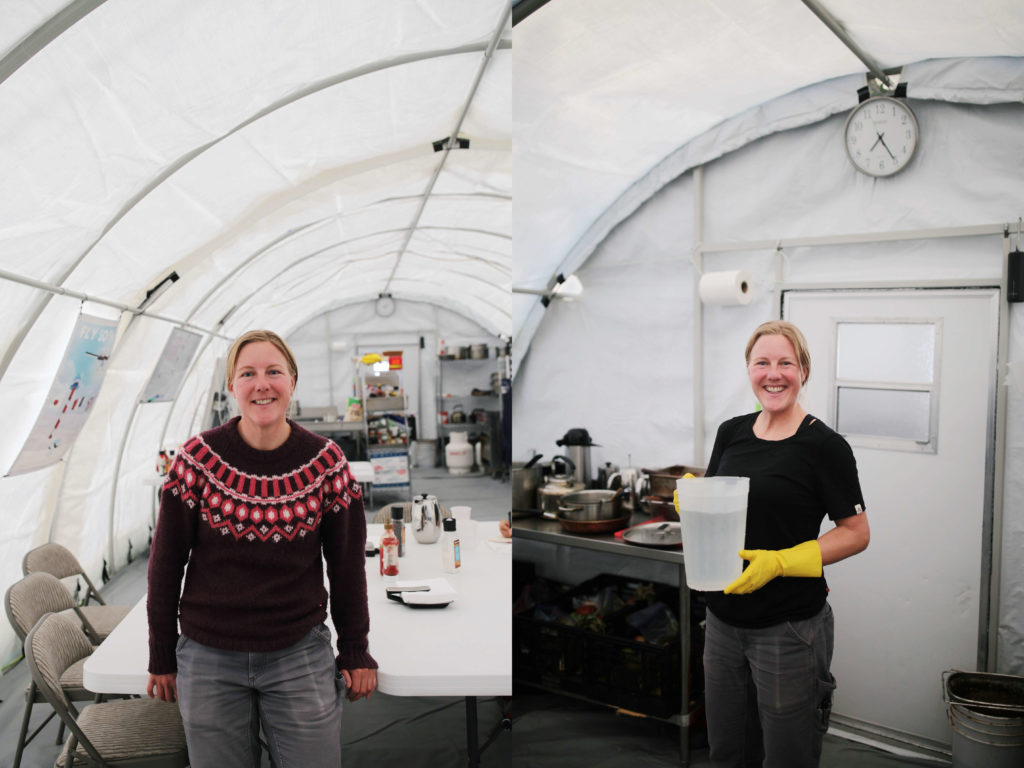 Emma Roos
“ALE has three permanent camps inAntarctica. I worked in two of them, on the Union Glacier and in a small camp at the South Pole. I was part of the hotel team keeping everything in working order for the guests. For example, we helped with resettlement, tents, looked after all the amenities, toilets and showers, prepared water, that is, we dug a lot of snow. I like this job, I like to work outdoors. And in Antarctica, all life is outdoors. It's also physically quite hard, unlike my usual job.
The main camp on Union Glacier is much larger,than everyone else. And there is a completely different system when compared with the South Pole. There is a camp manager who looks after everything at once, and there are workers divided into several sections. I worked in the hotel and kitchen section. People from other departments always worked like this: three weeks here, three weeks at the South Pole. For the hotel group, this is a new system. Three years ago in small camps there was no one from the hotel group at all, then they began to send one person at a time for the whole season. I am very lucky to be that person. At the Pole, the entire camp team is smaller than my hotel group at the main camp.”
EmilGrimmson
Managing Director of Arctic Trucks Internationaland Arctic Trucks Polar, founder of Arctic Trucks. Engaged in the modification of vehicles for extreme conditions and the organization of expeditions to the North and South Poles.
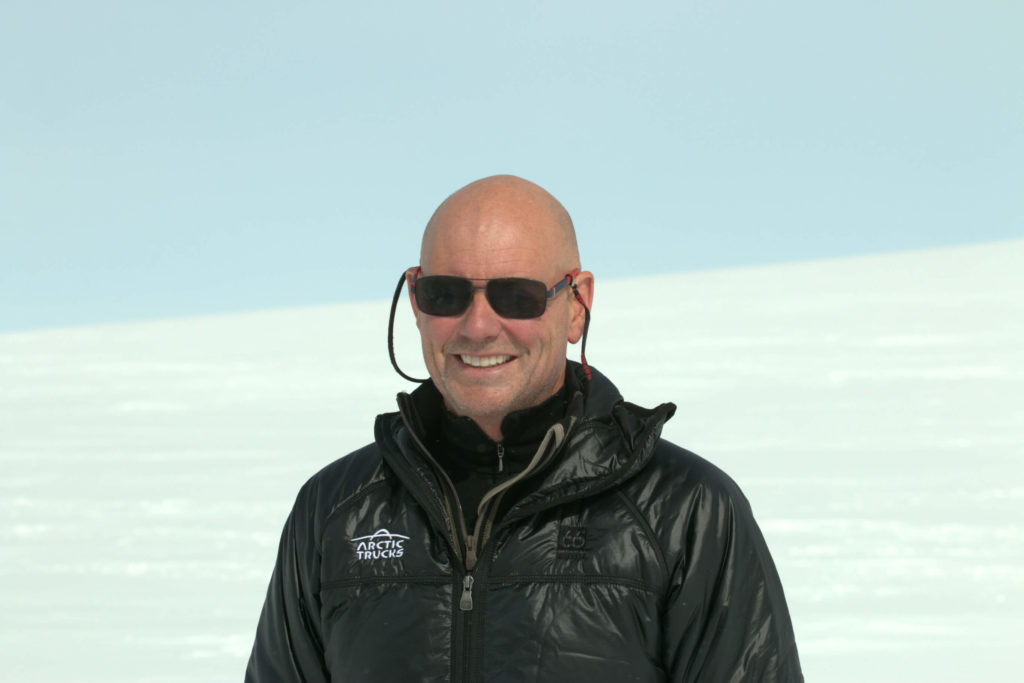 Emil Grimmson
Started working in Icelandic when he was youngdivision of Toyota, then became engaged in the adaptation of cars to difficult landscapes and organized his own company. In 1996, they made their first expedition to Antarctica, and in 1998 they crossed Greenland. In 2007, together with Top Gear, we reached the North Pole, and from the next year, 2008, we began regular expeditions to Antarctica.
The first major challenge for SUVs wassupport for the race to the South Pole: cars were the main transport that transported medics, film crews, provisions and materials. Since then, Arctic Trucks vehicles have covered more than 340,000 km across the Antarctic plateau.
 Vehicles of the Anthropogeos Expedition in Antarctica
Emil has repeatedly participated in expeditions:explored routes for new runways, organized fuel depots. Emil remembered one of the most memorable expeditions he had organized.
“We did an expedition for Hyundai Motor, inwhich was attended by the great-great-grandson of Ernest Shackleton. She passed through Antarctica along a route that his great-great-grandfather could not overcome. First we had to modify the car so that it could drive on snow. Then it was necessary to paint all the logistics together with ALE, he says. - And as soon as we started working on this project, thousands of letters rained down on me asking for presentations. And we were just at the beginning. These kinds of expeditions become complicated and provoke a lot of questions. So if I only have a couple of hundred emails and a couple of presentations during the expedition, it's very easy organization.
 Car tire tracks are a few and short-lived evidence of the presence of life on the White Continent
Juan Pablo Escobar
Alpine guide, last 16 yearsspecializes in high altitudes. He got to Antarctica through a friend who already worked there. Pablo spent two seasons on the White Continent in a remote camp near the FD83 fuel depot. In the first year, Pablo was a member of the team, in the second he was already its leader.
 Juan Pablo Escobar
Fuel depot FD83 serves to supportaircraft that make stops on their way to the South Pole and back. Camp workers help the crew with refueling and assist passengers. The road from the coast to the Pole is not easy - it is an intensive climb from several meters to several thousand meters above sea level. Pablo and the doctor, who must also be among the team members, helped to cope with altitude sickness, consulted, hosted teams and solo tourists traveling on land.
The expedition of the Anthropogeos project is exactly the samemet with Pablo at the fuel depot. The team stopped there twice - on the way to the Pole of Inaccessibility and on the way back, already in the direction of the Novolazarevskaya station.
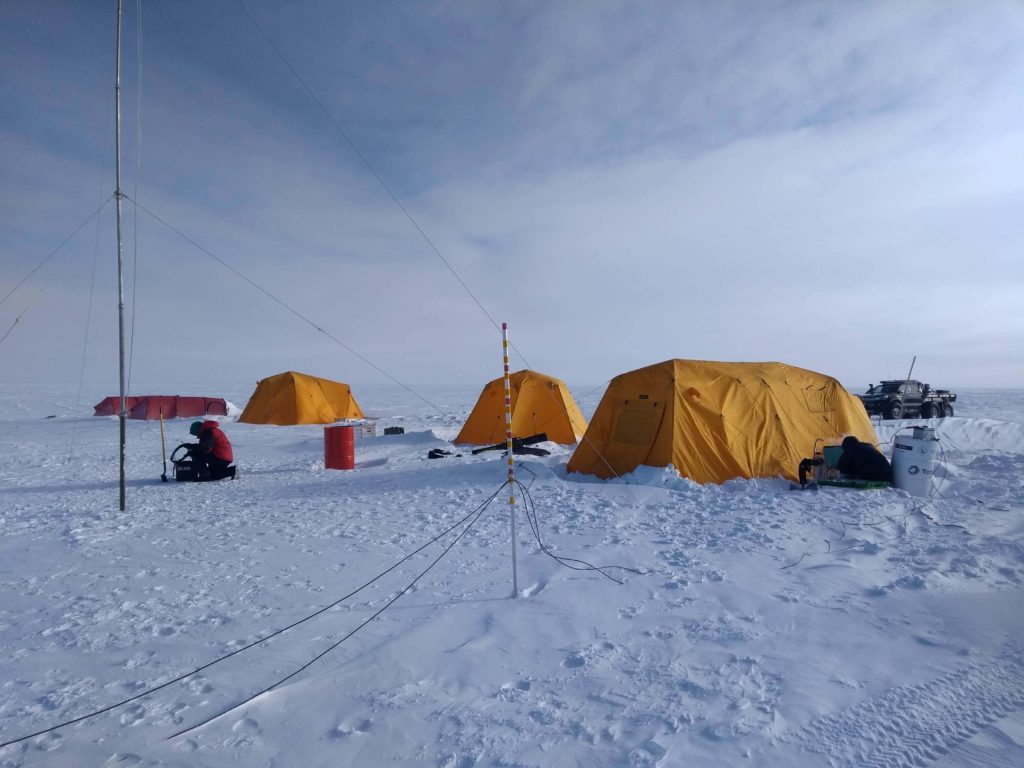 Seasonal gas station camp FD 83
“The depot is located 1,600 km from the ALCI base.When we arrive there at the beginning of the season, the first thing to do is to prepare the camp. Flatten the snow, set up big tents,” he says. — At the FD83 gas station, planes arrive that need refueling on their way to the South Pole, mostly Twin Otters or Bastlers. Our duties also included preparing the barrels of fuel that had been procured from the previous year, inventorying them, and receiving new supplies of fuel: they were dropped there from an airplane with a parachute.
Every day we met planes, cooked food,soup, assessed the condition of the pilots - they have the greatest responsibility. We also prepared the strip at the beginning of the season: equipment clings to the track and mechanic drivers drive across the snowy field, compacting it so that it becomes suitable for take-off and landing of aircraft. Basically, these are our main tasks. Working at the fuel depot is a pretty big operation. And interesting. It's like you're in a video game."
Read more:
Gas leak from Nord Stream was shown from space
Unusual structures found on the edge of the solar system. Only the Voyagers have been there.
See how Jupiter and the Moon approached in the night sky