After 30 years of planning and approvals in Australia and Africa, construction begins on the world's largest
The observatory will consist of two instruments:one in South Africa and one in Australia. Each of the telescopes will consist of many dishes that capture cosmic signals, and the total coverage area when completed will be 1 km².
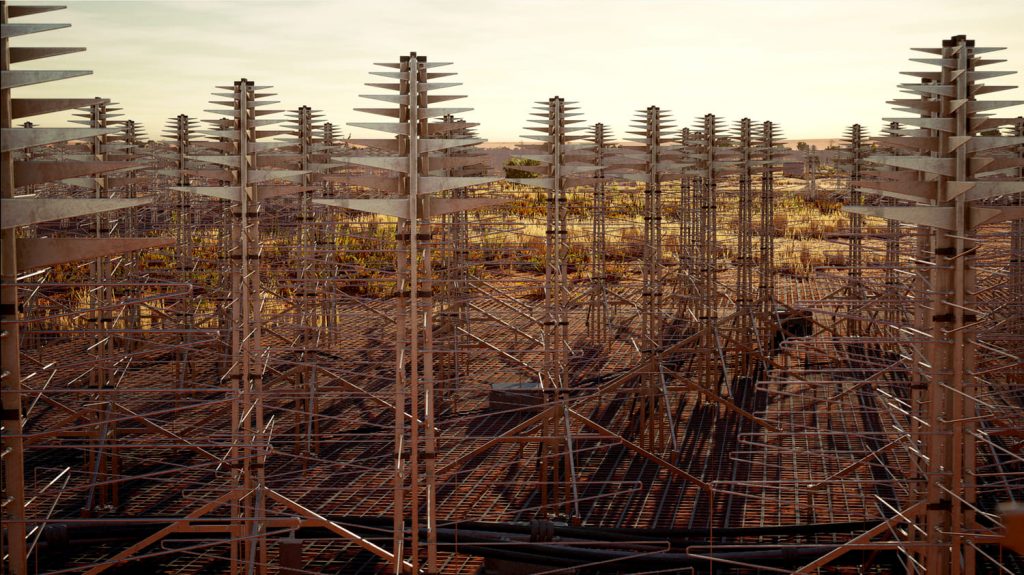 Artistic illustration of the SKA-Low telescope. Image: SKAO
The SKA-Low telescope in Australia will consist ofapproximately 131 thousand antennas (more than 500 arrays of 256 antennas), each of which will resemble a two-meter wire Christmas tree. This telescope will detect radiation at frequencies between 50 and 350 MHz.
The second telescope - SKA-Mid - will work with morehigher frequencies: from 350 MHz to 15.4 GHz. It will be formed by huge dishes (197 antennas in total) that will be installed on the territory of South Africa and neighboring partner countries. Both telescopes are interferometers that work together as a single device.
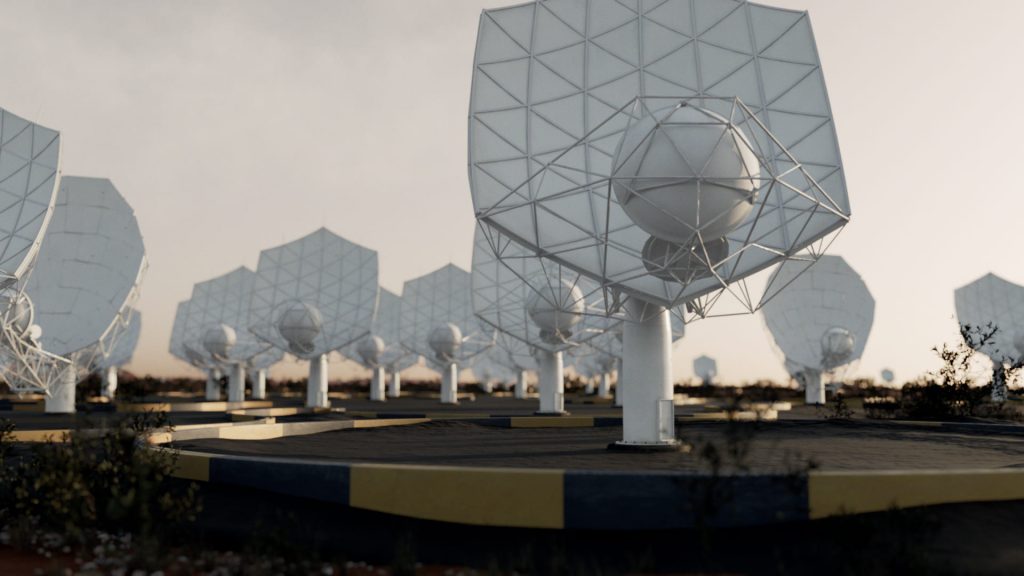 Artistic illustration of the SKA-Mid telescope. Image: SKAO
According to the plan, the construction of the first stageThe observatory will be completed as early as 2024, after which it will begin work, and new antennas and dishes will be connected as they are created. The full current phase will be completed by 2028. But this is not the final point: the ultimate goal of the project is two hundred, the total number of antennas in Australia is up to a million, and dishes in South Africa - up to a thousand.
SKA-Low sensitivity allows you to observethe distant Universe in much more detail than anything we have done so far, the participants of the project note. And SKA-Mid will be able to display in all details the galaxies closest to us, gas flows and star formation processes in them. Astrophysicists hope that with the help of telescopes they will be able not only to answer the questions already raised about the evolution of the Universe, but also to observe previously unseen processes.
Read more:
Restored appearance of a medieval woman who suffered from syphilis
Brain-eating amoeba is spreading in the US: is there a danger to Russia
The ancient mystery of the genome is revealed: what our DNA has been hiding for so many years
On the cover: an artistic illustration of two telescopes of the SKA observatory. Image: SKAO