Apple and Android OS update
A MAC address is a unique identifier for a mobile device. Wi-Fi radar and APK
Previously, this data was embedded in every smartphone and laptop. They were assigned to each device and could not be changed.
However, in September 2019, Google Corporationreleased Android 10 firmware version with MAC address randomization feature. Following it, Apple came out with the iOS 14 OS update. Corporations decided on such an update in order to protect the privacy of users. Now device data will be updated every 24 hours.
How randomization influenced the Moscow government project
The Moscow government planned to establish the agro-industrial complexto collect MAC addresses of pedestrians at public transport stops to track passenger traffic. It was assumed that this would relieve the streets and optimize the work of urban transport.
Due to the update of Apple operating systems andAndroid has become almost impossible to monitor the movement of citizens. Therefore, the Moscow authorities are likely to curtail the project, which had already spent 62.8 million rubles by the time the OS was updated.
The new project has sparked excitement over possiblesurveillance of citizens. But the MAC addresses that the Moscow government's agro-industrial complex planned to collect is completely impersonal information. They are not personal data. This means that with their help it is impossible to determine the specific data of people. Having MAC addresses, the authorities will not be able to find out either the passport data, or the telephone number, or the residential address.
But using MAC addresses, you can build analytics in real time. And the collected data should be used only to analyze the flow of people, traffic load and stops.
If the goal of the authorities was surveillance, then there are much more effective methods for this, using video recording.
“MAC address is just a “number” forunique identification of a device on the network. Only if there is information about who owns this device does the MAC address become an identifier. Otherwise, the tracking system is able to determine the type of device or its manufacturer, but nothing more.”
Mikhail Kondrashin, Technical Director of Trend Micro in Russia and CIS
Who else uses MAC addresses
MAC addresses are used not only by the authorities, but also by IT companies and some manufacturers of modern devices.
- The MAC address is used to filter access tonetworks. For example, it is necessary if the user connects the computer to the Internet and then decides to connect other equipment through a router. As a rule, the provider allows access to the network only to devices with a MAC address similar to the data on the network card.
- Many smart home functions work withMAC addresses. To connect the controller, the system needs to know the device data. So, you can monitor your home using video surveillance and use smart sockets through your smartphone.
- Many IT companies use MAC addresses toousers for marketing purposes. Business owners collect them using Wi-Fi radar to upload data to ad platforms and set up targeted ads.
How will randomization affect the rest of your life?
Users will have difficulties in managing a smart home and filtering network access. But the randomization function can be easily turned off in the smartphone settings.
OS updates are more likely to affect IT companies that use Wi-Fi technology for marketing purposes.
As in the case of the state project onmonitoring, collection of MAC addresses is not a violation of the law on personal data. Entrepreneurs do not have the tools and capabilities to gain access to phone numbers, addresses and other personal data of specific users.
The maximum that the collectedMAC addresses - see detailed statistics about the movements of anonymous users. This information is used to customize advertising campaigns for specific target audiences in order to attract new visitors to the institution or to catch up with advertising potential customers.
The use of these technologies has been compromised by randomization.
How much will IT companies suffer
We decided to check if the randomization is stronginfluenced Wi-Fi marketing. To do this, we analyzed the number of MAC addresses that Wi-Fi radars collected from January to February and from September to December 2020.
In December, 58% fewer unique items were collectedaddresses than in January. However, the percentage of coincidences on advertising sites remained practically unchanged and even increased. It is worth considering that due to new restrictions on the coronavirus, the flow of people has decreased, and the number of installed radars has decreased.
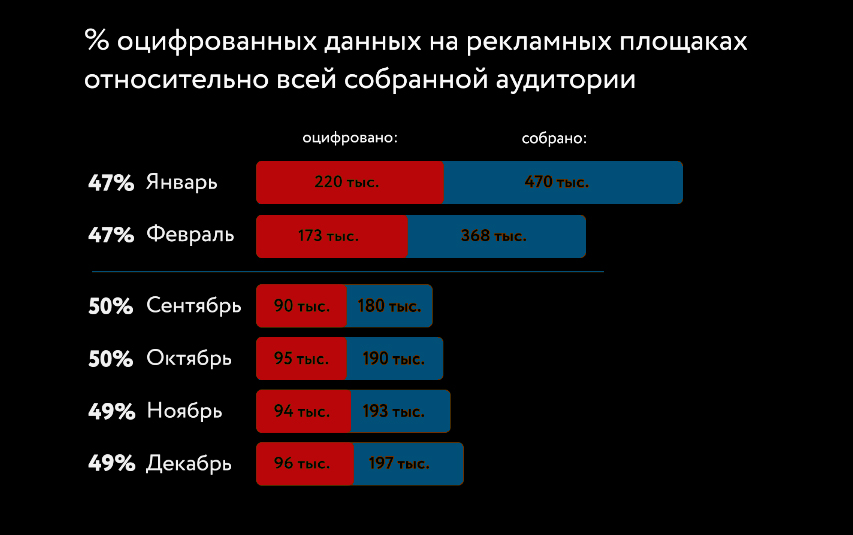 *Collected— the number of MAC addresses collected by the Wi-Fi radar.Digitized— number of matches with users afterexport of MAC addresses to advertising platforms Yandex.Direct, myTarget and Facebook ADS.** January-February - before quarantine 2020, September-December - after quarantine 2020.
For all Wi-Fi marketing, this isinsignificant figure. In our experience, if among 100% of passers-by at least 40% are caught, then this is a great number for setting up an advertising campaign. Having such a contact base, you can set up a look-alike extension for it and find tens of thousands of similar users on advertising platforms.
Other government projects on social monitoring
Actually tracking passenger traffic withMAC addresses are not the government's only social monitoring project. Discontent among Muscovites about surveillance began long before the advent of a project to track pedestrian movement by MAC addresses.
In 2017, Moscow began testingface recognition technology using video cameras. According to Forbes, the Moscow system is the largest in the world. More than $ 3.2 million was spent on the launch of the project.
The technology works with the help of artificialintelligence. Cameras scan faces in range, and a smart system analyzes every pixel. After the AI determines the similarity, which allows you to follow the movements of the passer-by. Artificial intelligence can also compare the image to photographs of wanted people from police bases.
This gave rise to a wave of discontent in society.The organization No Facial Recognition was created, the experts intend to stop the collection of biometric data. Supporters of the movement believe that without the written consent of citizens, this procedure violates the law on personal data.
The corresponding petition was posted on Change.org. It has already been signed by 105,816 people. And a lawsuit was even filed against the Ministry of Internal Affairs and the Moscow Information Technology Department. However, it was rejected. The court considered that the video surveillance system does not violate the laws of the Russian Federation.
See also:
Abortion and science: what will happen to the children who will give birth
Unknown animals resembling sponges found in the ice of Antarctica
Look at an 8 trillion pixel image of Mars