An international team of scientists has developed a computer program that simulates the transfer of space
What are cosmic rays?
Cosmic rays by their nature areelementary particles and atomic nuclei that move with high energies in outer space. The main sources of primary cosmic rays are considered to be explosions of supernovae (galactic cosmic rays) and the Sun, but their nature is still not fully understood.
High energies (up to 1016 eV) of galacticScientists explain cosmic rays by the acceleration of particles on shock waves generated by supernova explosions. They move at almost the speed of light, approximately 300,000 km/s.
Discovery history
Cosmic rays were discovered in 1912 by an Austrianphysicist Victor Hess. He was an employee of the Radium Institute in Vienna and conducted research on ionized gases. However, even until this moment, scientists suspected their existence.
French physicist Charles Augustin de Coulomb,While exploring the nature of electricity using an electroscope, he discovered that charge spontaneously flows away from sheets of foil even with the best electrical insulation. William Crookes later discovered that the rate of this process decreases when the air pressure in the electroscope decreases. So the scientist came to the conclusion that the cause of the discharge was the ionization of the air.
 Author: Montage: Helmholtz Alliance for Astroparticle Physics / A.Chantelauze, Picture: Pierre Auger Observatory. Copyright: CC BY-NC 4.0
However, what its reason was was unknown untilphysicists did not discover the phenomenon of radioactivity. Then scientists hypothesized the existence of a global background radiation, the source of which was either the Earth, the atmosphere, or space.
After a series of experiments, Hess came to the conclusion that the source of radiation was the sky. The scientist called it “high-altitude radiation.”
20 years later, Hess received the Nobel Prizeprize, and his research served as the foundation for the development of a new field of science—cosmic ray physics. Since then, scientists have made great progress in their research, but some questions still remain unanswered. For example, about the speed and process of formation of cosmic rays.
Why are cosmic rays difficult to observe?
100 years since the discovery of cosmic raysago researchers are trying to decipher where they come from. The problem is that when viewed from Earth, they cannot be seen “separately” with the naked eye. They are equally brightly lit almost everywhere a person looks.
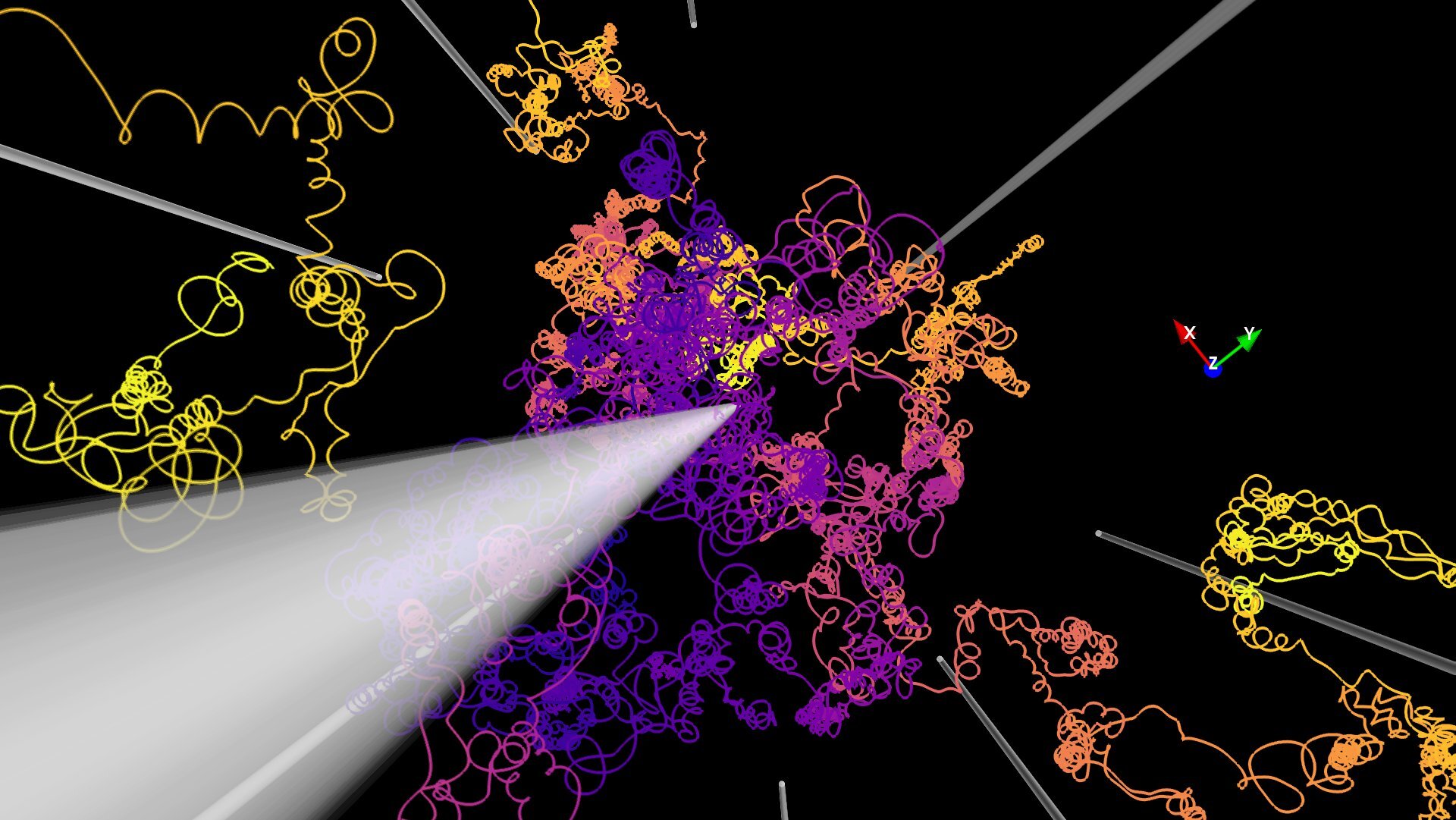 The colored lines show how cosmic rays are deflected in magnetic fields.
The white straight lines represent the large-scale magnetic field.
The particle paths (colored lines) are affected by small-scale magnetic fields not shown here.
Illustration: Lukas Merten
This is because sunlight scatters inEarth's atmosphere and spread evenly across the sky. Cosmic rays also scatter on their way to the planet. It does this by interacting with magnetic fields. All we can see from the surface of the Earth is a uniformly lit image. However, the very origin of the radiation remains unknown.
What have the scientists done?
To solve the problem, scientists have created a specialcomputer program CRPropa (eng. Cosmic Ray Propagation Framework, cosmic ray propagation scheme). It allows scientists to track the trajectories of particles from their formation to their arrival on Earth. In addition, the data will help to fully explain the interaction of particles with matter and photon fields in the universe.
It is noteworthy that the program models not onlythe propagation of cosmic rays, but also the signatures of neutrinos and gamma rays that arise when they interact. Unlike cosmic rays, these messenger particles can be observed directly from their sources. This is because they fly to Earth in a direct path.
Let us remind you that neutrinos are neutralfundamental particles with half-integer spin. They participate only in weak and gravitational interactions. Previously, Hi-Tech told what it is and what other interactions exist in nature.
They support the universe: how the four main forces of nature work
In addition, the scientists plan to use the software to predict such signatures of neutrinos and gamma rays from distant galaxies, such as stellar flares or active galaxies.
How will she help?
The authors of the development are confident —their software “opens new windows into the Universe.” With its help, physicists are exploring new energy ranges that cannot be fully covered using currently available programs.
And most importantly, now scientists will developa theoretical model that describes the movement of cosmic rays from our Milky Way galaxy to distant clusters of stars and compare the data with observations.
The simulation program was developed by 17researchers from Germany, Spain, Holland, Italy, Croatia, England and Austria. The project was carried out within the framework of the Joint Research Center, which is funded by the German Research Foundation.
Scientists confident CRPropa will make a significant contributionin understanding where cosmic rays come from. New theoretical calculations will help physicists interpret the variety of data that scientists receive from various instruments that observe the cosmos.
Read more:
Look at a phenomenon that is simply impossible on Mars
A huge satellite can outshine all the stars and planets in the night sky
China says they will have fusion power in 6 years