Korean researchers from the Daegu Gyeongbuk Institute of Science and Technology (DGIST) have developed the world's first
Back in 2017, a group of researchers underled by DGIST professor Jin Ho Changa, suggested that micrometer-sized gas bubbles, which are commonly observed when exposed to tissue with high-intensity ultrasound, can be used to improve the quality of images obtained from laser scanning.
In a paper published in the journal NaturePhotonics, scientists announced the successful creation and testing of such an installation. The operating principle of the device is based on the fact that gas bubbles temporarily generated by ultrasonic waves cause optical scattering in the same direction as the incident light, thereby increasing the penetration depth of the light.
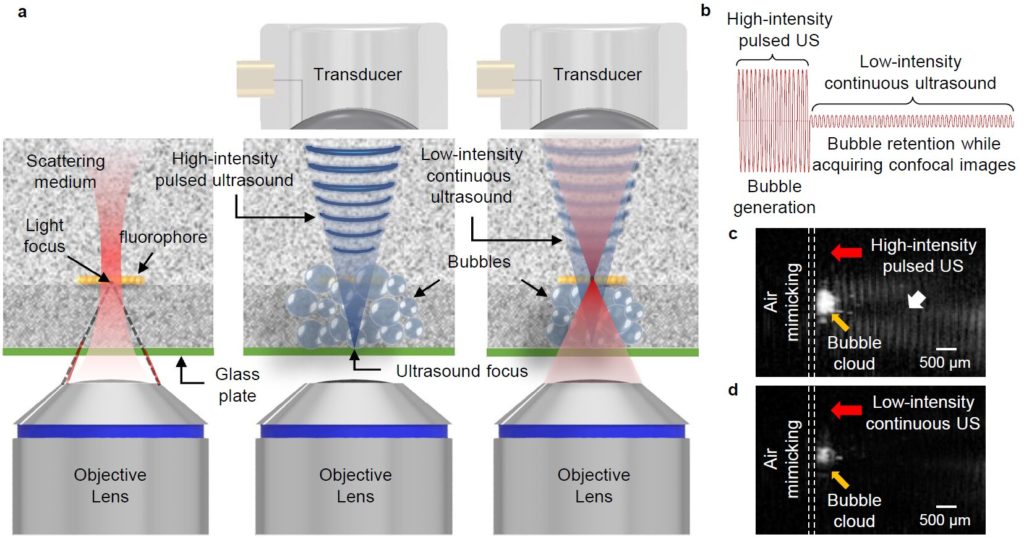 Scheme of the laser installation. Image: Haemin Kim et al., Nature Photonics
Scientists have developed ultrasound technology tocreating a bubble layer in the desired area with dense gas bubbles (with a density of 90% or more) inside the living tissue. The device can contain the resulting gas bubbles throughout the scanning process. In this layer, the direction of propagation of photons is not distorted, the scientists note.
The confocal fluorescence microscope isa device that selectively detects fluorescence signals generated in the plane of light. This device provides high contrast, high resolution images of microstructures such as cancer cells. Such microscopes are widely used in medicine and life science research.
The main problem with the microscope is thatdepths greater than 100 µm, the focus of light is blurred due to light scattering occurring inside the tissue. This significantly limits the use and effectiveness of confocal fluorescence microscopy. The new technology solves this problem, allowing you to look deeper and create sharper images.
Read more:
See what a woman, a priest and a bishop looked like in the Middle Ages. Their faces are alive
Recreate the Sun on Earth: how physicists solved the main problem of thermonuclear fusion
Created a compact nuclear reactor for safe energy production