An international team of scientists led by the University of Sydney has developed a technology
The walls of natural blood vessels arefrom a series of concentric rings of elastin (a protein that gives blood vessels elasticity and the ability to stretch). Several structures are inserted into each other like a nesting doll. This makes the rings elastic, which allows the blood vessels to expand and constrict, allowing blood flow.
Technology featured in Advanced magazineMaterials, uses only two natural materials that take root well in the body. The main elastic scaffold is made of tropoelastin, which is embedded in a PGS suture matrix. After transplantation, the latter dissolves, leaving ready-made elastic “tubes”.
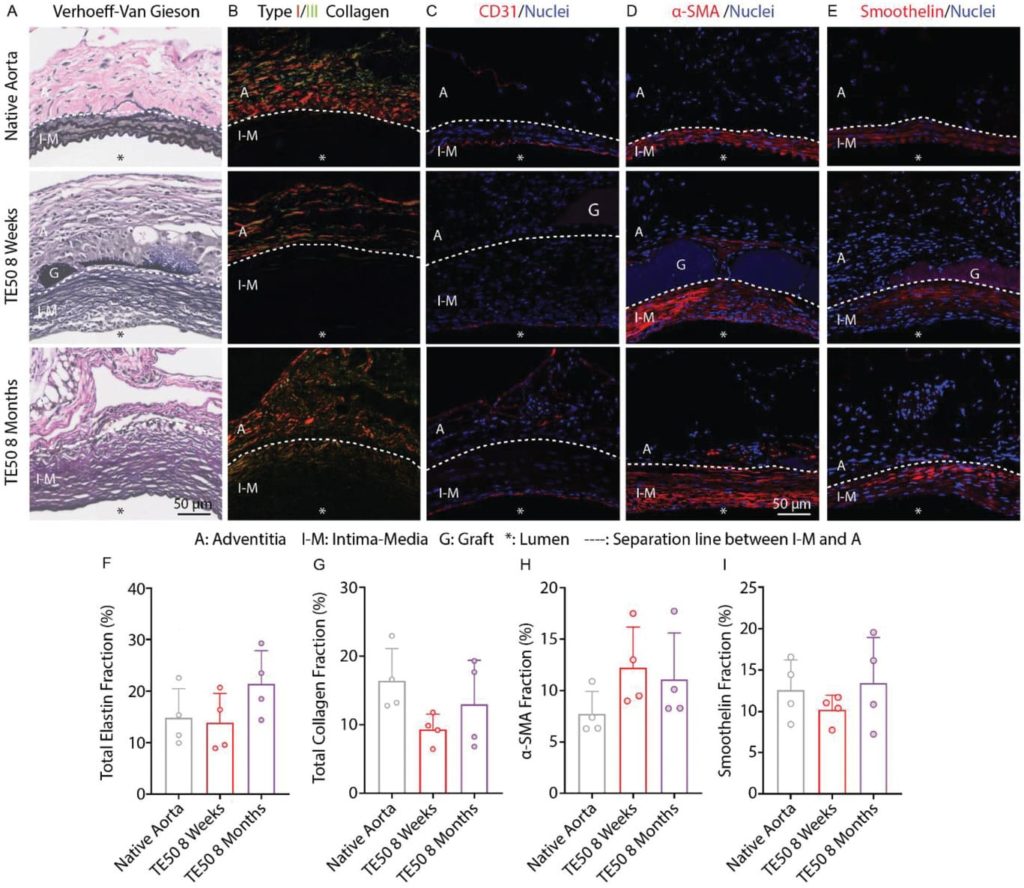 Comparison of abdominal aorta and graft in mice at 8 weeks and 8 months after transplantation. Image: Ziyu Wang et al., Advanced Materials
Preclinical studies in mice have shown thatafter transplanting the fabricated blood vessel into mice, the body accepts the material. During development, new cells and tissues grow in the right places. “Nature eventually transforms this artificial tube into one that looks, behaves and functions like a real blood vessel,” says Professor Anthony Weiss, co-author of the work.
Researchers note that a major problem inmodern surgery is transplantation for children. Artificial vessels available on the market solve the problem only temporarily, as the body grows, new operations and replacement of the implant are required. The new material should solve this problem, the developers say.
Read more:
Starlink signal hacked to be used as an alternative to GPS
NASA revealed the origin of Haumea - the most mysterious planet in the solar system
Physicists Break Standard Quantum Limit With 'Quantum Horror'
On the cover: an artistic illustration of an artificial vessel. Image: Ziyu Wang, University of Sydney, Ella Maru Studio