Researchers from the Johannes Guttenberg University of Mainz have developed a prototype device,
Brownian reservoir calculations representis a combination of two non-traditional methods of calculation, physicists explain. Computer processes are usually performed at room temperature. Brownian computing is a calculation that uses the thermal energy of the environment to reduce energy consumption.
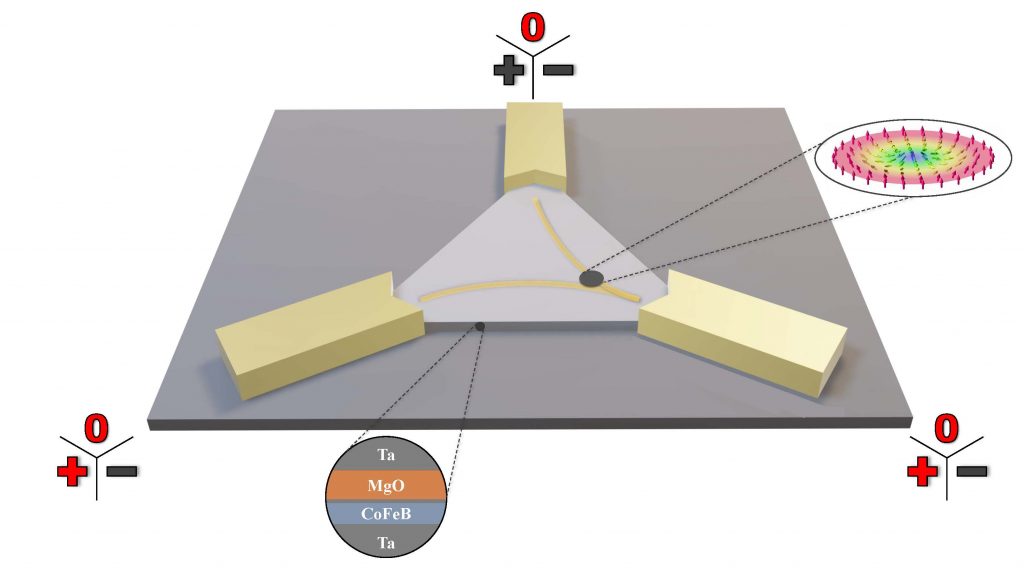 Scheme of the device.A magnetic vortex, known as a skyrmion (gray dot), is displaced into the corners of the triangular field by electric currents, where it bounces off the sides. The potentials shown in red are sufficient to perform basic logic operations. Image: Klaus Raab, JGU
Tank computing uses a complexthe response of a physical system to external influences, resulting in an extremely resource-efficient way of processing data. Most of the calculations are performed by the system itself, which does not require additional energy. The advantage of such a system is that this type of reservoir computer can be easily configured to perform various tasks, the scientists say.
In their work, the researchers createdsolid-state system, which consists of thin metal films with magnetic skyrmions. These magnetic vortices behave like particles and can be driven by electric currents. The behavior of skyrmions is affected not only by the applied current, but also by their own Brownian motion. This Brownian motion of skyrmions can lead to a significant increase in power savings as the system automatically reboots after each operation and prepares for the next calculation.
The researchers tested their systemusing boolean logical operations that test the accuracy of calculations. The results confirmed the operation of the system. The authors note that the prototype is easy to manufacture from a lithographic point of view, and theoretically it can be reduced to a size of only nanometers.
Read more:
Does science exist in extreme conditions? We answer in numbers
The Yellowstone supervolcano turned out to be many times more dangerous than scientists thought
The egg was dropped from space: look what happened to it
Cover image: Karin Everschor-Sitte and Matthias Sitte, CC BY-SA 3.0, via Wikimedia Commons edited by Hi-Tech