Problems with the passage of electrical current through the heart cause many problems in the body and can
Most accurate measurement methodselectrical currents in the heart requires invasive intervention and exposure to radiation. Magnetocardiography (MCG) is a promising alternative approach. In this technique, scientists measure weak magnetic fields near the heart. The procedure can be carried out non-contact, but this requires sensitive sensors.
Researchers at Tokyo TechInstitute have developed a new setup for high-resolution MCG. For the measurement, they used a quantum sensor based on nitrogen-substituted vacancies in diamond. This is one of the possible defects that is formed when one of the carbon atoms is replaced by nitrogen.
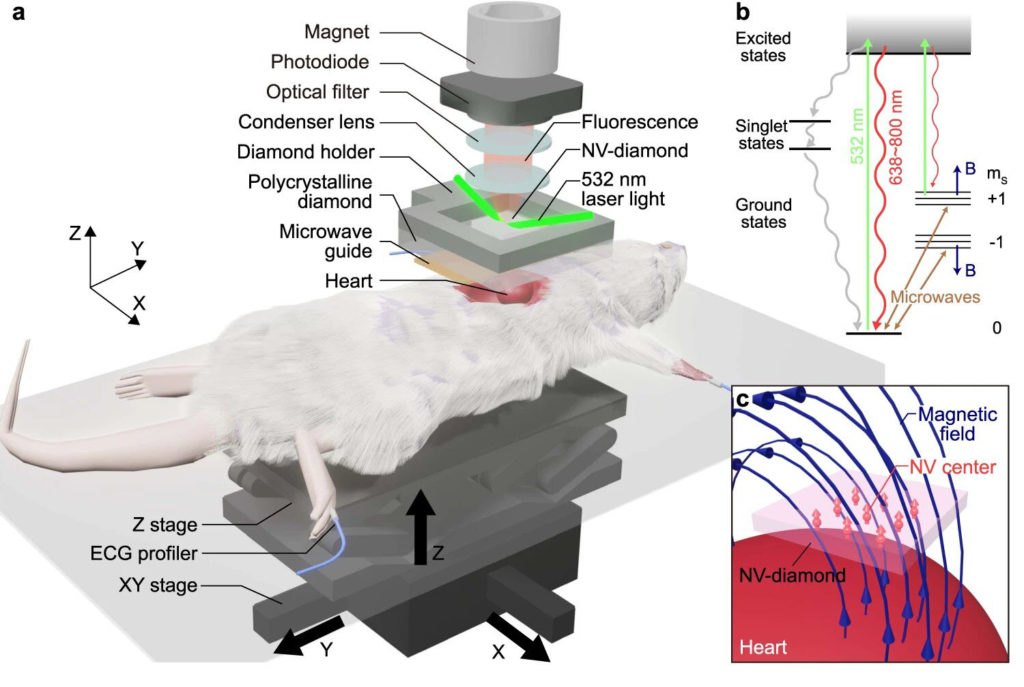 Installation diagram. Image: Keigo Arai et al., Communications Physics
Such vacancies act as specialmagnetic "centers" that are sensitive to very weak magnetic fields, the authors say. To "take readings" from the device, scientists use fluorescence. A quantum sensor easily absorbs light at certain frequencies and then re-emits them at other frequencies. In this case, the intensity of light coming from nitrogen vacancies depends on the strength and direction of the external magnetic field.
In their setup, the scientists usedA 532nm (green) laser to drive the diamond sensor and a photodiode to capture the re-emitted photons. Tests have shown that the MCG instrument provides an unprecedented resolution of 5.1 mm. With its help, scientists were able to create detailed two-dimensional maps of cardiac currents in laboratory rats.
Scientists hope that the new device will help diagnose, better understand and treat various heart diseases and other health problems earlier.
Read more:
Russia has invented an alloy that can withstand the energy of a thermonuclear reactor
The largest migration in the history of the Earth will affect all living organisms on the planet
Nearly half of cancer cases linked to preventable risk factors