The University of Surrey summed up the results of an international competition for developments in the field of robotics for
This robot is more like a salmon in size,in appearance and the ability to swim make him related to fish. The device filters water and keeps microplastics inside a special container while swimming thanks to the "gills" located on the sides and a small mesh between them, which can trap all particles larger than 2 mm.
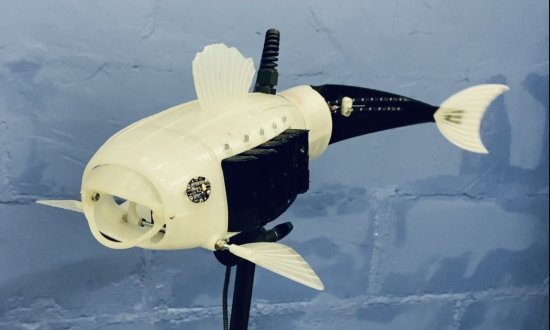
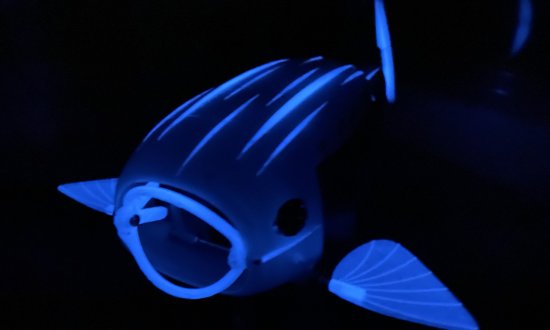
Robot fish. Photo: University of Surrey
The robot moves through the water, waving its tail, holdingmouth open to trap water and microplastics into the internal cavity. Water passes through a tiny mesh connected to the gill struts, and plastic debris remains in the cavity. The device glows in the dark for easy identification.
I tried to construct it in such a wayso that it works in the same way as the gills of fish. The chamber inside the fish's body is filled with water and particles, the mouth is open and the gills are closed. When the mouth closes, the gills open and the cavity contracts to force water through the mesh filter inside the body.
Eleanor McIntosh, student at the University of Surrey and author of the development
The researchers plan to make several improvements to the robot to make it faster, smarter and teach it to work autonomously rather than under remote control.
The organizers of the competition note that this yearHe received over 100 entries from all over the world. Among them, for example, a robot bear to protect the forest, crabs to explore Mars, and even a robotic sea urchin.
Read more:
Named the consequences of the last solar storm that hit the Earth
A huge tunnel under the Egyptian temple “hidden” mysterious artifacts
A massive impact from a space object triggered the Earth's magnetic field