Scientists from the Max Planck Institute for Intelligent Systems have equipped E. coli bacteria
The researchers attached to each bacteriumnanoliposomes and iron oxide molecules. The spherical liposomes are filled with water-soluble chemotherapy drugs and consist of a material that melts when exposed to near-infrared radiation.
Nanoliposomes are used to deliver drugs,while the magnetic properties of iron oxide help control the movements of bacteria. In a series of experiments, the researchers showed that by acting on modified bacteria, they can deliver a therapeutic drug to various tissues and release them under the influence of infrared radiation.
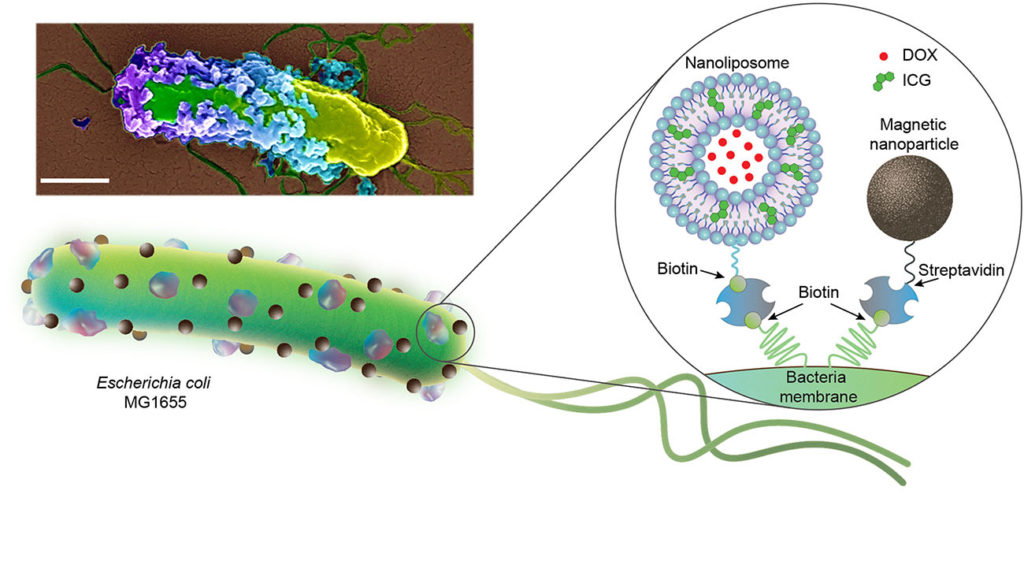 Nanoliposomes and magnetic particles are attached to the body of the bacterium using a stable and strong compound of biotin and streptoidin. Image: Mukrime Birgul Akolpoglu et al., Science Advances
coli bacteria are good swimmerswhich can move through a variety of materials ranging from liquids to highly viscous tissues, the scientists explain. In addition, they can feel the location of the tumor by chemical markers. The low oxygen levels and high acidity around tumor cells attract bacteria.
Injections of bacteria to treat cancer -Bacterial-mediated therapy has been used in medicine for a long time. This method is based on an immune reaction: microorganisms move to where the tumor is located, grow there and thus activate the immune system of patients.
A new approach based on hybrid bacteria can work more efficiently, the developers say. It simultaneously activates the immune system and uses drug delivery to treat tumors.
This on-site delivery will be minimally invasive to the patient, painless, and minimally toxic. And the drugs will act where it is needed, and not inside the whole body.
Yunus Alapan, head of research
Cover image: Mukrime Birgul Akolpoglu et al., Science Advances
Read more:
The James Webb telescope took the first picture of Jupiter: it shows 9 moving targets at once
Physicists have found a universal "clock" in space: they are more accurate than atomic
A huge comet flew past the Earth, but became larger and headed towards the Sun